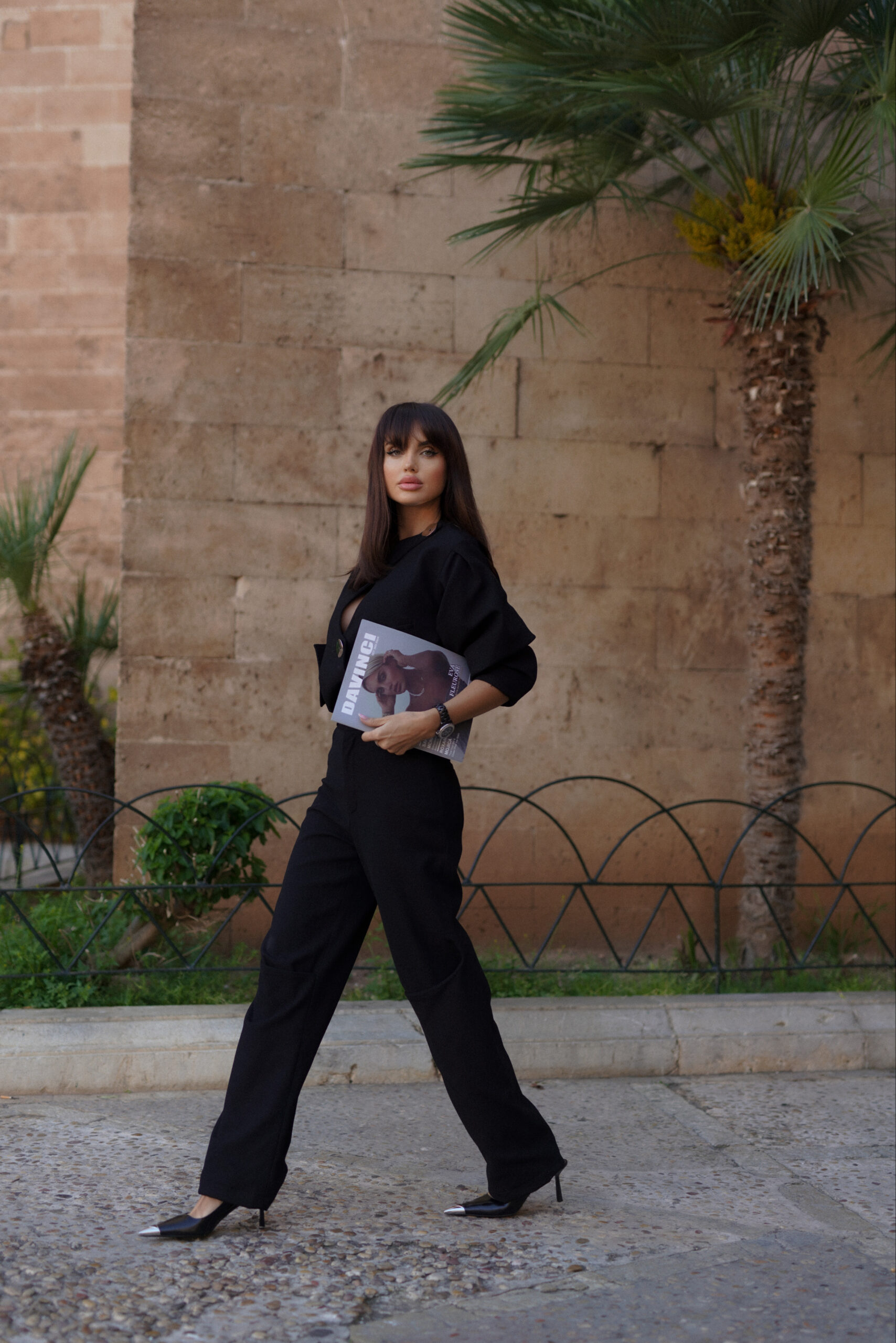


By Peter Koloff
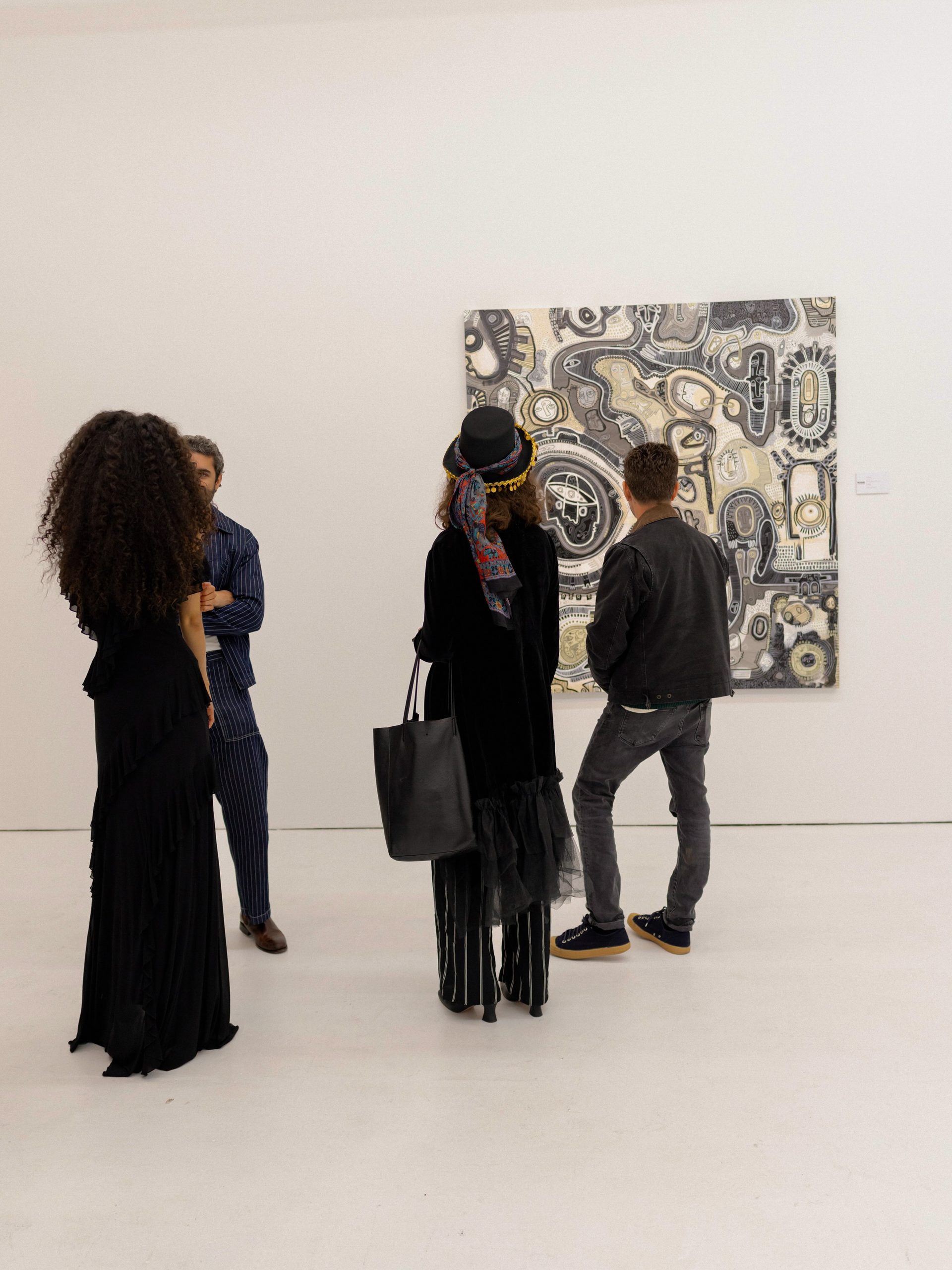
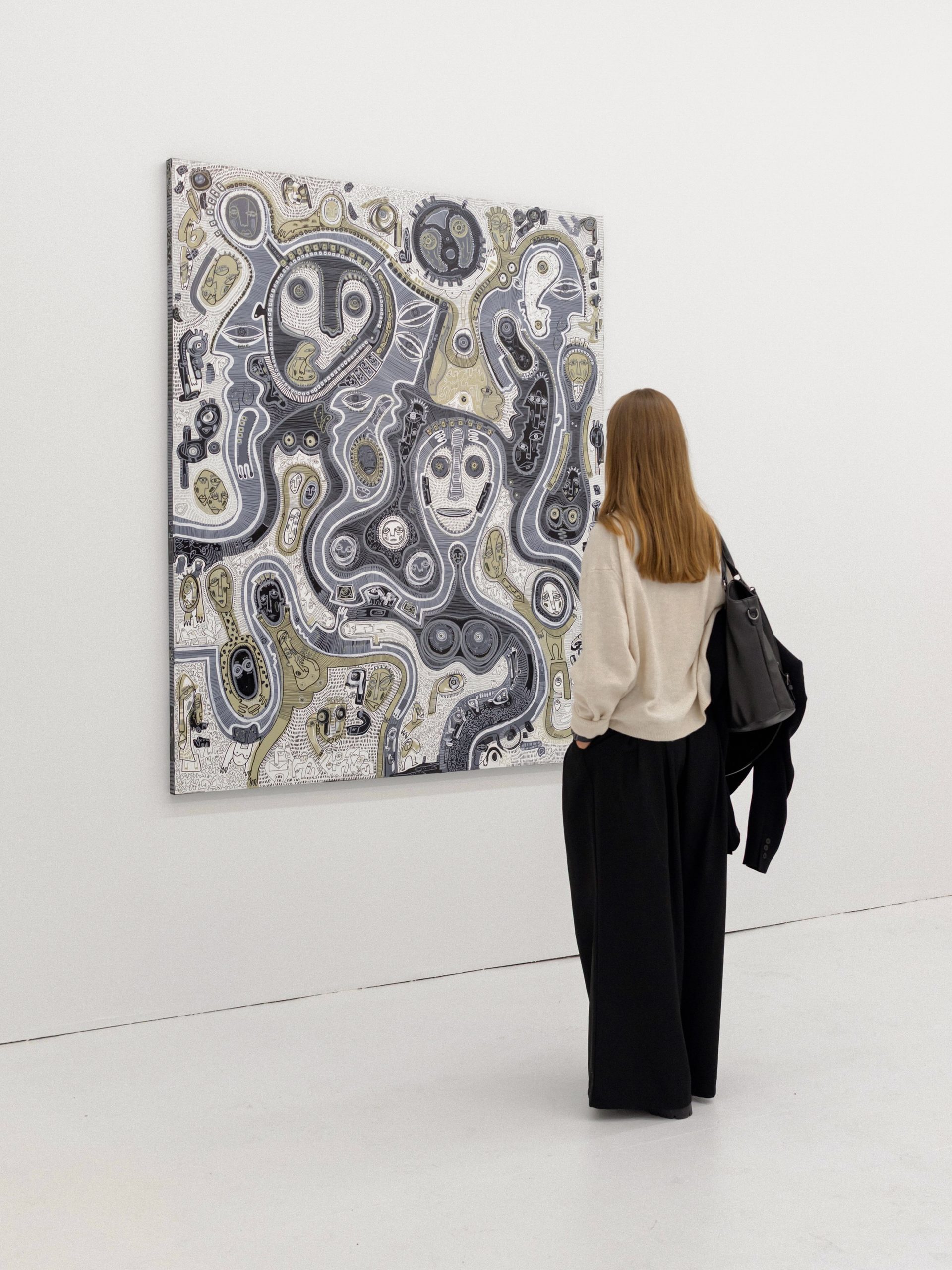
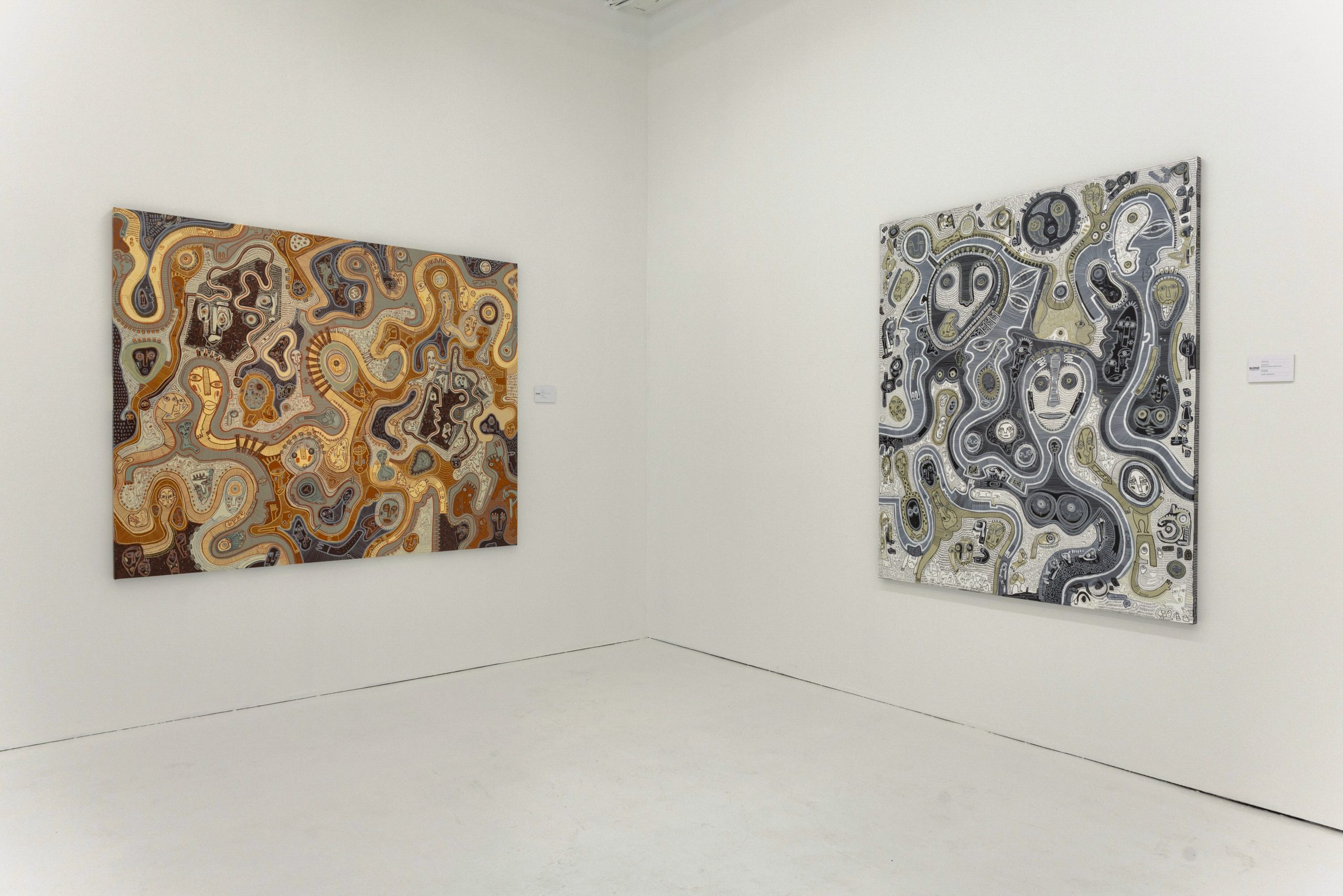
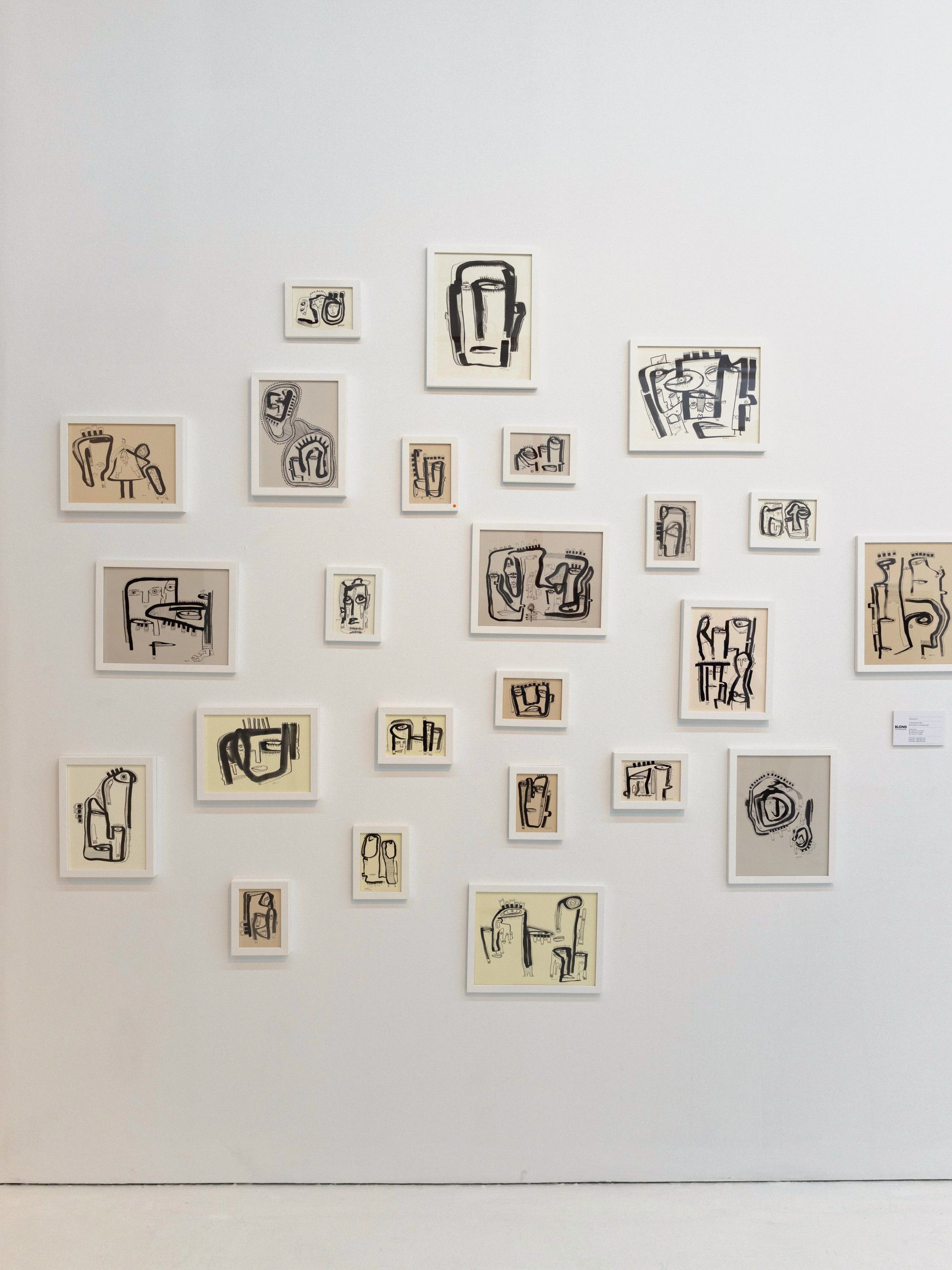
One of Sophia Bounou’s paintings at The Hole in Tribeca pulled me across the room: a large composition of browns, ochres, creams, and muted blue-gray, filled with faces, figures, and winding pathways. From a distance, the arrangement reminded me of a circuit board, with lines traveling in different directions, connecting one part of the canvas to another.
The longer I looked, the more individual characters I began to recognize.
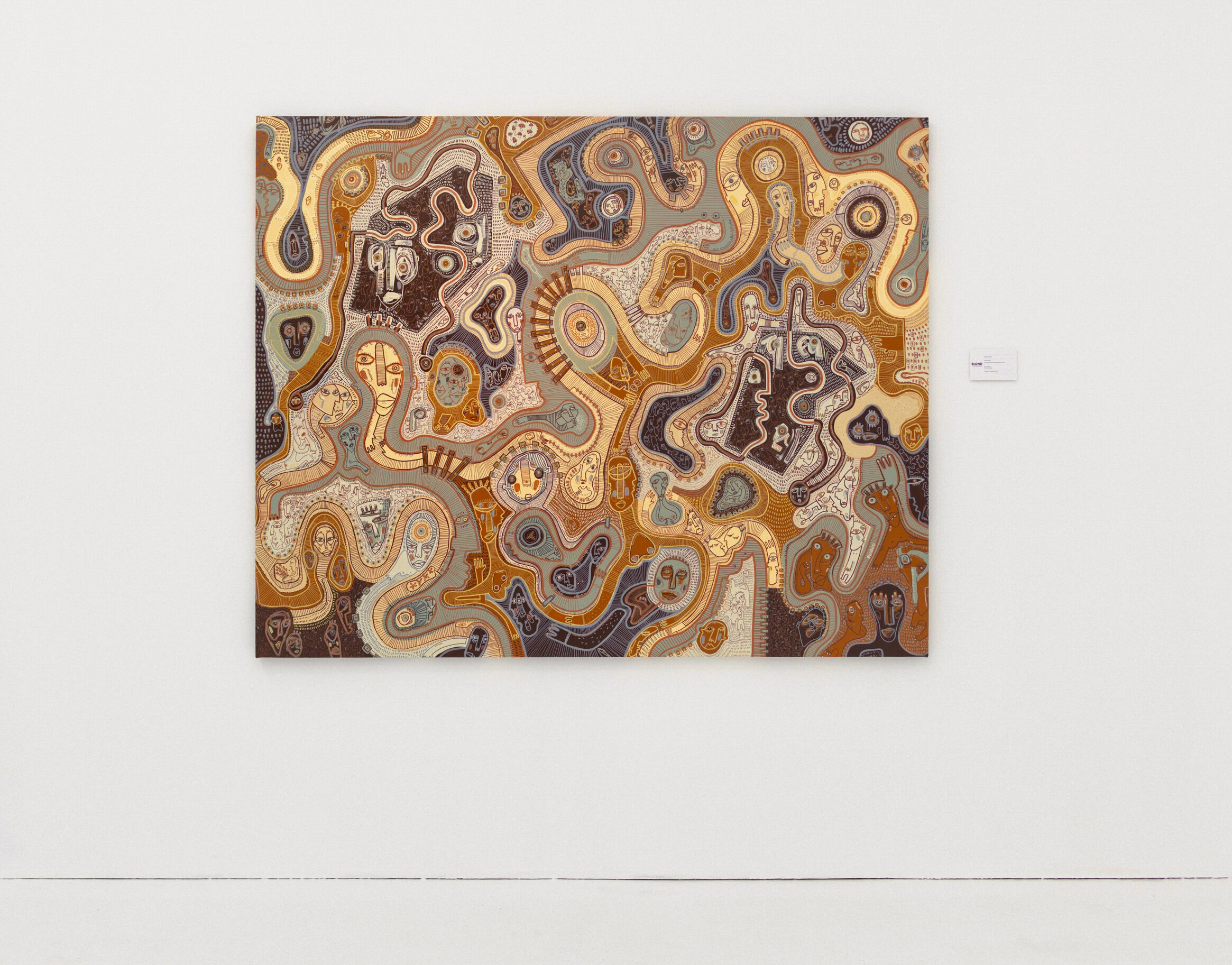
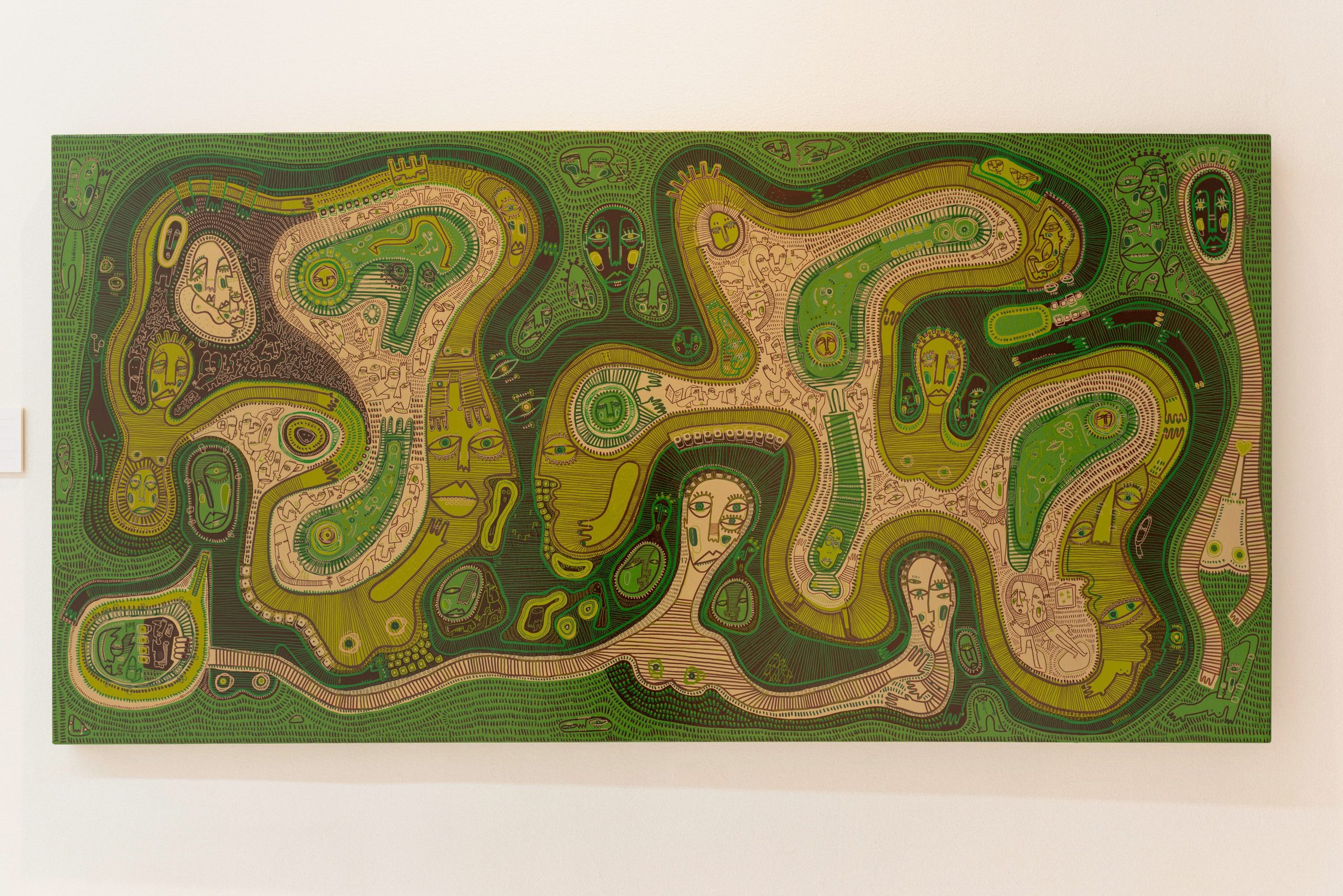
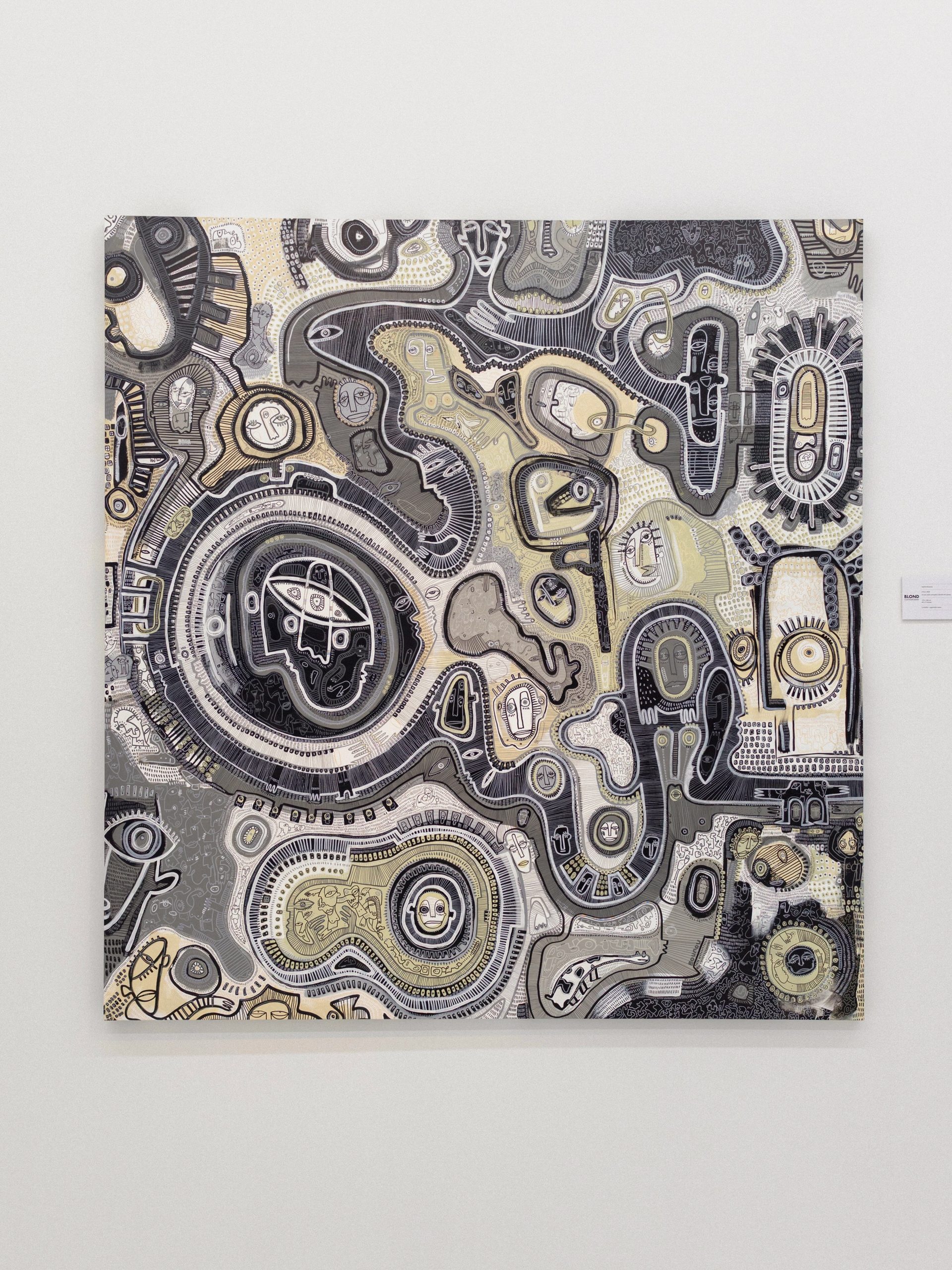
When I later spoke with Bounou about The Lines Between Us, her solo exhibition presented by her London gallery, Blond Contemporary, she mentioned that some viewers see maps or aerial views of cities in her paintings. I understood the comparison.
She thinks of the compositions as worlds of their own, populated by characters connected through roads and pathways. Someone might be playing drums, another walking a dog, while others hold hands or share a drink.
“I like to think of them as my little utopias,” she told me.
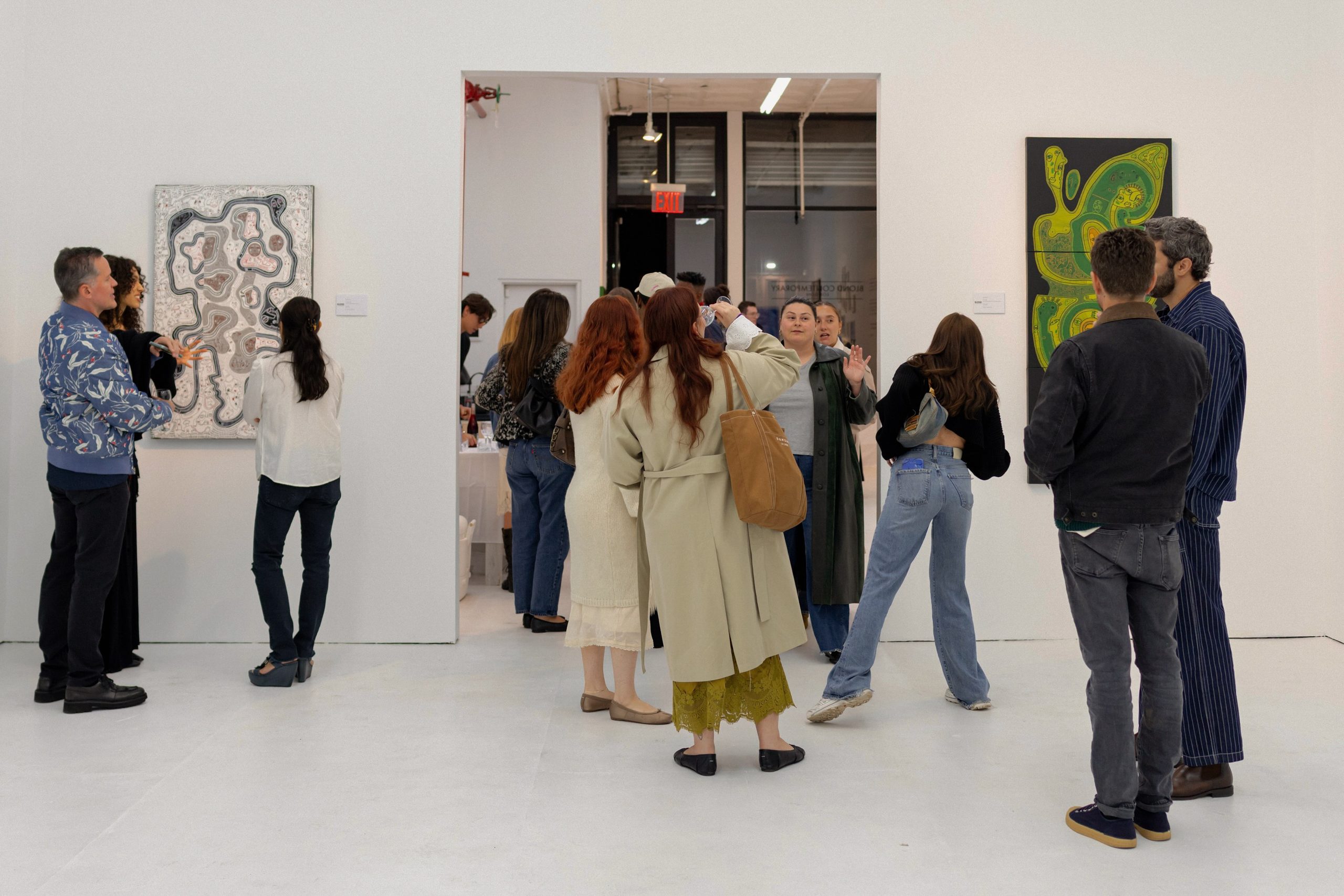
We first met on opening day, as the gallery began filling with visitors. When I returned to photograph and interview her, people continued to come through the exhibition.
I began our conversation by asking whether understanding another person requires eliminating the boundaries between us or learning to respect what we can never fully know about someone else.
“I think getting to know someone, you have to respect their boundaries,” she said.
Giving people the space they need, she continued, allows them to open up on their own terms.
It was a revealing answer from an artist whose paintings bring so many people together without making them indistinguishable from one another.
A Life Between Places
Bounou was born in Louisiana and moved with her family to Arcachon, France, before living in Iowa, upstate New York, and Chicago. Modeling later took her to other cities, including Los Angeles and Athens. She began traveling to New York at sixteen, staying in model apartments with women who were older and more experienced.
“I used to think that it gave me sort of like an identity crisis,” she recalled.
Over time, she began to understand her identity as something formed by all those experiences rather than defined by a single place.
She spoke about wanting to travel and meet people outside her immediate circle, something she had felt compelled to do from an early age.
Athens left a particular impression. She spent a month there on a modeling assignment and found herself drawn to the city’s less polished character. While others encouraged her to visit Mykonos and the Greek islands, she preferred Athens, with its graffiti, cats, and everyday life.
When I asked whether the interconnected figures in her paintings were a response to an increasingly divided society, she acknowledged that politics is difficult to separate from everyday life. But she doesn’t approach her work as an explicitly political statement.
Instead, she imagines worlds where people coexist harmoniously, connected through paths that lead from one character to another.
When the Work Leaves Your Hands
As a photographer, I can choose the frame, the light, and the moment I want to preserve. What I cannot control is how someone else will interpret the photograph once it leaves my hands.
I asked Bounou whether she felt something similar about her paintings.
What happens when someone stands in front of a work and discovers a meaning the artist never intended?
“I don’t think any interpretation is the wrong interpretation of my art,” she said.
She wants to create paintings that feel happy, loving, and intimate, but understands that viewers bring their own experiences to what they see.
“I think that’s the beauty in making art,” she explained. “Once you put it up on a wall, it’s no longer yours.”
A photograph can begin with one intention and acquire an entirely different meaning for someone else. Her answer reminded me that the person making the image is only one part of that exchange.
Making Art on Her Own Terms
I asked how she maintains her independence as her work reaches more collectors.
She spoke about working closely with her gallerist, who gives her room to explore without demanding specific subjects or compositions. But she was equally open about paying attention to what sells.
“I’m also a very data-driven person and I’m a very analytical person,” she told me.
“If we know that brown paintings do well, I’m always up to making another brown painting.”
She understands what collectors respond to without necessarily allowing those preferences to determine everything she creates.
Bounou also developed her painting techniques without a conventional art-school education. She considers that independence important to her work.
Beauty and the Question of Being Seen
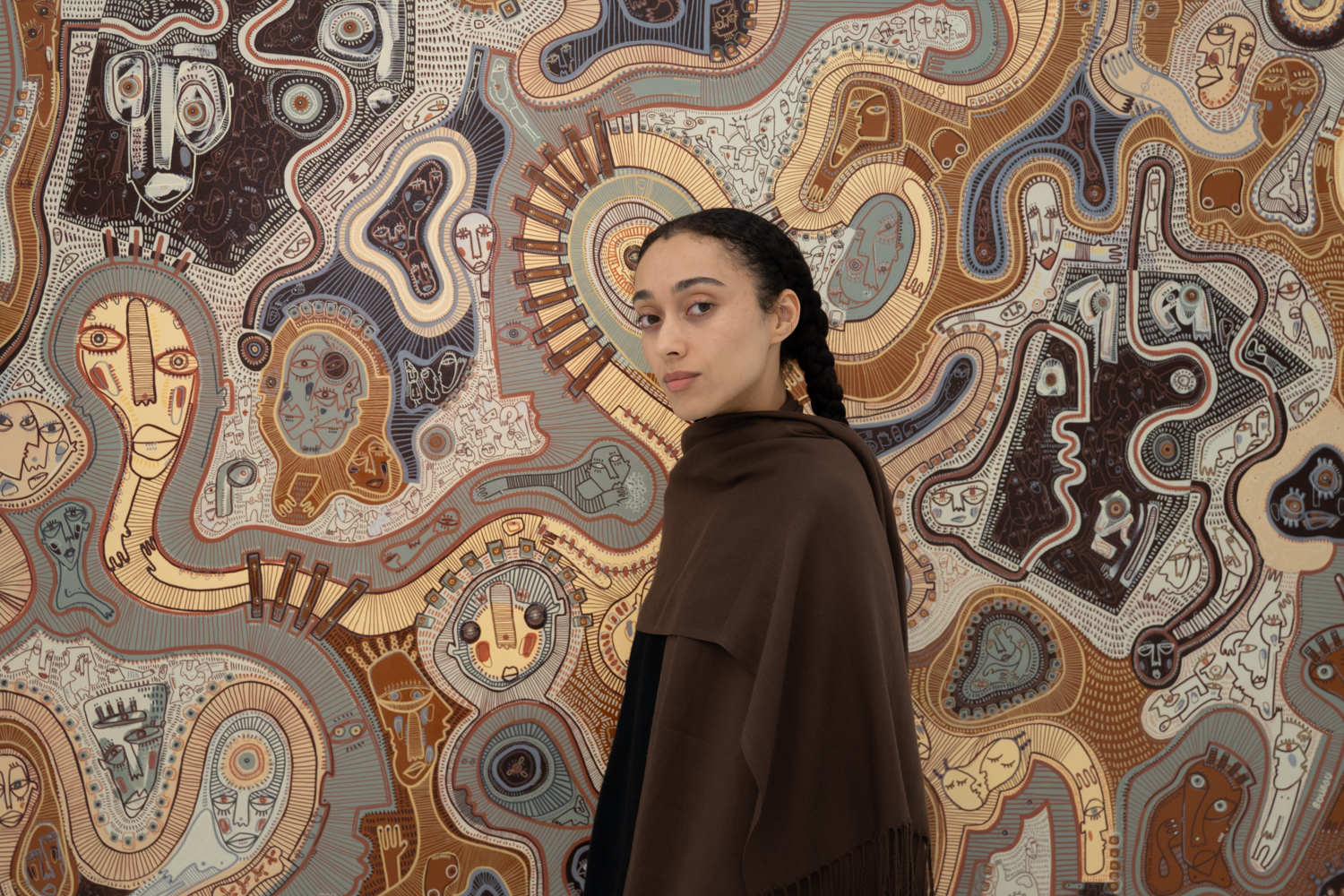
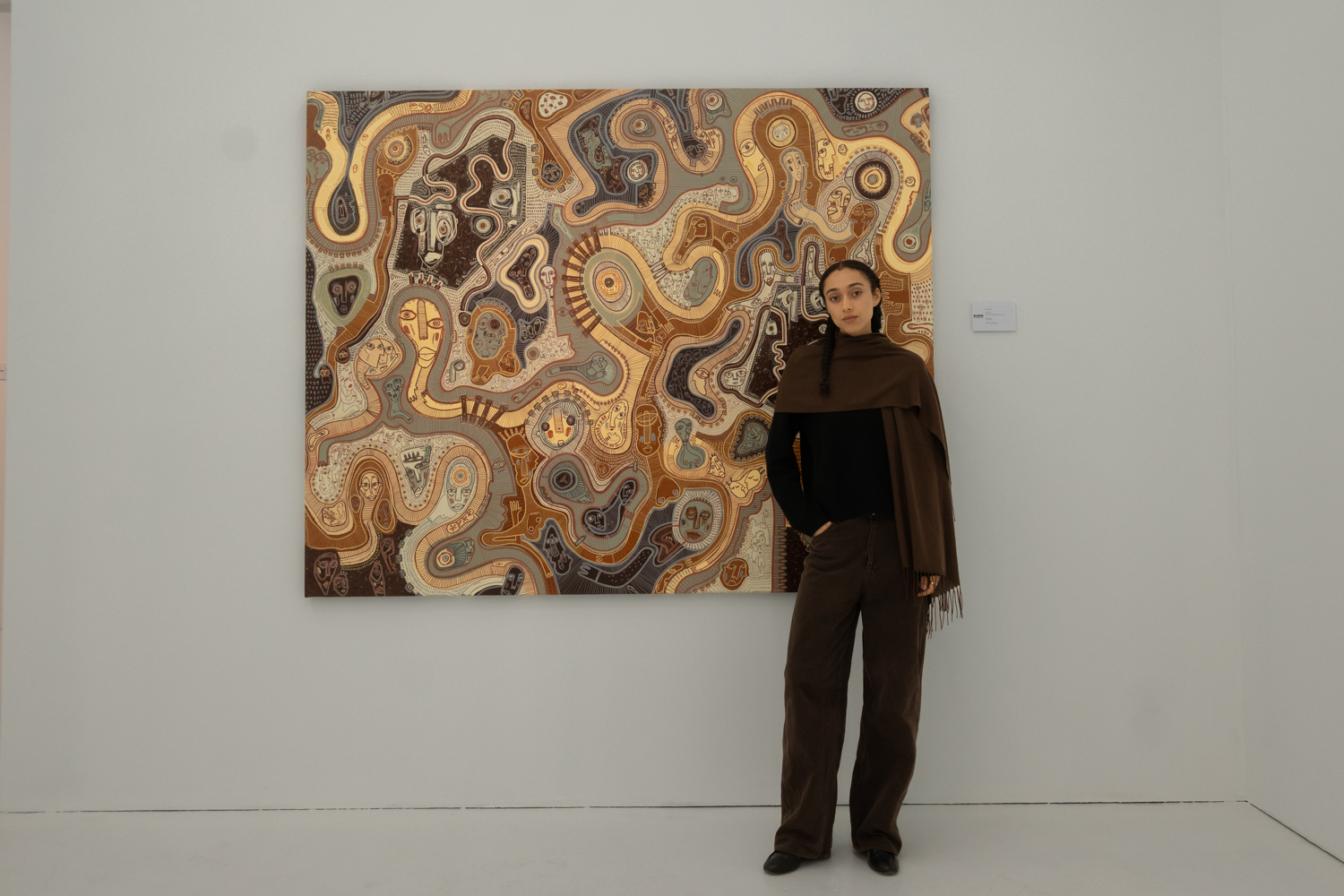
When it came time to photograph Bounou, I asked her to stand in front of the earth-toned painting that had first drawn me into the gallery.
She posed easily, almost seeming to belong inside the painting.
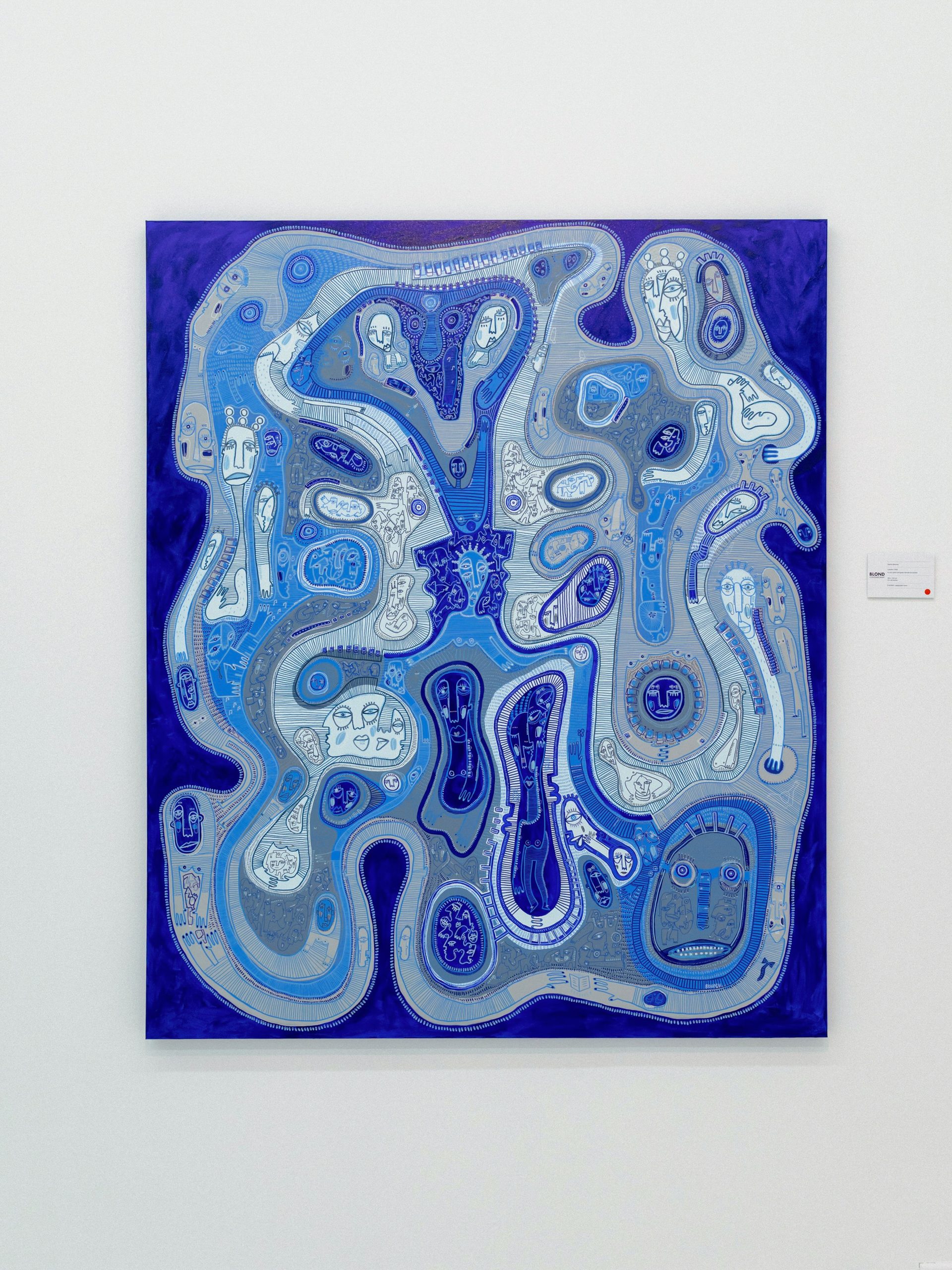
We also photographed her beside a blue composition, her favorite, where pale figures and winding forms emerge against a deep blue background.
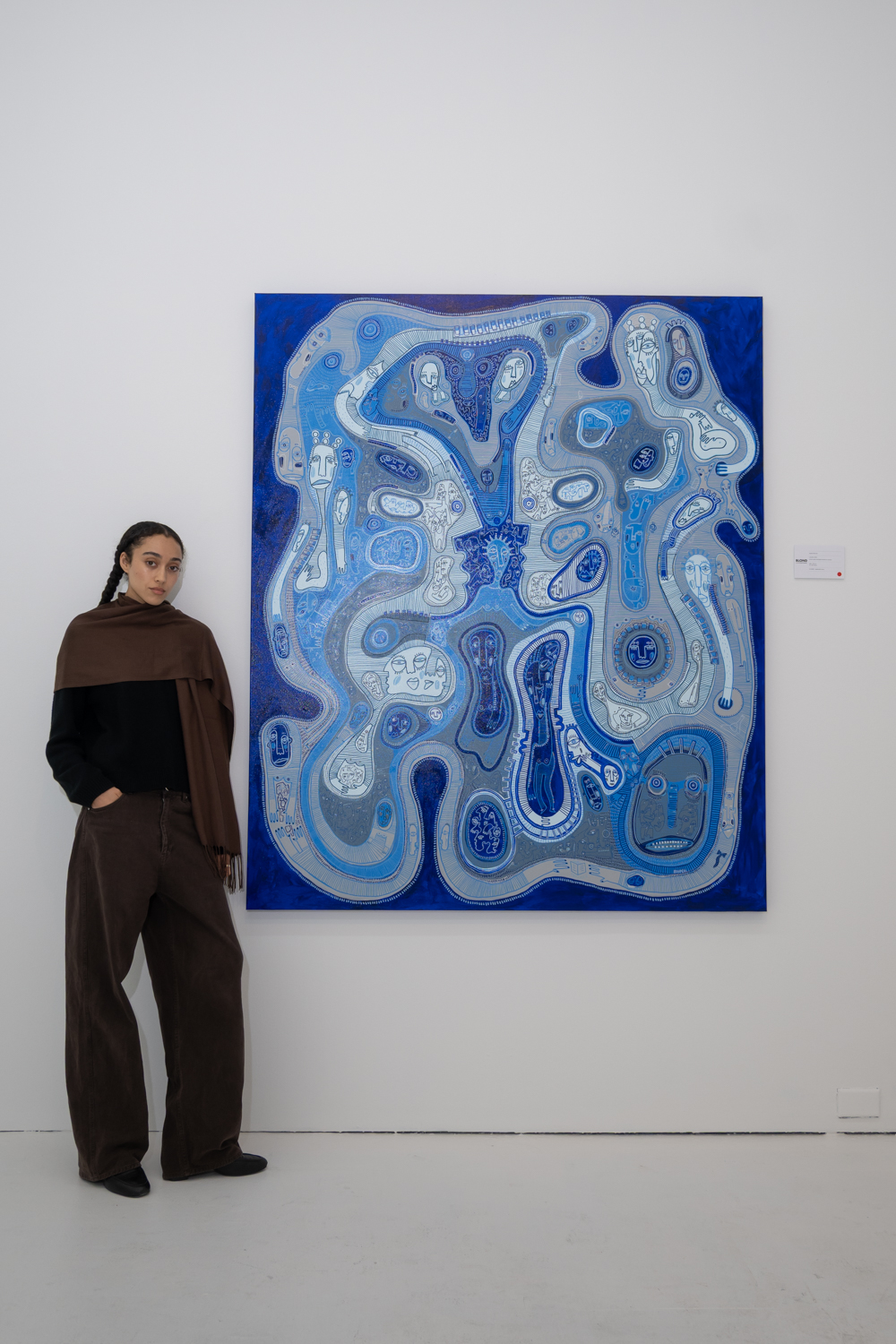
Bounou is strikingly beautiful, and she carries herself with the ease of someone accustomed to being photographed. As a photographer, I’m trained to notice faces, expressions, posture, and the relationship between a person and their surroundings.
But looking at someone is not the same as understanding them.
I had just made photographs that visually brought Bounou and her artwork together. In one sense, that was exactly what I wanted from the images. Yet our conversation raised another question: where does the work end and the person begin?
I asked whether her appearance had ever influenced how seriously people took her as an artist.
She welcomed the question.
Bounou acknowledged that modeling and the visibility it brings have helped her painting career. She doesn’t deny those advantages. But she has also questioned whether people were interested in her paintings because of the work itself or because of their interest in her personally.
Over time, conversations with collectors and clients have reassured her that many genuinely connect with what she creates.
Still, she described occasions when men approached her about purchasing artwork while also expressing a personal interest in her.
“If you’re interested in the work, buy the work, but I’m not for sale.”
Her experience also explains why she has been deliberate about establishing herself in the art world.
For years, she received invitations to attend Art Basel parties through her modeling connections. She decided she wouldn’t go until she was participating as an artist.
When that opportunity finally arrived, she attended with her own work on exhibition.
She wanted to be there because of something she had created, not simply because she had been invited.
The Person and the Painting
I think about the photograph I made of Bounou standing in front of the brown painting.
Her clothing shares its colors. Behind her, faces and figures emerge from winding lines. Through my lens, I brought the artist and her work into the same composition, almost allowing one to become part of the other.
But the woman standing in front of the painting has her own history, ambitions, and boundaries, none of which can be understood from a photograph alone.
I had begun our conversation by asking what it takes to understand another person.
Her answer was simple.
“I think getting to know someone, you have to respect their boundaries.”
Sophia Bounou’s solo exhibition, The Lines Between Us, presented by Blond Contemporary, is on view at The Hole, 86 Walker Street, Tribeca, New York, through November 1, 2026.
Photo Credits: Portrait photography by Peter Koloff. Additional artwork and exhibition images courtesy of Sophia Bounou.
Related DaVinci Magazine coverage: The Houses and the Bodies: What Holds Us in Chelsea