

Is art merely a surface painted over something humanity has outgrown..or is it a realm waiting to be breached? And does the way you see the world change when you look at the sun through your own fingers?
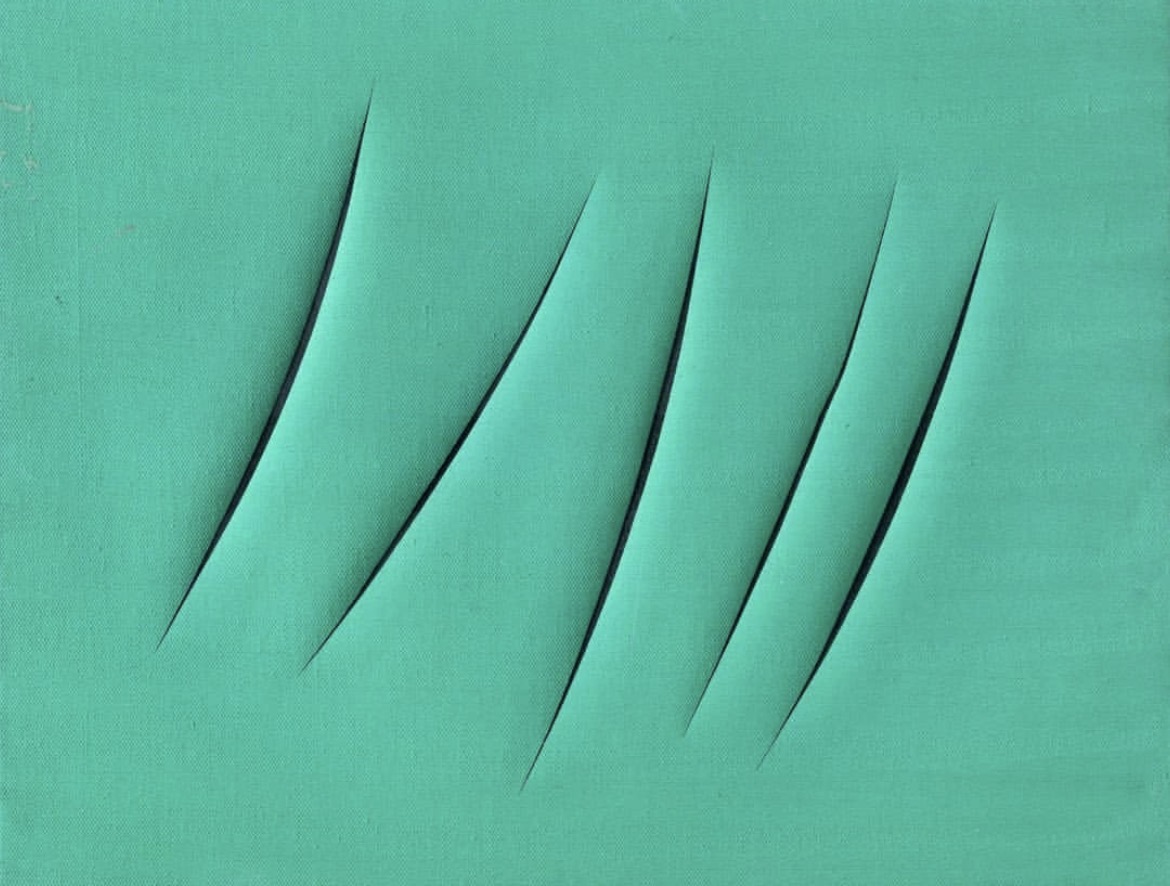
Perhaps you once stood before an artwork and found it incomprehensible until you gave your mind the space to catch a new dimension you had never considered before.
Should we trace back through time as usual? No… just look at the image first, and perhaps you will understand.
Sometimes, everything seems ordinary. Putting an idea into words can feel like drifting into aimless confusion, while a simple appearance reveals nothing at first glance. Yet, at its core lies something truly unfamiliar..something the mind cannot grasp through a single peek into the void. It goes far deeper than initial impressions suggest. Have you ever wondered what might happen if art began breaching beyond the third dimension back in the 1940s? You might ask yourself: How so?
This is where Lucio Fontana enters.
About Lucio Fontana
Fontana was, first and foremost, a sculptor. Trained in traditional techniques by his father, he went on to refine his craft at the Brera Academy of Fine Arts in Milan. But he didn’t stop there. He evolved, driven by the conviction that traditional artistic categories like painting and sculpture were no longer enough to capture the dimensions of a new world..a world surging with scientific discoveries, technological leaps, and the dawn of space exploration.
Fontana decided to forge a new dimension within his work. His canvases were never just a “slash in the fabric”; they were portals. He set out on this journey by founding an art movement he named “Spatialism“, followed by the release of the “Manifesto Blanco” in Spanish, alongside a group of leading thinkers and artists.
The result was a vision steeped in philosophy: a drive to break through the confines of the two-dimensional canvas and conventional art, stepping straight into the fourth dimension..time and space.
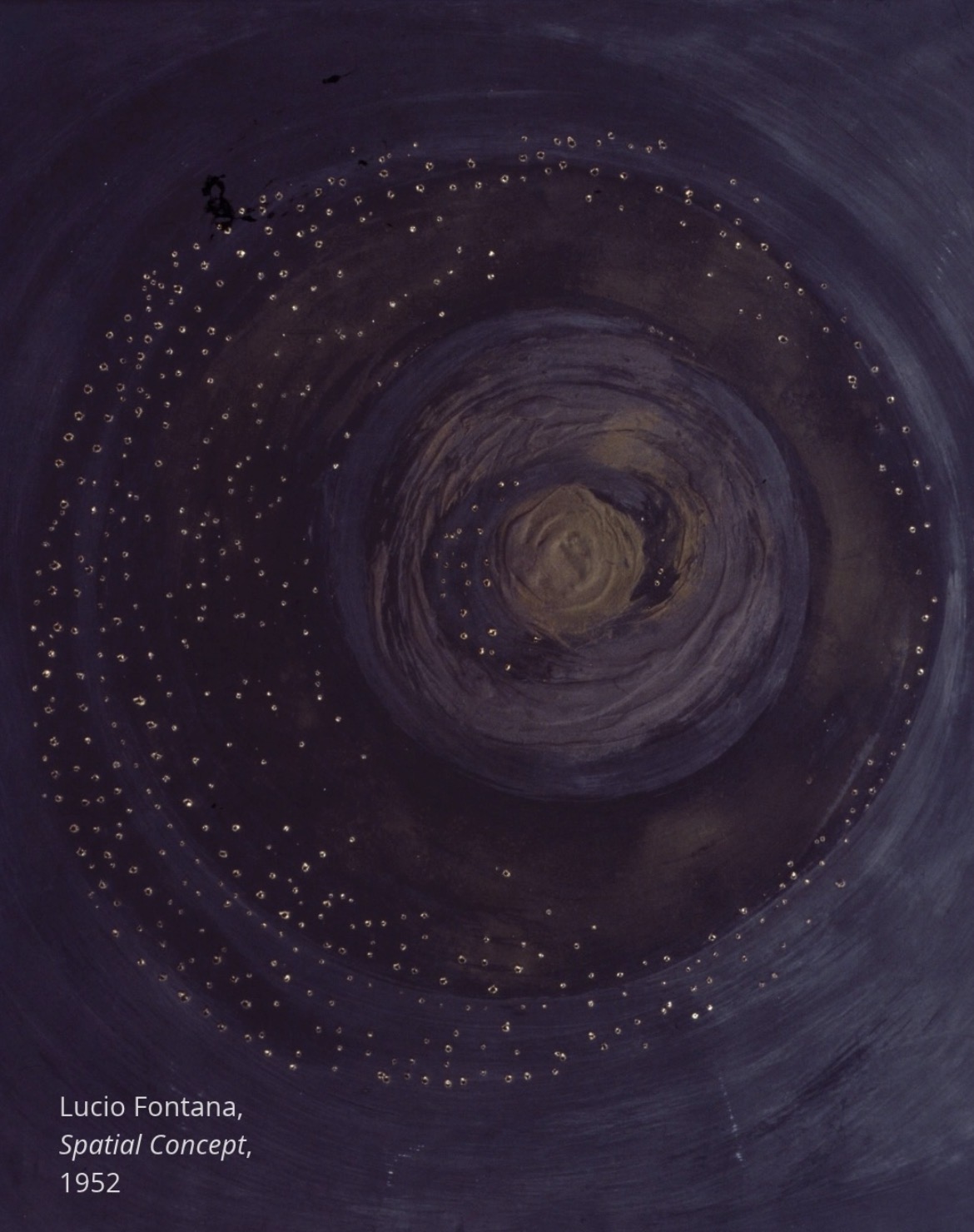
Why Time and Space?
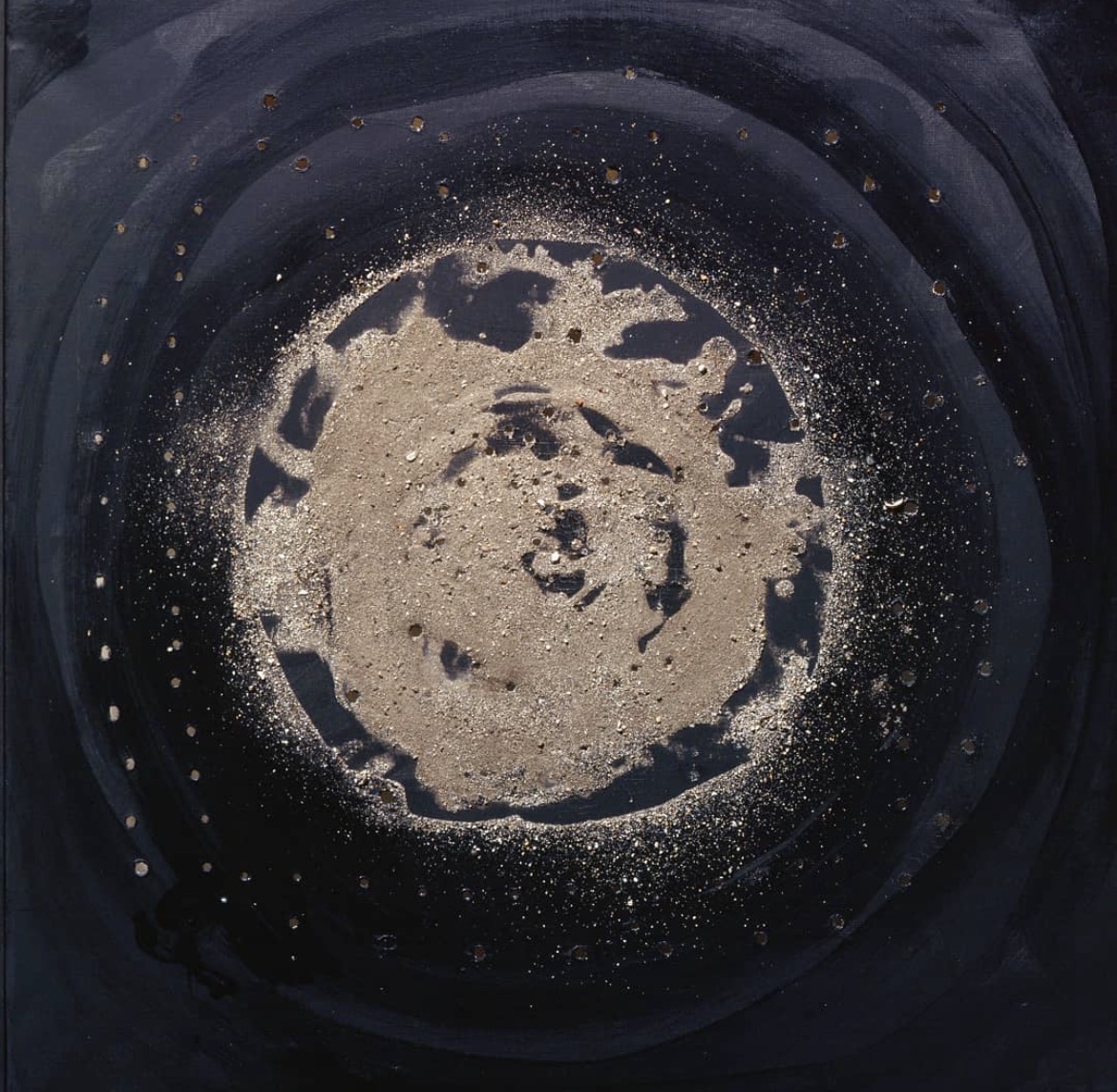
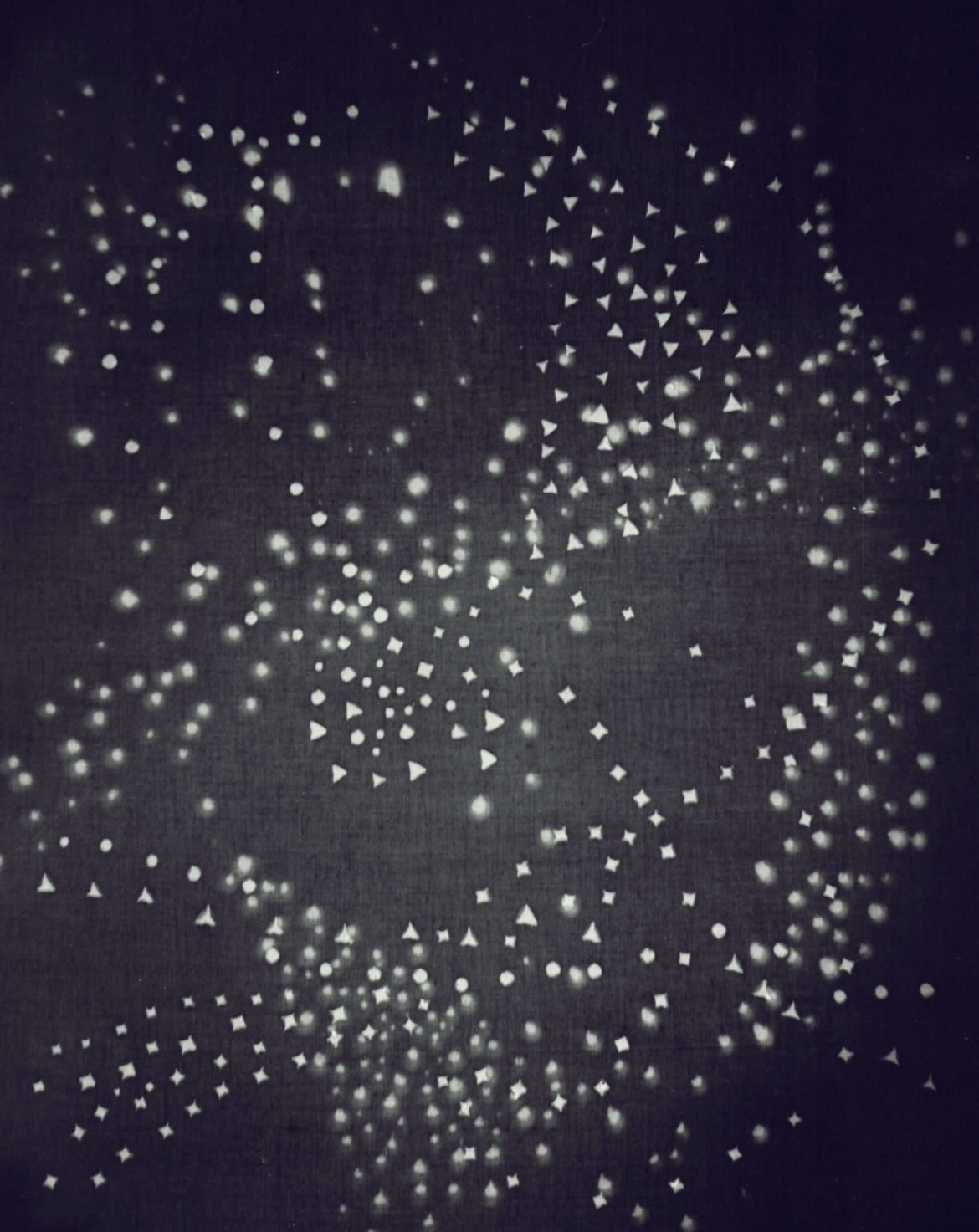
When you puncture a sheet of paper, tear a canvas, or burn through it, you perform an act anchored in a specific moment, executed with a decisive gesture that triggers an instant reaction. But where does space reside in all of this?
Space is the tear itself… what lies behind it, its narrative, and everything contained within and beyond it. Everything around us is interwoven with space and shaped by pauses:
- A pause lingers between your words and another’s.
- A pause separates what you say now from what you will say seconds later,
- A pause rests between each breath you take,
- A pause exists between closing your eyes and opening them again,
- And a pause lives even between one thought and the next…
Even your movement from one place to another is bound by distance, obstacles, and space. For Fontana, transcending physical matter meant tearing through it to reach what lay beyond the surface. These punctures allowed actual light and real emptiness to flow through the canvas. Void was no longer an illusion painted on fabric; it became a living part of the artwork and of reality itself. He often remarked that this slash was “the window that connects us to the hidden space we sense and feel around us.”
A single slash, meanwhile, is the embodiment of time..executed by the artist in a swift, decisive stroke that marks the exact divide between before and after, between zero and one.
Beyond the Canvas
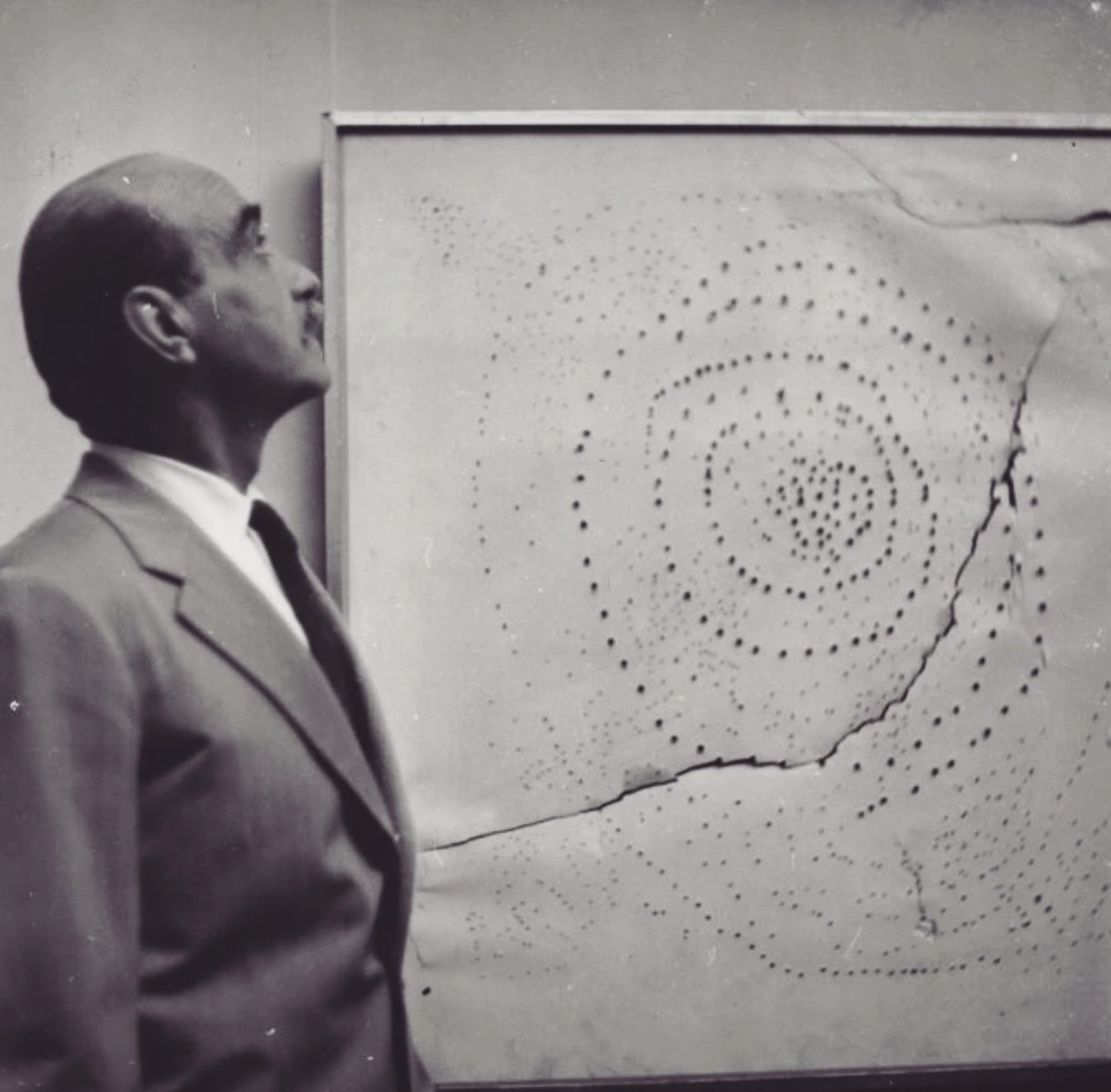
Born in Argentina to an Italian father and an Argentine mother, Fontana lived through the horrors of war, yet his creative spirit remained unstoppable.
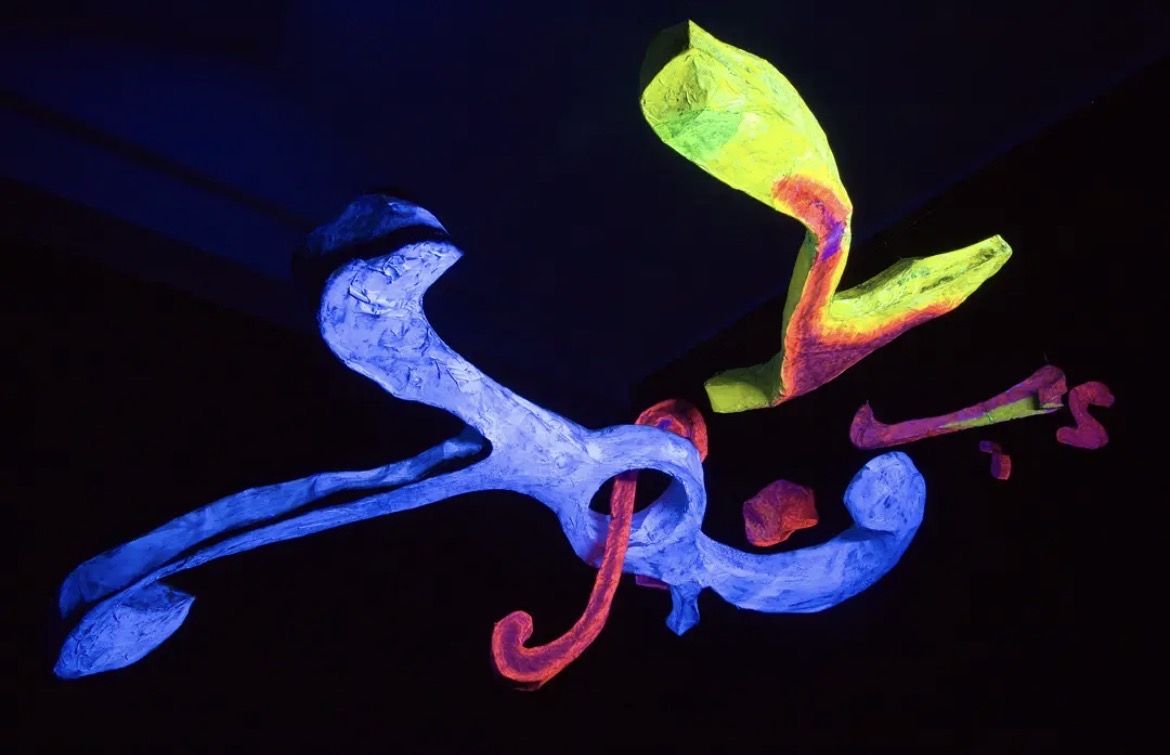
In 1949, he took a revolutionary step by creating a completely darkened room where abstract forms hovered, glowing under ultraviolet light. He utilized neon lighting..which he viewed as a modern medium capable of giving light physical presence and unique geometric structure creating what became known as his Spatial Environments.
In Conclusion
Lucio Fontana’s works are far more than mere paint and canvas. They are dreams, emotions, and a philosophy that is felt rather than easily described. This is why his creations remain among the most inspiring works of the 20th century. Today, his masterpieces command millions in global museums and auctions, standing as rich metaphors for the exquisite overlap between the third and fourth dimensions, light arts, and spatial installations.
You may have seen his slashed canvases before without understanding them… but now, you certainly do.