

There is a version of Miami Beach that exists beyond the velvet ropes, sprawling resorts and polished new towers.
You find it walking Collins Avenue, where pastel buildings sit beneath palm trees, neon signs wait for nightfall and nearly a century of Miami history remains embedded in the architecture.
That is the Miami we wanted for this story.
And that is what brought us to Hotel Shelley.
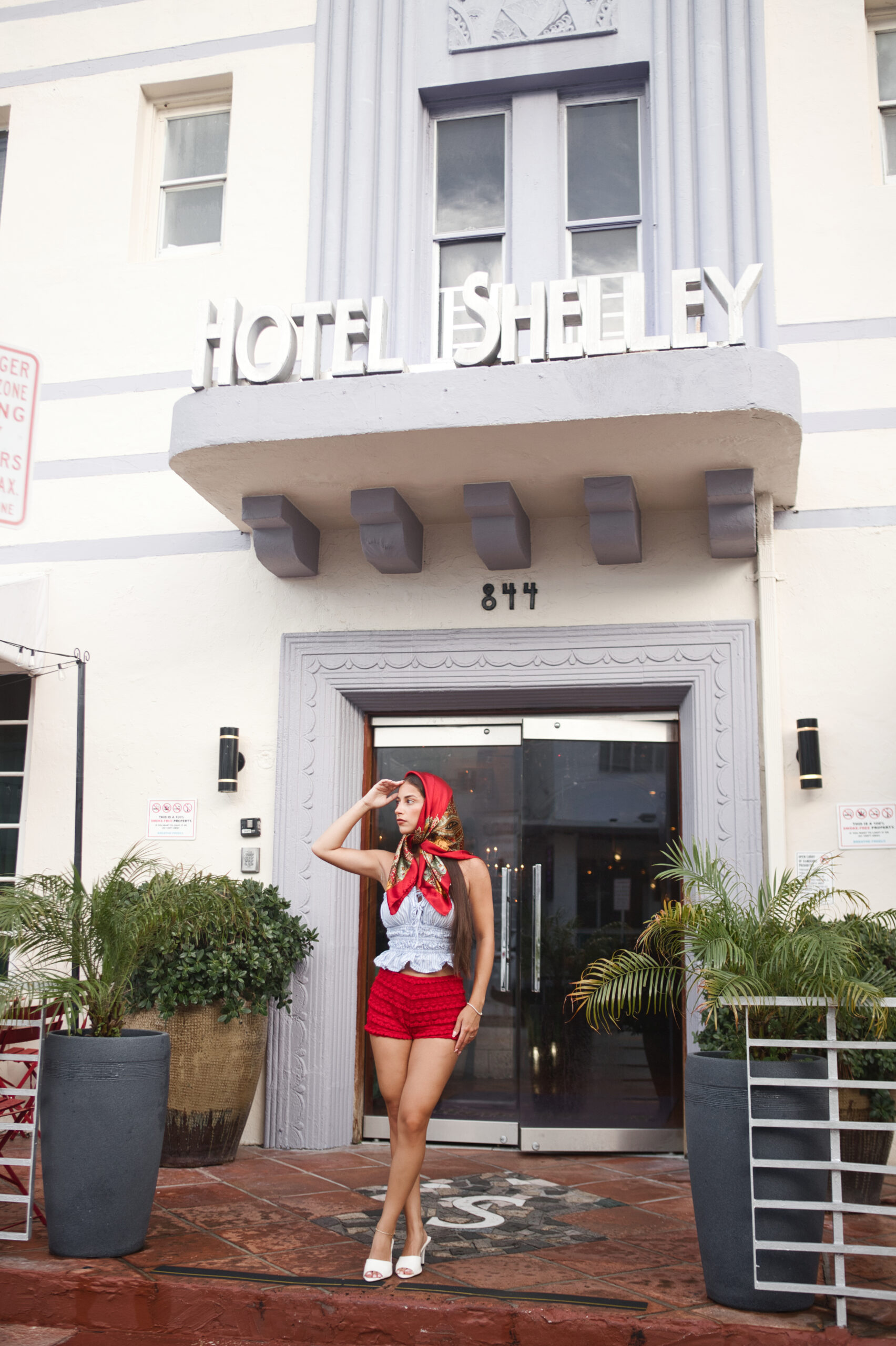
At 844 Collins Avenue, only a block from the beach and Ocean Drive, the Shelley has the kind of character that would be nearly impossible to recreate on a set. Its architecture, muted lavender detailing, tiled entrance, tropical greenery and unmistakable marquee gave us something more valuable than a beautiful backdrop.
It gave us a sense of place.
A Piece of Miami Beach History
Before it became Hotel Shelley, the building was known as Hotel La Salle.
Architectural records date its construction to 1931 and credit architect Henry J. Moloney. The building is part of the Miami Beach Architectural District and remains a recognizable example of the Art Deco architecture that transformed South Beach into one of the most visually distinctive neighborhoods in America.
Look closely at the building and those details begin to reveal themselves.
The symmetrical facade is interrupted by strong vertical lines running through its center. Fluted columns pull the eye upward, horizontal bands stretch across the exterior and decorative bas-relief panels add geometric texture. Above the entrance, the oversized HOTEL SHELLEY lettering feels almost cinematic.
The Wolfsonian-FIU has even highlighted the building’s decorative reliefs and zigzag cornice as examples of design motifs associated with the Art Deco period.
Those details were exactly why the location worked.
We were not interested in photographing Samantha in front of a generic luxury hotel. We wanted somewhere that immediately said Miami Beach, but without relying on the obvious visual shorthand of sand, turquoise water and bikinis.
Hotel Shelley offered another version of the city.
Why We Shot Here
The concept began with contrast.
Hotel Shelley describes itself as casual and unpretentious, a South Beach hotel where the prevailing attitude is essentially bathing suits and flip-flops all day. We approached the location differently.
Instead of matching that casualness literally, we used it as the foundation for a fashion story.
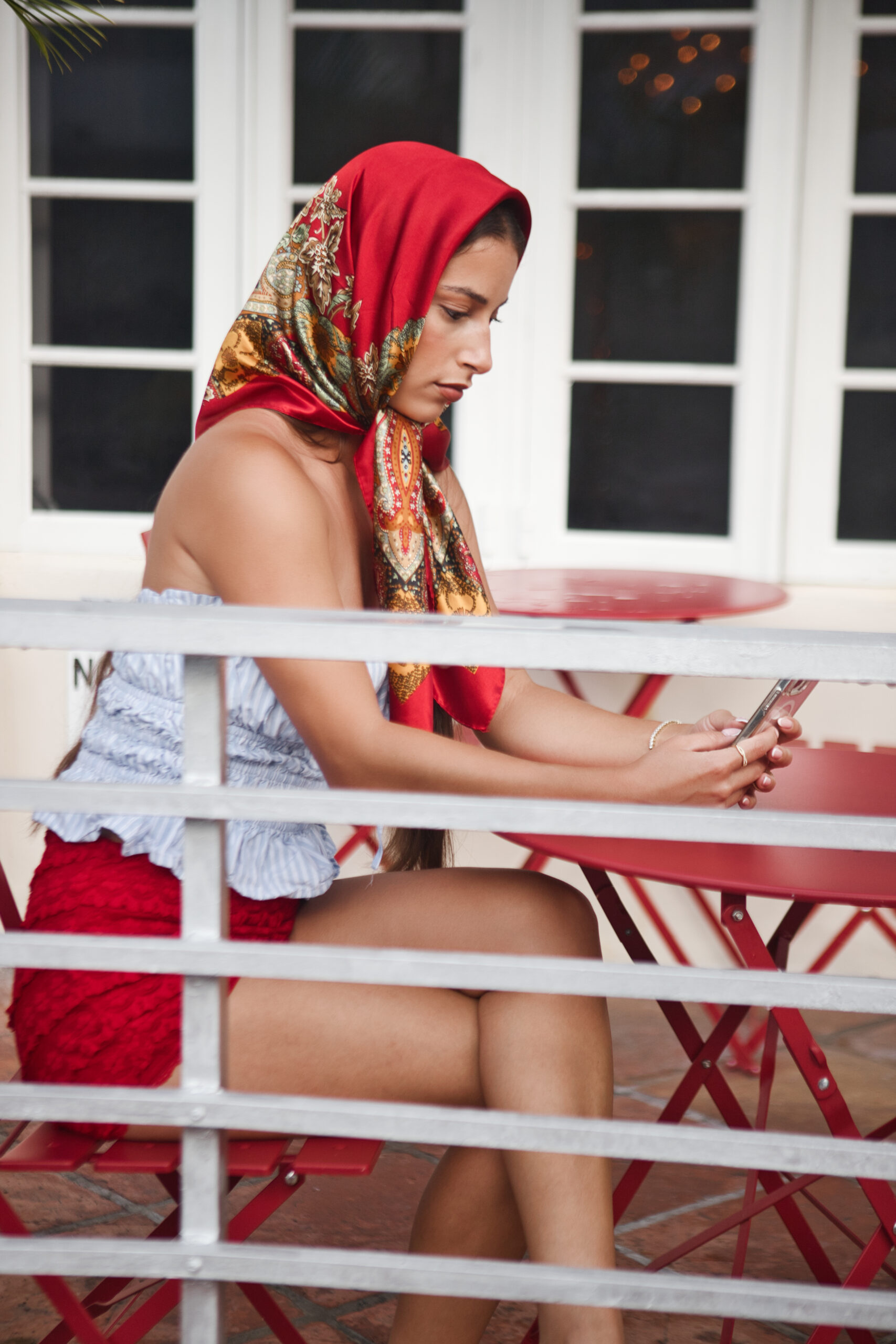
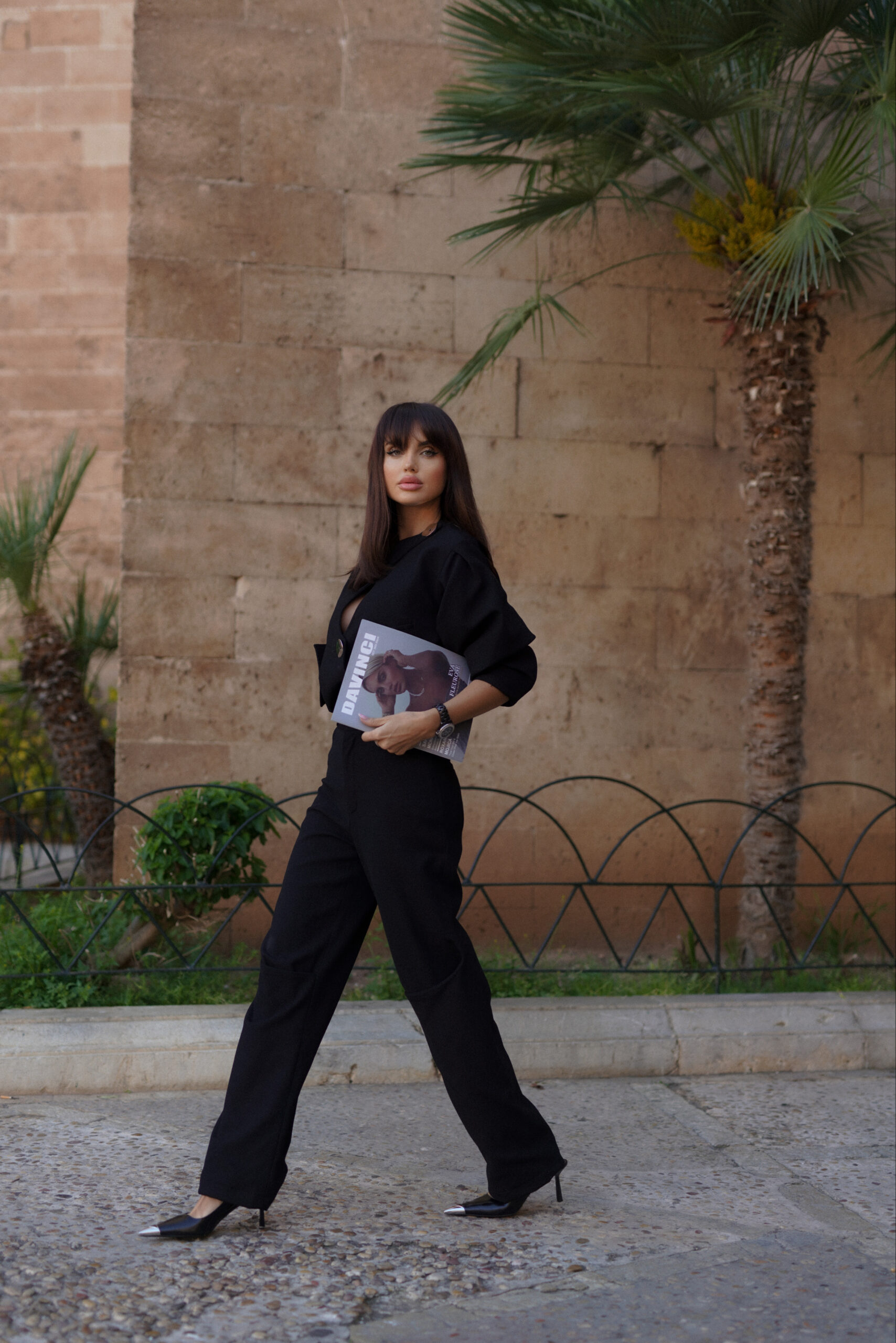
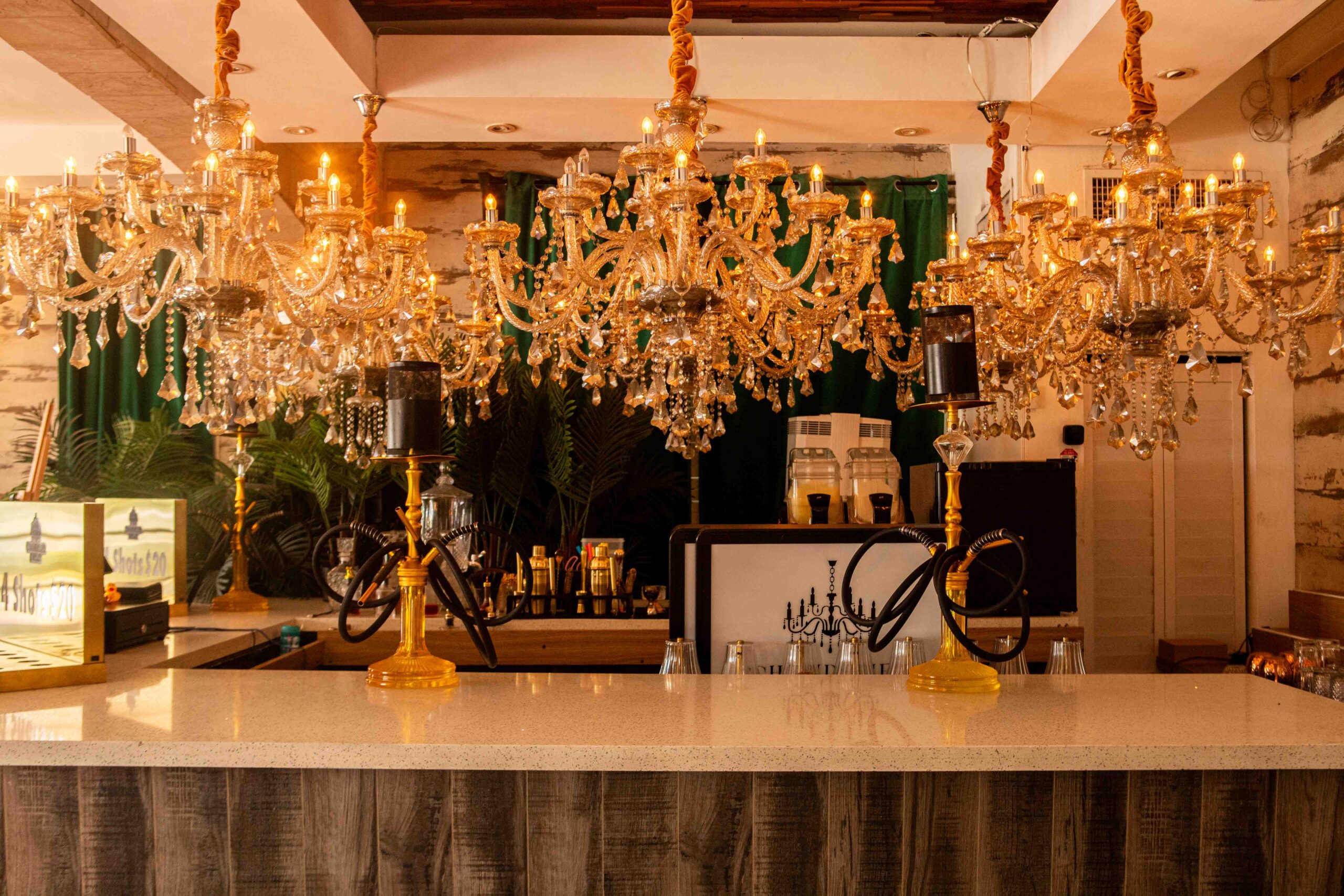
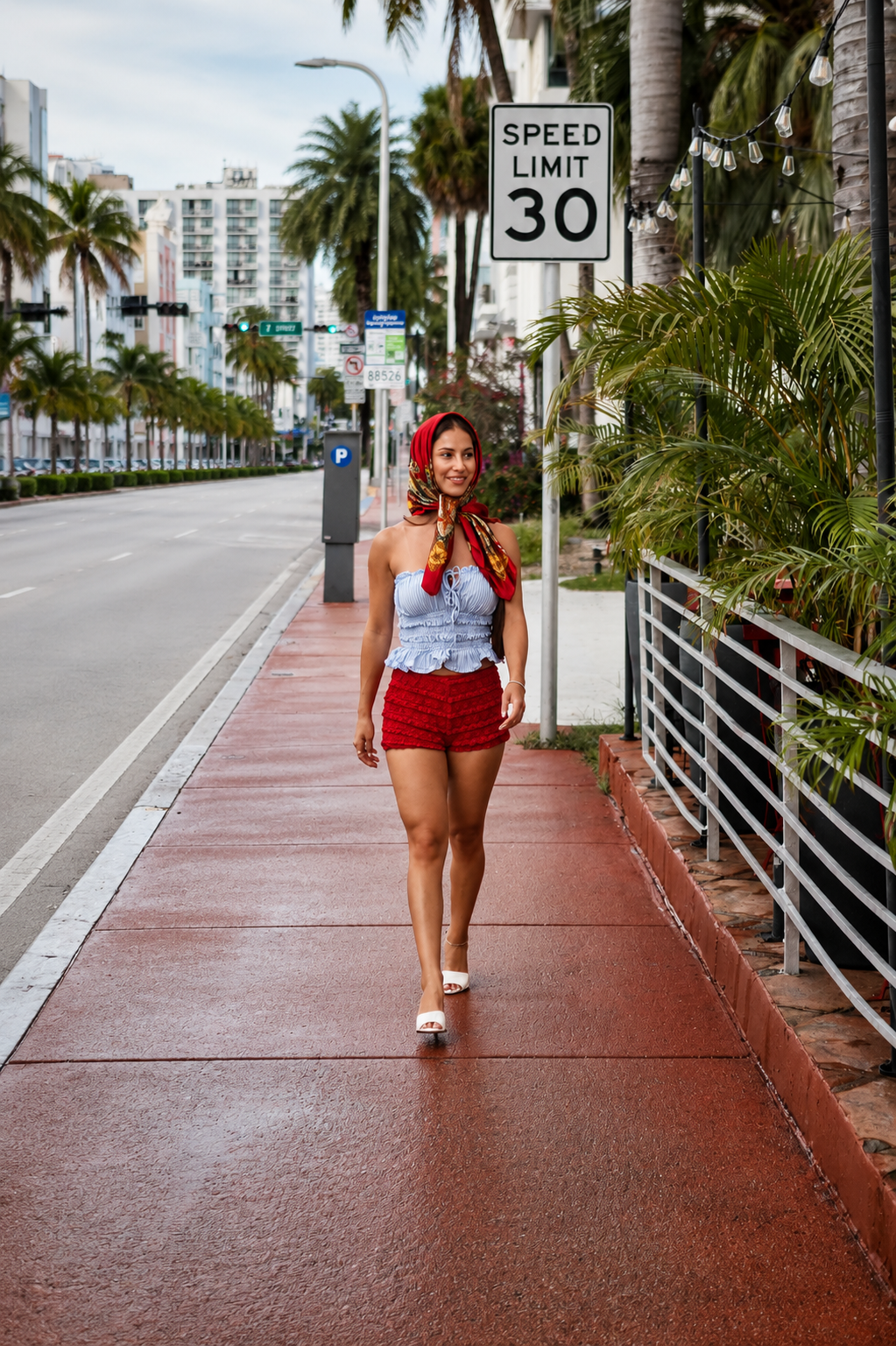
The photographs move between the hotel’s entrance, its sidewalk patio and Collins Avenue. Samantha walks beneath palms and string lights. She pauses under a speed limit sign. She sits alone at one of the red café tables. In other frames, she stands beneath the Hotel Shelley marquee as the building towers above her.
The location is never simply scenery.
It becomes another character.
The wet reddish pavement adds richness to the photographs. The greenery introduces deep tropical tones. The cream and lavender facade softens the environment. Then there are those unmistakable flashes of red throughout the property, chairs, tables and architectural surroundings that unexpectedly connect back to Samantha’s wardrobe.
Suddenly, the entire scene has a palette.
Red. Cream. Powder blue. Tropical green.
And at the center of it is Samantha.
Styling Samantha Melendez

The styling needed to feel nostalgic without becoming costume.
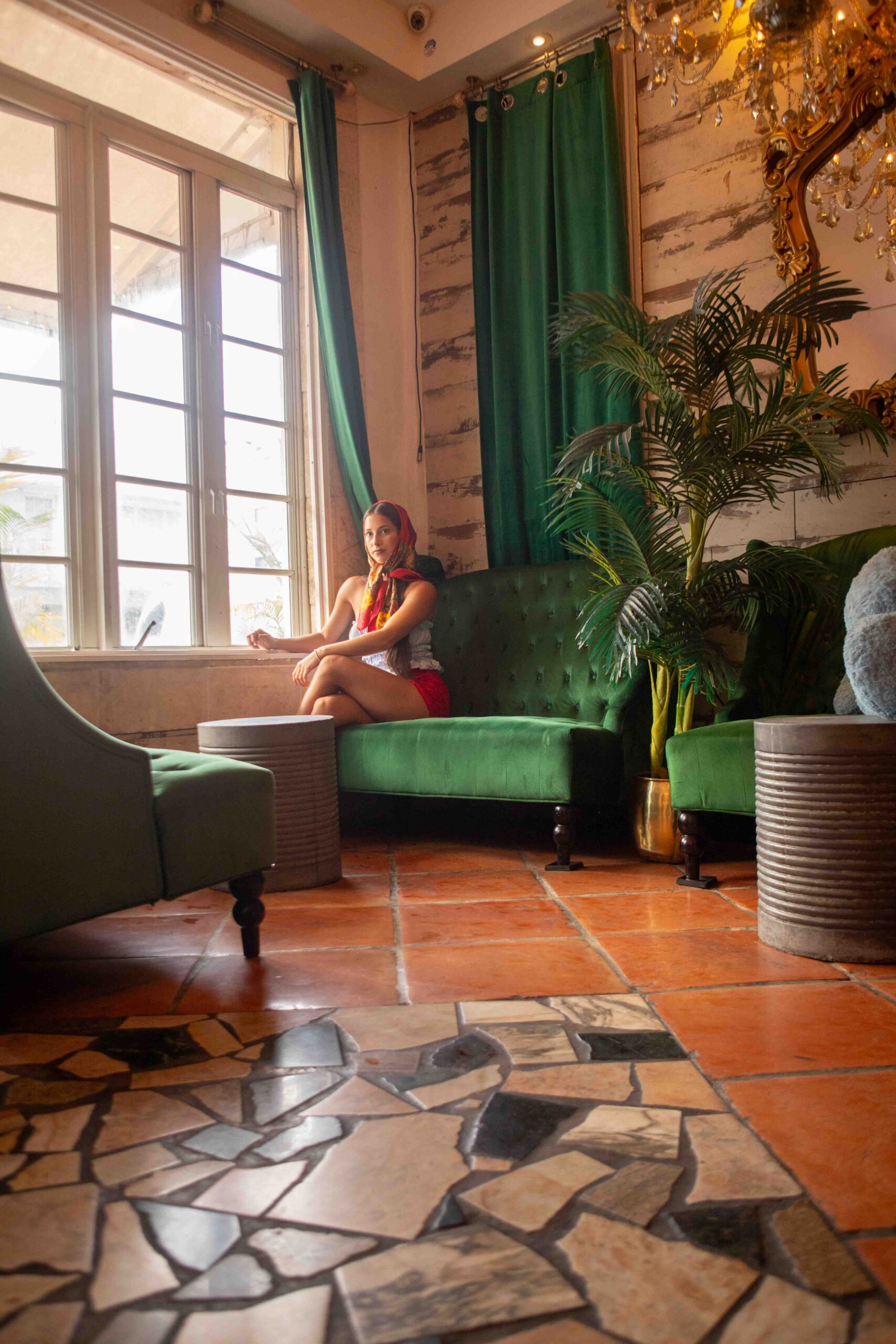
Samantha wears textured red shorts, a pale blue ruched top, white heels and a richly patterned red silk scarf wrapped around her head and tied beneath her chin.
The scarf is the piece that changes everything.
Without it, the look could easily belong to contemporary South Beach. Add the scarf and another era begins creeping into the frame.
There are echoes of mid-century travel photographs, European resort dressing and women arriving at seaside hotels with scarves protecting their hair from the wind. Yet the cropped silhouette and textured shorts pull everything firmly back into the present.
That tension was intentional.
We did not want to recreate 1931. We wanted to photograph 2026 through the atmosphere of old Miami Beach.
The white heels provide another important detail. They dress the look up just enough, creating a playful contradiction against a neighborhood synonymous with sandals, swimwear and walking to the beach.
Even the colors interact with the architecture. Samantha’s red scarf becomes dramatically saturated against the Shelley’s restrained facade, while her pale blue top picks up some of the cooler tones running through the building.
She does not disappear into the location.
She interrupts it.
The Woman Arriving at the Shelley
As the shoot developed, a loose narrative began forming naturally.
Who is she?
Maybe she has just arrived in Miami.
Maybe she is waiting for someone.
Maybe nobody is coming.
We intentionally leave that unanswered.
One moment Samantha is walking down Collins Avenue with the confidence of someone who knows exactly where she is going. In another, she is seated at a café table, absorbed in her phone. Then she appears beneath the hotel’s entrance, looking into the distance as though she has spotted someone across the street.
The images begin to feel less like individual fashion portraits and more like still frames from a movie whose plot we never fully explain.
That ambiguity is part of the fun.

And Then, the Strawberry
The story becomes more intimate as the camera moves closer.
The street disappears. The architecture fades into soft shapes behind Samantha. Her red scarf fills the frame.
Then comes the strawberry.
It is a simple prop, but visually it connects almost perfectly to everything already happening in the story. Its saturated red echoes the scarf and shorts while introducing something playful, sensual and slightly unexpected.
These close portraits are important because they break the rhythm established by the wider photographs.
We have already seen Samantha in relation to Miami Beach. Now the city becomes secondary.
The editorial shifts from place to personality.
That transition is what gives the story dimension. Fashion photography does not always need a complicated plot. Sometimes a sequence can be built through distance: establishing the location, introducing the subject, following her through the environment and eventually moving close enough that the world around her disappears.

Miami Without the Cliché
Hotel Shelley still operates today as a 49-room boutique property, maintaining the relaxed identity that has long distinguished smaller South Beach hotels from Miami’s sprawling luxury resorts.
But for this shoot, its importance was not about rooms or amenities.
It was about memory.
South Beach has changed endlessly, but buildings like the Shelley create continuity between different versions of Miami. Generations have walked these sidewalks. Travelers have arrived carrying suitcases. Cars have passed beneath those windows. Fashion has changed, disappeared and returned again.
And the building remains.
That made it the right setting for Samantha Melendez.
The resulting photographs are not intended to reproduce vintage Miami. They imagine what happens when contemporary fashion walks directly into its history.
A red scarf.
White heels.
A strawberry.
A 1931 Art Deco hotel.
And one afternoon on Collins Avenue.
Sometimes that is enough to build an entire world.