

By Peter Koloff
At first, it was the colors that caught my attention.
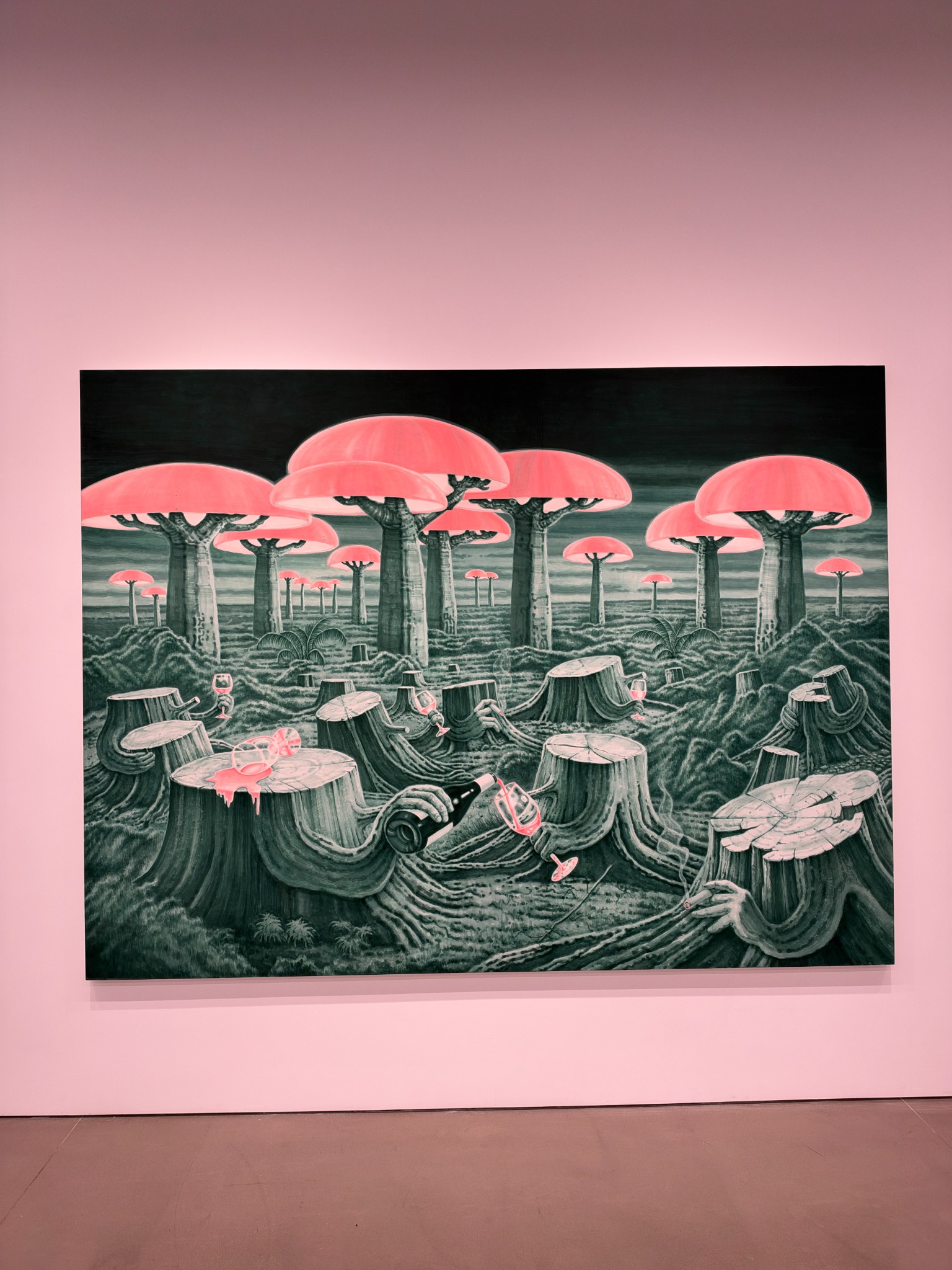
Jongwan Jang’s I prefer white wine is a dark green landscape of baobab-like trees capped with glowing pink canopies. In the foreground, the stumps of cut trees have sprouted human hands. They pour wine, hold glasses, smoke cigarettes. One glass has already spilled.
It is funny at first. Almost playful. Then, the longer I looked, the stranger it became.
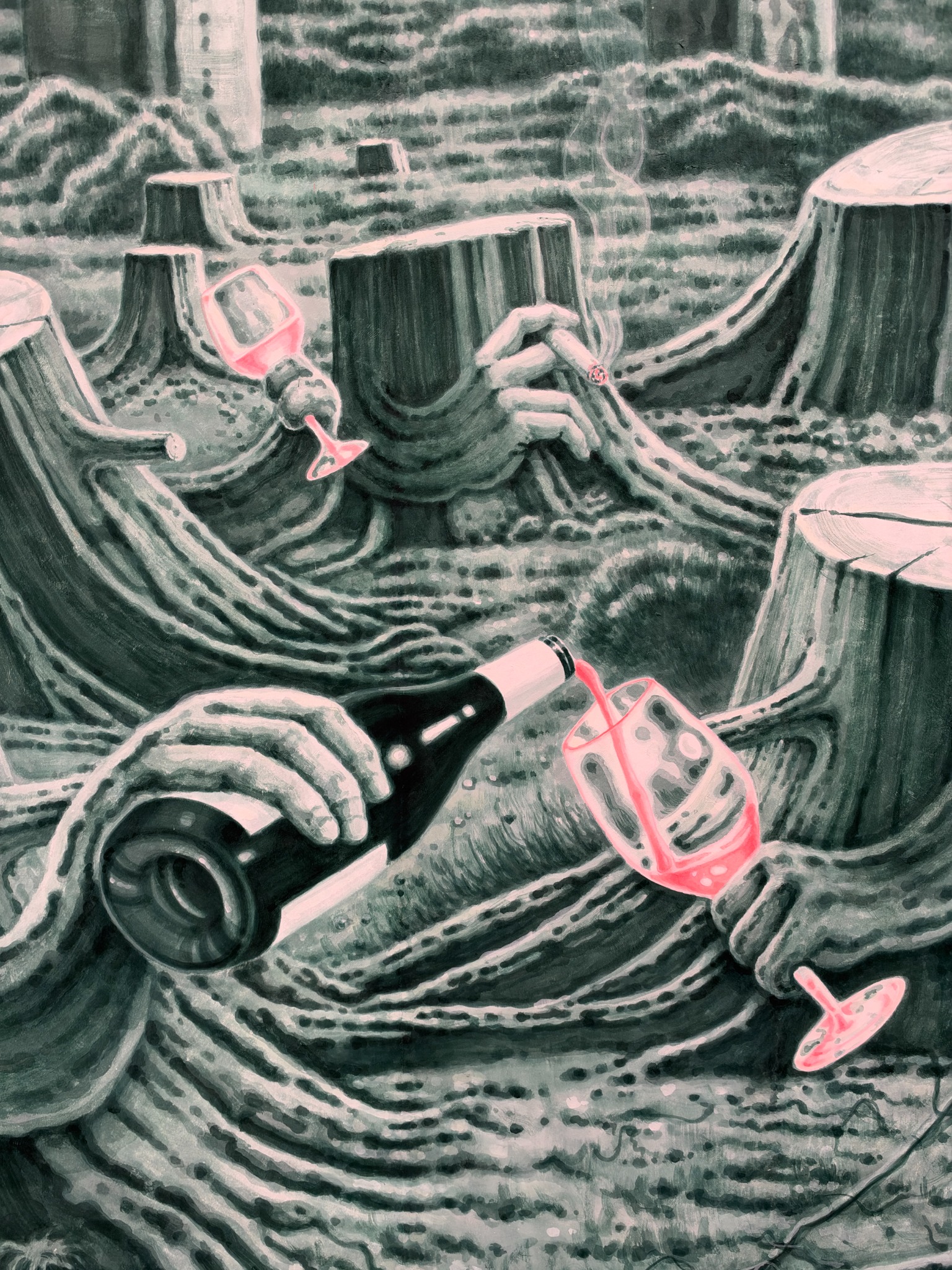
There is something slightly wrong about the world Jang has built. It feels social and abandoned at the same time, like the remains of a party continuing after everyone has disappeared.
Without realizing it, I had already started creating a story.
At Space ZeroOne, 371 Broadway in New York, MacGuffin: Five Korean Artists and Five Writers from Art Omi pairs each artist with a writer from Art Omi’s international residency in the Hudson Valley. Co-curated by Hayoung Chung and DW Gibson, the exhibition runs through December 19, 2026.
The curators borrow the term “MacGuffin” from film. In their framing, the paintings and sculptures set something in motion without determining where it has to end. The writers begin with the artwork, but their texts, displayed as working drafts that visitors can read and take with them, are not expected to explain the artist’s intention or reach the same conclusion. That distance between image and language is part of the exhibition.
During my walkthrough with Hayoung Chung, I stopped thinking about the writing as something placed beside the art to explain it.
The writers are viewers too. They just happened to arrive before us.
Jordan Kisner’s response to Jang begins somewhere else entirely. She writes about a boy who prefers the night, when familiar things lose their normal shape. Years later, as a soldier, he is given night-vision goggles and sees the darkness transformed again into a glowing green world.
Looking back at the painting, its green-black world already felt like something seen through night vision.
I had been looking at Jang’s painting as a strange gathering. Kisner made me think about what happens when the familiar world changes simply because the way we see it changes.
The painting had not moved.
I had.
The same thing happened with Goyoson and Lisa Brennan-Jobs. Goyoson’s work takes the form of a large car-like structure, something recognizable as a vehicle that no longer behaves like an ordinary one. It sits somewhere between sculpture, memory and machine.
Brennan-Jobs begins with a Hyundai Equus. At first she writes about the car almost clinically: its shape, its materials, its attempt at luxury. Then the machine begins carrying memory. Childhood enters. Family enters. Loneliness enters.
At one point she wonders how long machines can retain traces of the emotions and memories attached to them.
An object can be completely ordinary until memory gets involved.
Then it becomes something else.
Dongho Kang’s work pulled me in a different way.
Near the entrance, I saw shoes at the end of a corridor, a dog standing in a hallway, and a basement with an office chair and plaid sofa. In Cheering, two ordinary wall organizers, one pink and one blue, raise their hooks like arms.
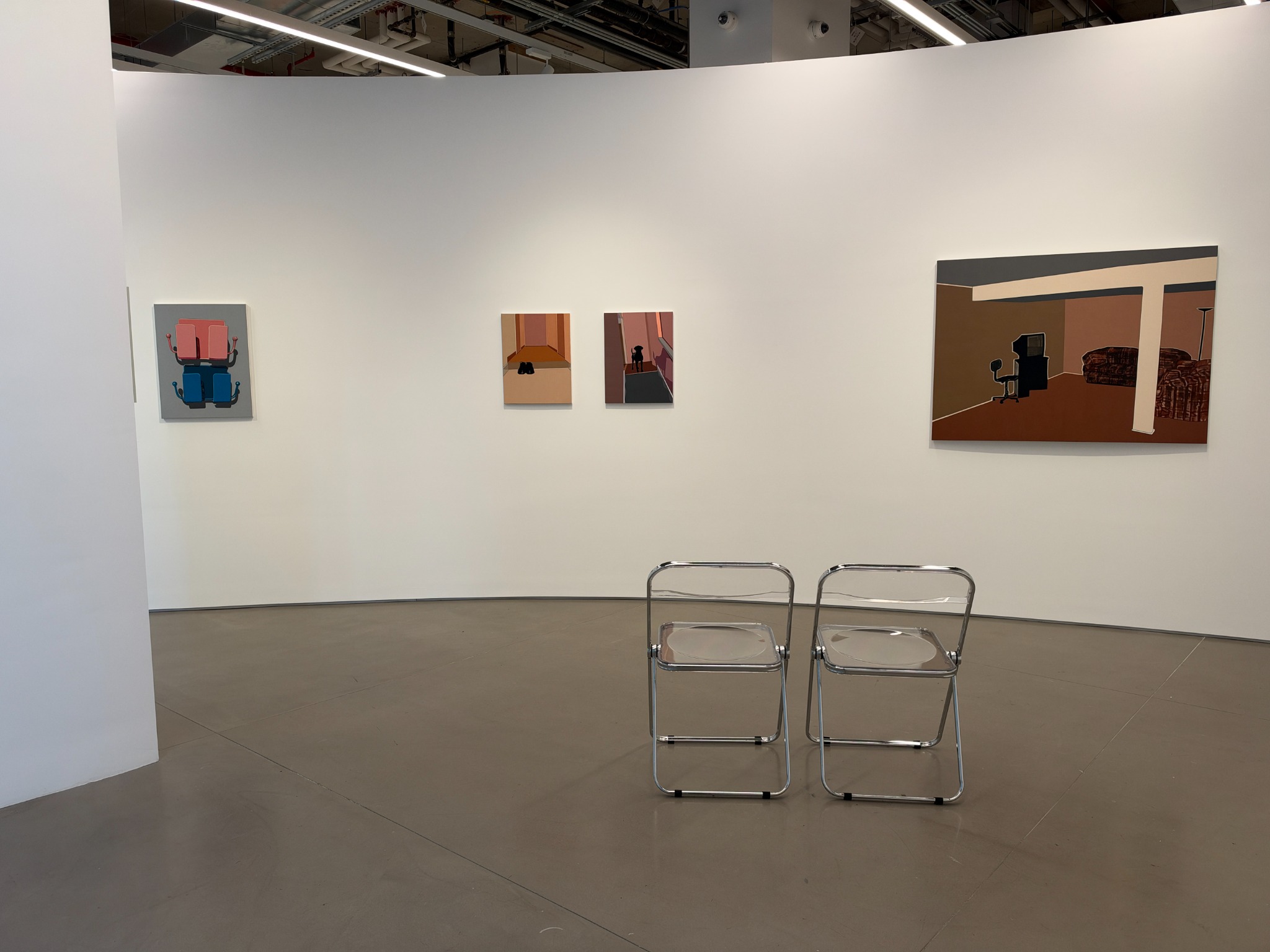
Two clear folding chairs faced the paintings. Sitting there, the room felt like a film set between scenes.
Edward Gauvin’s response took those spaces somewhere else. His text moves through repetition, objects, still life and rooms where apparently motionless things seem to accumulate their own strange presence. Near the end, he turns toward the idea of things that do not move but still move us.
I had been waiting for something to happen.
Gauvin made me wonder whether it already had.
That gap between what I saw and what another person saw became more interesting to me than deciding which interpretation was closer to the artist’s intention.
Ian Ha and Nadia Owusu offer another version of the same openness.
Hung in the middle of the room in acrylic, Ha’s work sets the green steel underside of an elevated track against fields of orange dots and a curled pink figure. With Owusu’s title, The Crossing, in mind, it was hard not to see a crossing.
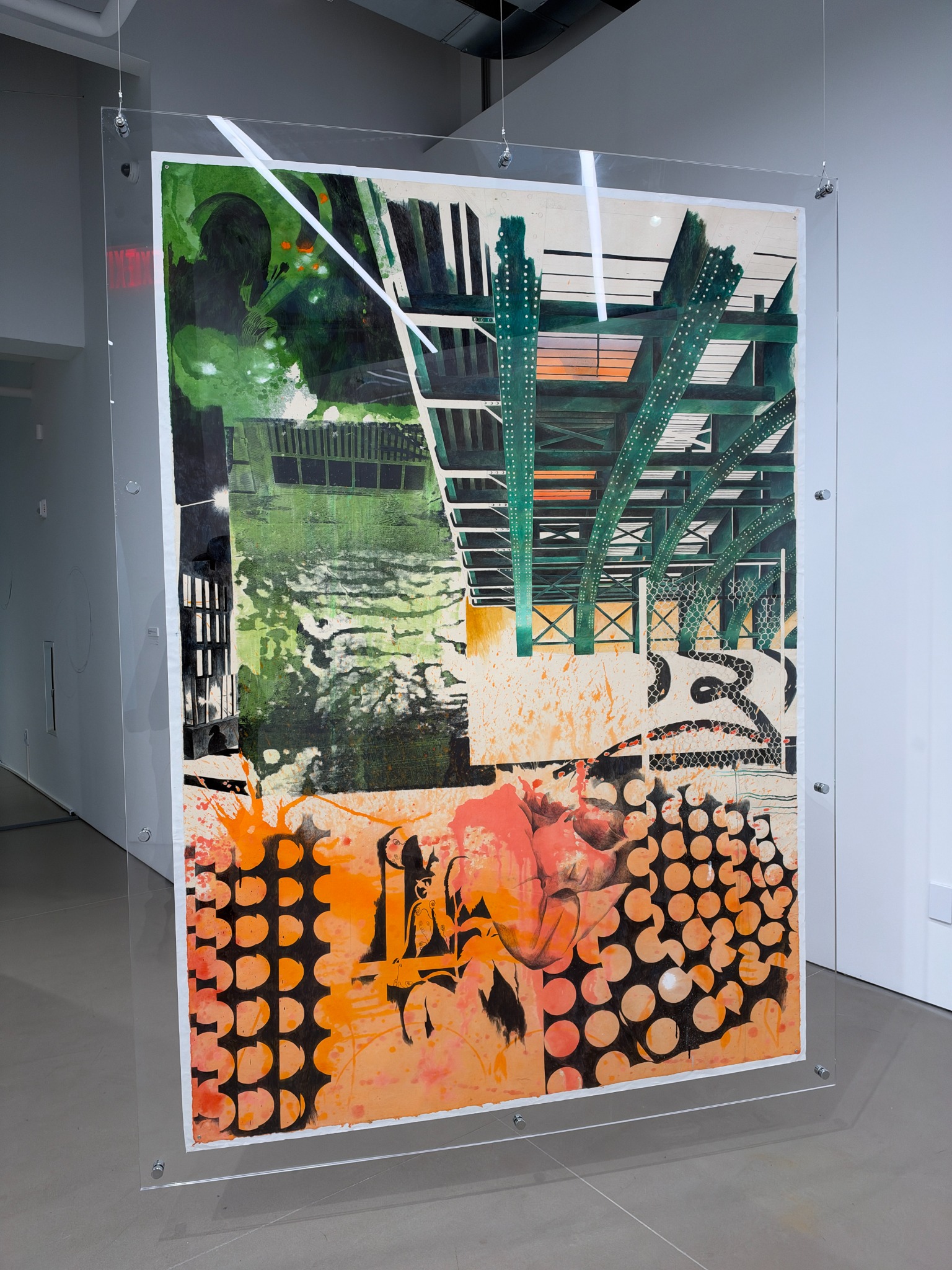
Owusu’s response moves through memory, dreams and half-recognized objects: a yellow frying pan, curtains, a blanket, childhood, loss and things that seem to disappear and return.
The writing does not close the work down.
It opens another route through it.
Then the exchange between Jenny Jisun Kim and ’Pemi Aguda pushed the idea further.
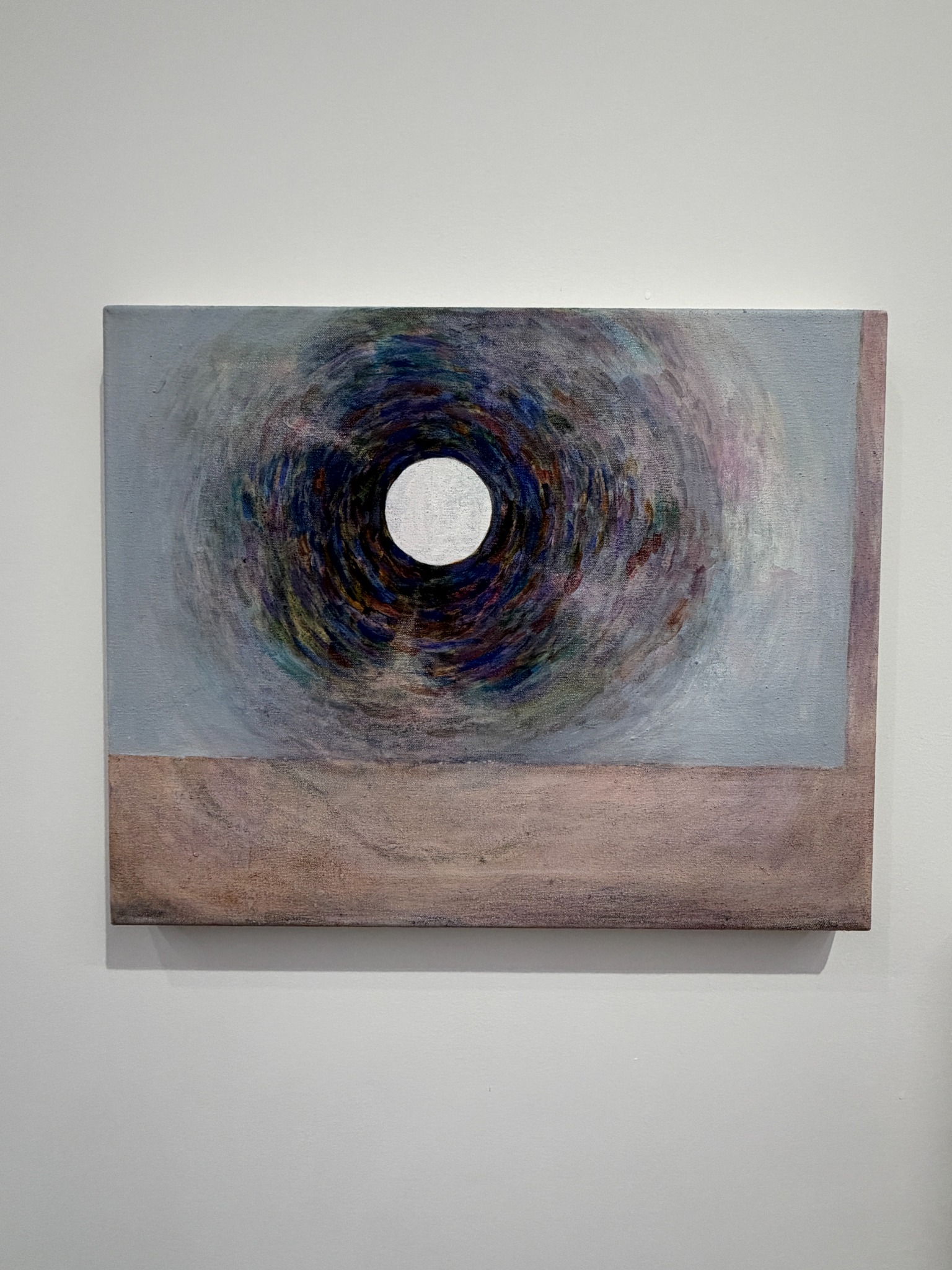
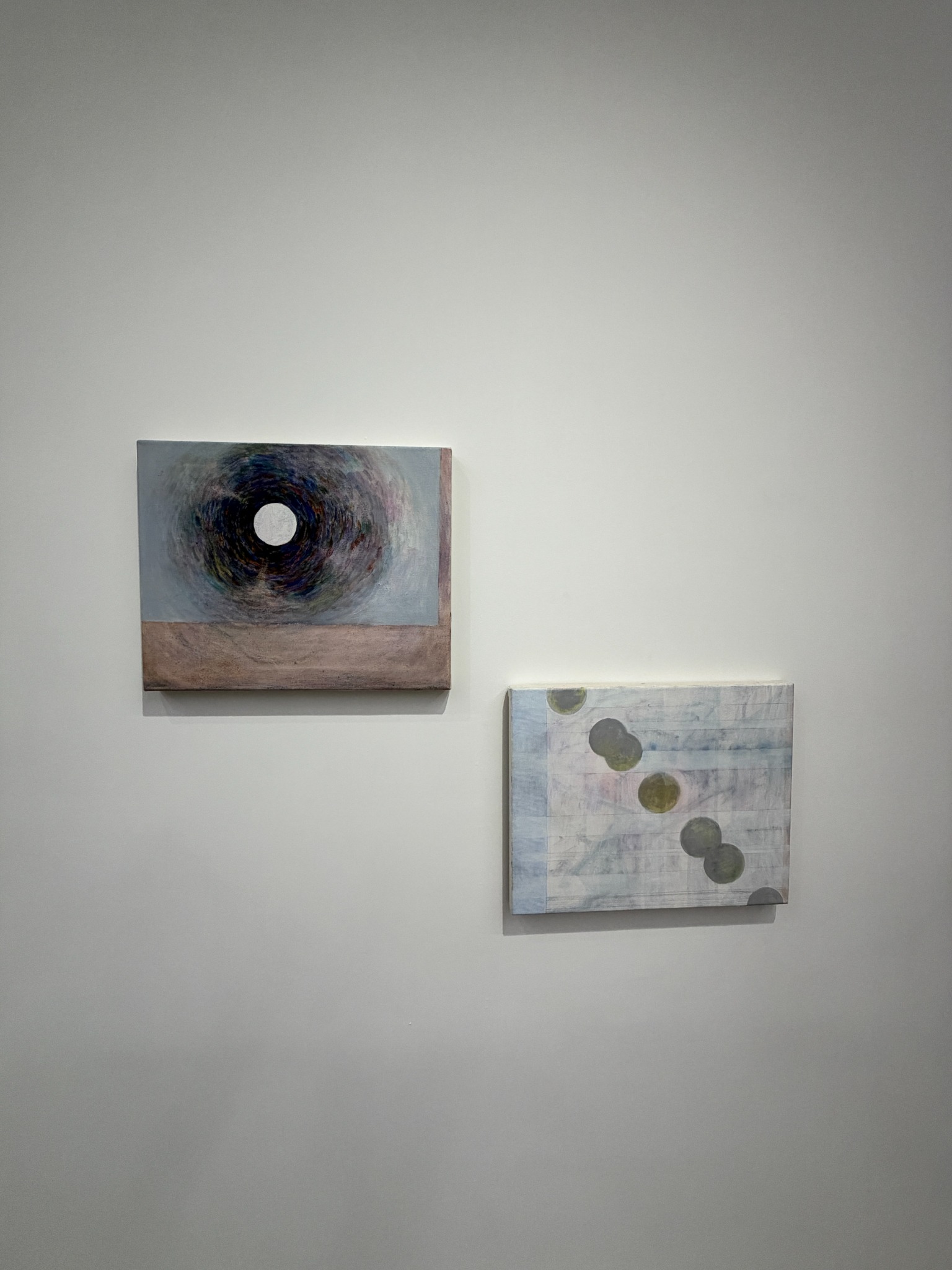
Kim’s paintings are quieter than Jang’s. One is a dark swirl closing around a single white circle, like looking up from the bottom of a well. Beside it, lower on the wall, gray circles tumble diagonally across a pale grid and off the edge.
The two works are visibly staggered rather than hung along a single eye line.
Aguda’s response follows a woman trying to enter a smaller city hidden inside a larger one. The city is surrounded by a circular wall without a gate. The woman begins walking around it, believing that if she circles it enough times something will eventually happen.
But she loses track of where she began.
As she continues walking, the circle begins to feel more like an endless line.
Reading it beside Kim’s paintings, the circular forms stopped looking purely formal to me.
They began to feel like boundaries.
And in this case, the writing did not simply respond to the art. As FAD Magazine reported, Kim had originally planned to hang the paintings in a straight line at the same eye level. After reading Aguda’s response, she reconsidered their sequence and height. The text had moved back toward the artist and changed how the work appeared in the room.
By the time the viewer arrives, meaning has already traveled in more than one direction.
That was when the title finally landed for me.
The art is the MacGuffin.
It starts something.
What happens afterward belongs to somebody else.
Artists can control the material: the color, the scale, the surface, the title, where something hangs. They cannot control what another person brings into the room.
That brought me back to Jang’s drinking stumps.
Before I knew anything about Jordan Kisner’s response, I had already invented my own story. Kisner saw something else. Jang had made the painting from somewhere else again.
None of those experiences had to cancel the others out.
By the time I left Space ZeroOne, I was thinking less about what any single work meant and more about what happens to art once another person begins looking at it.
Maybe meaning is not something an artwork contains.
Maybe it is something that keeps happening to it.
All photographs by Peter Koloff.
MacGuffin: Five Korean Artists and Five Writers from Art Omi
Space ZeroOne, 371 Broadway, New York
Through December/19, 2026