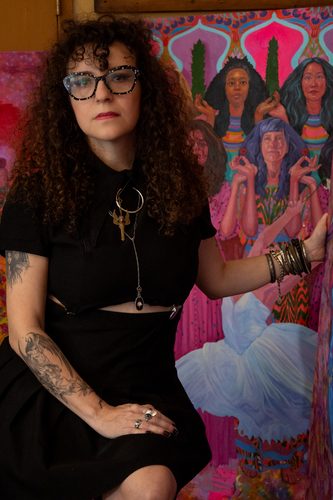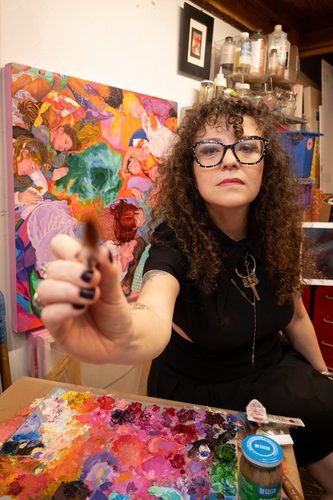


In Patches For a Broken Harmony, the New York artist looks at grief, migration and the fragile things that keep us connected.
By Peter Koloff
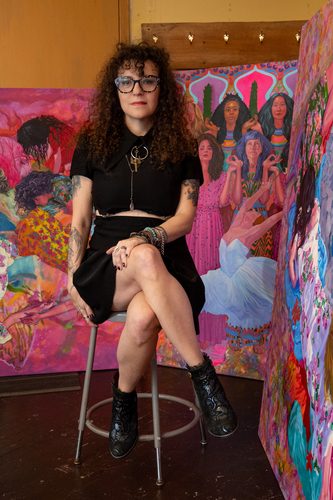
Buket Savci’s paintings look happy until you spend time with them.
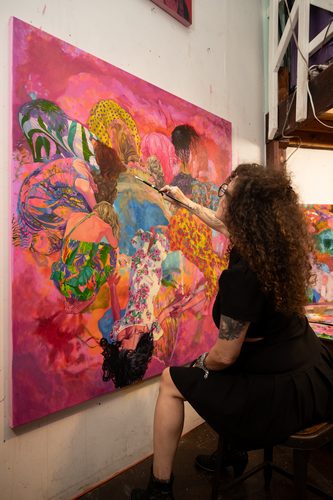
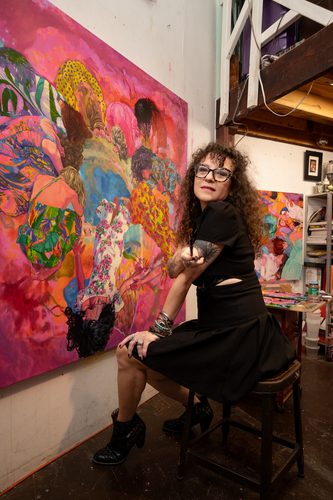
They’re crowded with color, flowers, patterned fabrics and bodies pressed together. People embrace, lean, crawl and disappear into thick fields of turquoise, pink and yellow. There’s almost nowhere for the eye to land, and that saturation, it turns out, is the argument.
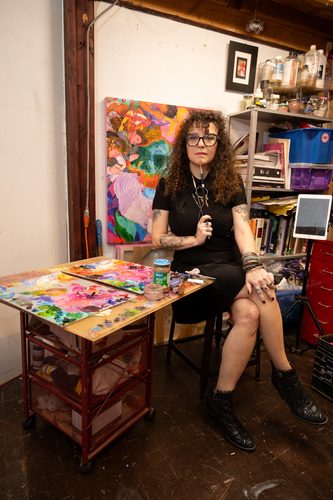
“It’s not just about colors and flowers,” Savci says from her New York studio. “It’s the fight against the negativity and darkness surrounding us.”
Her new show, Patches For a Broken Harmony, opens September 10 at Kravets Wehby Gallery, and it comes from a more vulnerable place than its exuberant surfaces suggest.
“The paintings are rooted in my own personal grief, loss, all these years of trying to belong,” she says. “Even as an immigrant trying to belong here.”
Savci’s exhibition arrives during a season of renewed attention around contemporary figurative painting in New York, a conversation DaVinci has also explored in recent coverage of CJ Hendry.
Savci has lived in New York for twenty years. She was born and raised in Turkey, and that experience of existing between places sits at the center of how she thinks about belonging.
“I’m not one hundred percent American because I didn’t grow up here,” she says. “But being away from Turkey all these years, I don’t totally feel connected there anymore either.”
“I see myself as patches of both worlds.”
The title isn’t only about repair. Savci is painting what happens when identity itself is assembled from fragments: memories of one country, a life built in another, grief, relationships, distance and the small forms of hope that survive all of it.
Her figures rarely stand alone. They gather in clusters, touching and holding one another up, as if being close might offer some protection from whatever exists beyond the canvas.
She sees the same vulnerability in New York.
“You see it in people’s faces,” she says. “We show ourselves like we are happy, we are strong, but inside everybody is struggling.”
One painting shows figures crawling through a burst of color. Savci imagines them caught between opposing forces.
“They are either trying to crawl away from their struggles or the struggles are pulling them.”
She doesn’t resolve which. The figures stay in the pull. And they stay together. For Savci, that persistence is the whole point. So is the joy.
“I see joy as a rebellion,” she says.
The color carries history too. Savci remembers the turquoise of the Mediterranean, Turkish textiles, patterned interiors and the visual density of Istanbul. But some of the strongest threads lead back to her mother.
Before she married, Savci’s mother worked with friends in a bridal boutique, making dresses, headpieces, flowers and bouquets. Later she kept sewing at home. Savci grew up surrounded by scraps of fabric and remembers using the leftovers to make clothes for her dolls.
She hadn’t really considered how much of that childhood remained inside her paintings. Now it’s hard not to see it.
Fabric covers bodies. Patterns collide. Flowers return again and again. The paintings begin to feel like tapestries assembled from memory, much like the life she describes between Turkey and New York.
Her father left a different kind of mark. Savci did not grow up in an art-world family, but he regularly took her to the ancient sites scattered across Turkey. She has a photograph of herself at two years old, standing near the Temple of Apollo.
A small girl among ruins that have held their shape for two thousand years.
Fragments again. Ruins, textiles, family, Istanbul and New York, all finding their way into paintings about holding things together.
That is what Patches For a Broken Harmony is finally about: not a world restored to perfect balance, but the ways people go on after balance is gone.
“There’s still hope,” Savci says. “Whatever happens, life is short. You need to keep pushing and following your dreams.”
The dolls in homemade dresses. The child at Apollo’s temple. The crowded, holding, crawling figures.
In a way, Savci has been assembling the same language her whole life: stitching fragments of memory, place and loss into something you’d want to look at.