

Luxury fashion has long thrived on desire for the next thing. A new season arrives, silhouettes change, colors shift, and another object is positioned as the piece worth adding to the collection.
Penny Crook is building a luxury brand around a very different proposition: What if the handbag you already owned could simply do more?
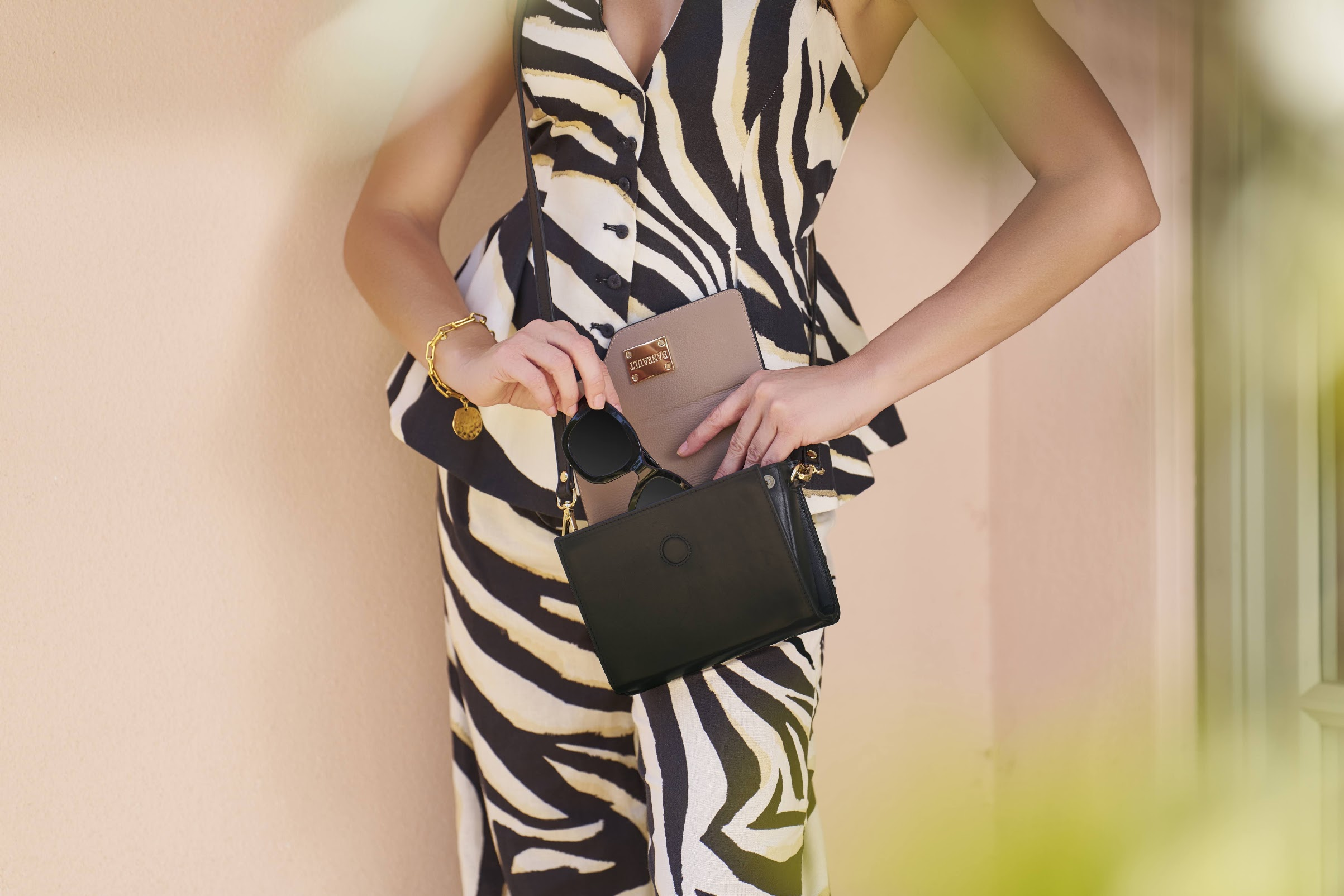
As founder and CEO of Daneault, Crook has taken that question from an everyday frustration to a patented approach to handbag design. The brand’s reversible handbags are engineered to transform into two distinct looks while retaining the structure, finish, and sophistication expected of a luxury accessory.
But the idea behind Daneault did not begin with an attempt to disrupt an industry. It began with Crook’s own life.
From an Everyday Frustration to a Bigger Idea
Like many women, Crook found herself changing handbags constantly. There was one for work, another for dinner, another for travel, and still others chosen around particular outfits.
The routine felt increasingly unnecessary.
“Why can’t one luxury handbag do more?” she remembers asking herself.
That practical question became considerably more meaningful following the death of her father. While helping her mother sort through her belongings, Crook discovered a leather handbag her father had given her more than 50 years earlier.
The bag had aged, but it had not lost its beauty. Instead, time had given it character.
For Crook, the discovery reframed what a handbag could represent. It was no longer simply an accessory. It had become a physical connection to her parents, their marriage, and a moment in their shared history.
That realization became part of Daneault’s foundation.
Crook wanted to create something capable of solving the practical problem she had experienced while also possessing enough quality and permanence to remain meaningful decades later.
The goal was not simply to make another handbag.
It was to reconsider what one could be.
Luxury Without the Excess
Daneault enters the market at an interesting moment for luxury. For decades, status has often been communicated through accumulation: more handbags, more collections, more seasonal purchases.
Crook believes that definition is changing.
Today’s luxury consumer, in her view, can be just as interested in craftsmanship, longevity, versatility, and intentional purchasing as she is in exclusivity.
“True luxury isn’t about excess; it’s about excellence,” Crook says.
That philosophy is central to Daneault. Rather than asking a customer to choose between two handbags, its reversible construction allows one piece to present two distinct identities.
It is an idea that feels particularly relevant for women whose days rarely fit neatly into a single category. A morning business meeting may become an afternoon lunch, an evening dinner, and a flight the following day.
The handbag is designed to adapt alongside her.
For Crook, practicality does not undermine luxury. Done correctly, it can become part of the luxury experience.
The Engineering Behind the Elegance
Making a handbag reversible sounds deceptively simple.
Creating one that still feels like a genuine luxury product proved considerably harder.
Traditional handbag construction assumes there will always be an exterior and an interior. Seams, pockets, reinforcement, hardware, and finishing can therefore be designed around what will and will not be visible.
Daneault had to eliminate that assumption.
Both sides needed to function as the exterior, which meant every seam, panel, edge, and stitch needed to withstand scrutiny. The handbag also had to maintain its silhouette after being reversed, without becoming bulky or feeling like a novelty product.
Crook and her team spent years developing the construction, working through prototypes, manufacturers, material thicknesses, stitching methods, reinforcements, and hardware.
Even existing handbag components presented limitations.
The company ultimately developed a custom magnetic locking system specifically for its reversible design, allowing the handbag to transform while remaining secure and structured.
That development eventually resulted in a utility patent, an important milestone for Crook not simply because of the intellectual property itself, but because of everything required to reach it.
For her, the patent represents the prototypes that failed, the manufacturing problems that had to be solved, and the moments when accepting “good enough” would have been considerably easier.
When Innovation Becomes Invisible
Perhaps the most interesting thing about Crook’s approach is that she does not necessarily want innovation to be the first thing a customer notices.
She wants them to notice the handbag.
“When people first experience a Daneault handbag, they’re often amazed that it transforms in seconds,” she explains. “But what I love most is that before they even see the transformation, they simply see a beautiful luxury handbag.”
That distinction matters.
Daneault uses premium Leather Working Group certified leather, with collections incorporating materials including suede, vegetable-tanned leather, and Crazy Horse leather. The selection is about texture and appearance, but also about how the materials will behave years after the purchase.
Crook is particularly interested in leather that develops character with age.
Vegetable-tanned leather can acquire a distinctive patina, while Crazy Horse leather develops marks and tonal variations through use. Rather than treating those changes as flaws, Daneault sees them as part of an object’s history.
It circles back to the handbag Crook discovered in her mother’s closet.
The aspiration is not to keep a handbag permanently untouched. It is to create one worthy of being used long enough to develop a story.
Designing for the Woman, Not the Logo
There is another rejection of traditional luxury codes embedded in Daneault: Crook does not want the brand to overpower the person carrying it.
She describes the idea as “quiet confidence.”
“I’ve never wanted Daneault to be a brand that enters the room before the woman does,” she says.
Instead of relying on oversized branding to communicate status, the company places its emphasis on leather, construction, proportion, versatility, and the experience of carrying the piece.
The woman remains the focal point.
That thinking extends to functionality.
Crook believes women should not be forced to decide between a handbag that photographs beautifully and one that actually works for their lives. Organization, pockets, straps, hardware, and carrying options have to be useful without disturbing the silhouette.
Adding more features, she discovered, was often easier than knowing what to remove.
If something introduced unnecessary bulk, interfered with reversibility, complicated the experience, or compromised the appearance of the bag, it had to be reconsidered.
The result reflects an increasingly important idea in design: some of the most successful engineering is the engineering the customer barely notices.
The Founder Behind the Patent
Crook’s route into luxury fashion was hardly conventional.
Her professional background was in banking, financial services, sales, and business development rather than traditional fashion design.
That distance from the industry may have helped her question it.
Instead of beginning with how handbags had historically been constructed, Crook approached the category as a consumer asking why they could not be constructed differently.
The distinction became important as Daneault moved from idea to manufacturing.
There was no established blueprint for the product she wanted to make. Multiple manufacturers, prototypes, hardware developments, design modifications, and quality-control challenges followed.
“When you are creating something completely original, there is no roadmap,” she says.
The experience also changed Crook’s understanding of entrepreneurship.
Resilience, she learned, is not an endless state of optimism. It is the willingness to experience disappointment and still return the following morning prepared to find another solution.
She also had to become comfortable entering rooms where other people knew more about manufacturing, leather, or engineering than she did.
What Crook did know intimately was the problem.
“I was the expert on the problem I wanted to solve and the woman I was designing for,” she says.
It is a lesson that reaches beyond fashion.
Founders do not necessarily need to enter an industry knowing every answer. Sometimes their advantage is being willing to ask a question the industry has stopped asking.
Building Outside the Trend Cycle
Daneault’s approach also challenges the pace at which fashion encourages consumers to replace what they own.
Rather than continually redesigning its identity around short trend cycles, the brand primarily works around Spring/Summer and Fall/Winter, using changes in color, texture, leather, and material combinations to introduce seasonal character while keeping its silhouettes intentionally timeless.
Crook wants a woman to buy a handbag today and still want to carry it 10 or 20 years from now.
That longevity is also part of her definition of responsible luxury.
Sustainability conversations frequently concentrate on materials and manufacturing, both of which matter. Crook adds another consideration: how long someone actually wants to keep the finished product.
A beautifully made object that remains desirable for decades creates a fundamentally different relationship between fashion and consumption.
Daneault’s reversible design pushes that idea further. Instead of encouraging a customer to purchase another bag simply because she wants a different look, the existing bag changes with her.
Own fewer. Expect more from what you own.
From Handbag Company to Luxury Innovation Brand
Crook’s ambitions for Daneault extend beyond reversible handbags.
She ultimately sees the company becoming a broader luxury innovation brand, one that applies the same question to other products women use throughout their lives: Could this work better?
Additional patent applications are pending, and one of the company’s next concepts takes that philosophy into an entirely different stage of a woman’s life.
Daneault is introducing a multifunctional parenting and career bag intended to challenge the short lifespan of the traditional diaper bag.
Crook questioned why an expensive bag should become obsolete once a child moves beyond the diaper years. Daneault’s answer is a design intended to work during the parenting years before transitioning into a career, travel, or everyday bag.
The concept recognizes something traditional product categories can sometimes miss: women rarely occupy only one role.
A woman can be a mother, executive, entrepreneur, traveler, partner, and individual at the same time. Crook wants the products surrounding her to acknowledge that reality.
Travel and additional leather accessories are also natural possibilities for the company, but Crook is cautious about expansion for expansion’s sake.
Any future Daneault product has to answer a series of questions. Does it solve a genuine problem? Can it be designed better? Can it improve someone’s life while remaining beautiful enough for luxury and timeless enough to avoid becoming disposable?
If not, Crook says, it probably does not belong in the collection.
A Different Measure of Luxury
Daneault may have begun with a reversible handbag, but Crook’s larger proposition is ultimately about how luxury should earn its place in someone’s life.
Beauty still matters. Aspiration still matters. Craftsmanship still matters.
But Crook believes modern luxury can ask more of itself.
It can be intelligent. It can adapt. It can solve problems. It can respect craftsmanship without becoming trapped by convention. And perhaps most importantly, it can be designed with enough permanence that the person who purchases it never feels pressured to replace it simply because another season has arrived.
That brings Crook’s story back to the handbag her father gave her mother more than half a century ago.
She remembers the emotional weight of holding something that had survived long enough to become more than the sum of its leather, stitching, and hardware.
It had become part of a family’s history.
That is the standard Crook is ultimately pursuing with Daneault.
Not simply a handbag someone wants today, but an object that accompanies a woman through careers, travels, celebrations, reinventions, ordinary days, and extraordinary ones.
And perhaps, decades later, someone opens a closet, discovers it waiting there, and realizes they are holding more than a handbag.
They are holding part of her story.