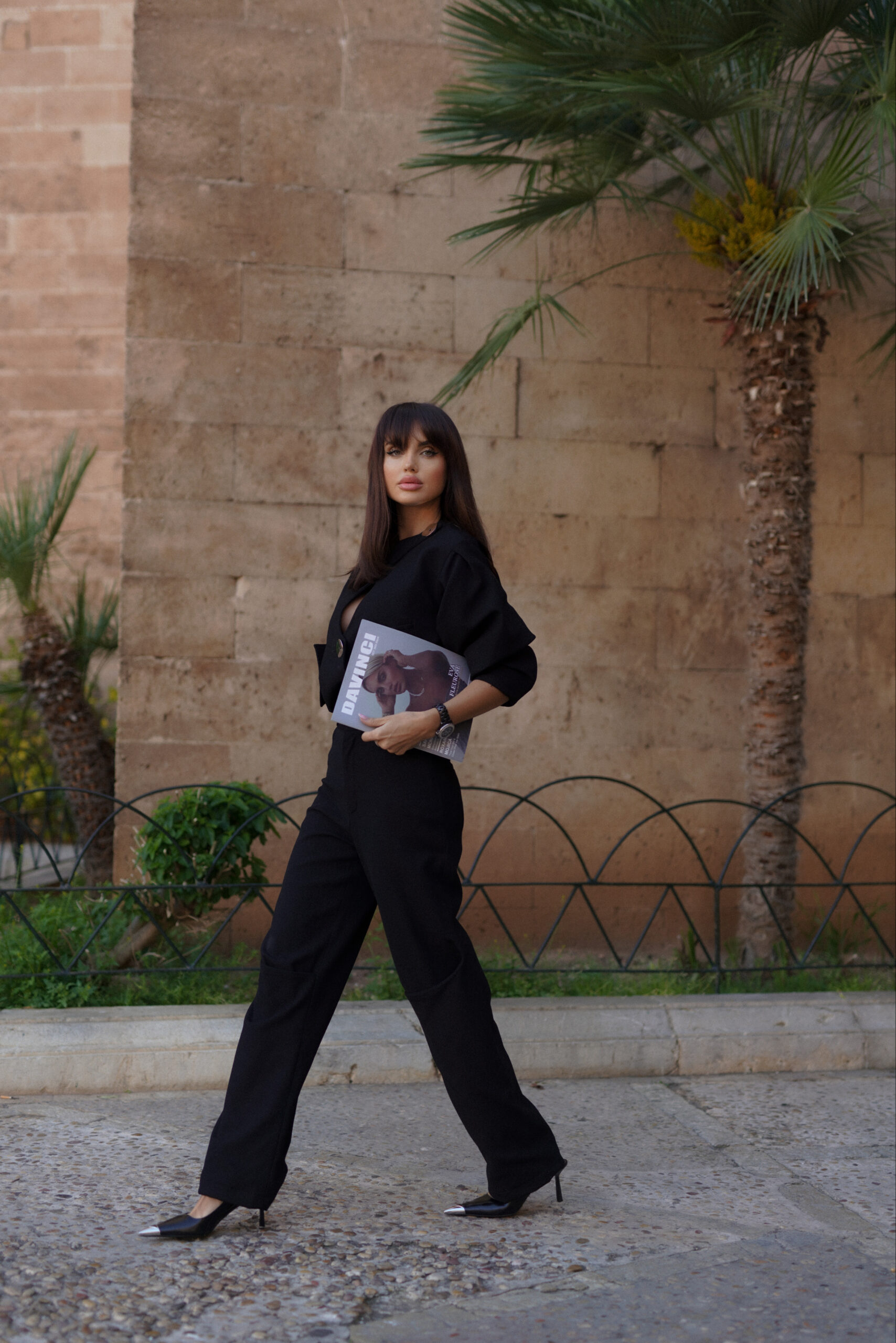


To speak of the Little Black Dress is to speak of the void as a canvas. In the lexicon of high fashion, black is rarely an absence; rather, it is a profound presence, an organizing principle that strips away the extraneous to reveal the essential architecture of the wearer. For exactly one century, this singular garment has functioned as a universal thread, weaving through the disparate landscapes of social upheaval, cinematic glamour, and personal revolution. At Davinci Magazine, we view the "LBD" not merely as a wardrobe staple, but as a philosophical habitat: a space where the woman and her narrative converge in a state of perfect equilibrium.
As we celebrate the centenary of its formal inception, we look back at the spectral shifts of this icon, from the industrial pragmatism of the Roaring Twenties to the resin-edged independence of the modern runway.
The Genesis of Uniformity: Chanel’s "Ford" (1926)
In October 1926, the fashion world witnessed a radical departure from the ornamental excesses of the era. A simple, long-sleeved black sheath dress in crêpe de Chine appeared on the pages of the industry's most influential journals, bearing the signature of Gabrielle "Coco" Chanel. It was immediately likened to the Model T Ford: not for a lack of luxury, but for its revolutionary accessibility and universal appeal.
Before this moment, black was the somber province of mourning and service. Chanel, ever the alchemist of social codes, transmuted it into the ultimate womens-fashion statement. By stripping away the corset and the heavy embellishment, she provided a "uniform for all women of taste." This 1926 sheath was a masterclass in trompe l'oeil simplicity: it looked effortless, yet its cut allowed for a range of motion that mirrored the newfound social mobility of the twentieth-century woman. It was the first time that a garment suggested that style was not a matter of wealth, but of intention.

The Architecture of Elegance: Givenchy and the Cinematic Sheath (1961)
If the 1920s introduced the LBD as a social tool, the 1960s elevated it to an architectural ideal. In 1961, Hubert de Givenchy crafted a floor-length Italian satin sheath for Audrey Hepburn that would become the most cited visual language in cinematic history. This was not the democratic "Ford" of the previous generation, but a structure of refined grace.
The dress featured a sleeveless, fitted bodice and a slightly gathered waist, but its true genius lay in the subtle back cut-out detail: a whisper of skin that balanced the high-necked modesty of the front. Givenchy understood that the Little Black Dress was a vessel for the persona; on Hepburn, it became a symbol of a particular kind of urban sophistication that felt both unattainable and deeply aspirational. This moment marked the transition of the LBD from a functional uniform to a "holy grail" of womens-style, proving that the most powerful silhouettes are often those that say the least.

The Fabric of Defiance: The Revenge Dress (1994)
By the final decade of the millennium, the Little Black Dress had become so ubiquitous that it required a moment of high-stakes drama to redefine its potency. That moment arrived on a June night in 1994, when Princess Diana stepped out in an off-the-shoulder black silk evening gown by Christina Stambolian.
The context was electric: the same evening, her husband had publicly admitted to his infidelity on national television. Diana’s choice of the "Revenge Dress": as it was swiftly christened: was a masterstroke of narrative reclamation. With its plunging neckline and above-the-knee hem, the dress was a departure from royal protocol, functioning as a visual manifesto of autonomy. It demonstrated that the LBD could be a shield and a sword simultaneously; a garment that doesn't just clothe the body but speaks a truth that words often fail to capture. It was the "universal thread" of resilience made tactile.
The Resurrection of the Soul: Blazy’s 2026 Finale
Today, as we stand at the 100-year mark, the Little Black Dress continues to evolve, shedding its historical skin to reveal new layers of meaning. In the Fall 2026 Haute Couture finale for Chanel, Creative Director Matthieu Blazy offered a stunning tribute to Gabrielle Chanel’s enduring spirit of independence.
Departing from the traditional bridal white that usually closes a couture show, Blazy presented a semi-fluid black sheath that seemed to vibrate with its own internal light. The sweetheart neckline was edged in a delicate fringe of ink and London fog-colored resin feathers, which moved with a spectral, liquid grace. These feathers, appearing both organic and synthetic, acted as a metaphor for the LBD’s ability to adapt to any era. By replacing the bride with the "independent woman in black," Blazy signaled a future where the dress remains the ultimate symbol of a self-contained, self-defined life. It is no longer just a garment; it is a roadmap for the modern soul.

The Eternal Horizon
To look back over a century of the Little Black Dress is to see the history of the modern woman reflected in a dark mirror. From the democratizing crêpe of 1926 to the defiant silk of 1994 and the resin-bound feathers of 2026, the LBD has remained the industry's most reliable constant. It is a testament to the power of restraint and the enduring allure of the enigmatic.
As we move forward, the "Century of Shadows" reminds us that while trends may flicker and fade like streetlights in the rain, the black dress remains: a steady, elegant beacon in an ever-shifting world. It is the ultimate expression of the Davinci ethos: a perfect synthesis of art, history, and the human spirit, cut from a single piece of cloth.