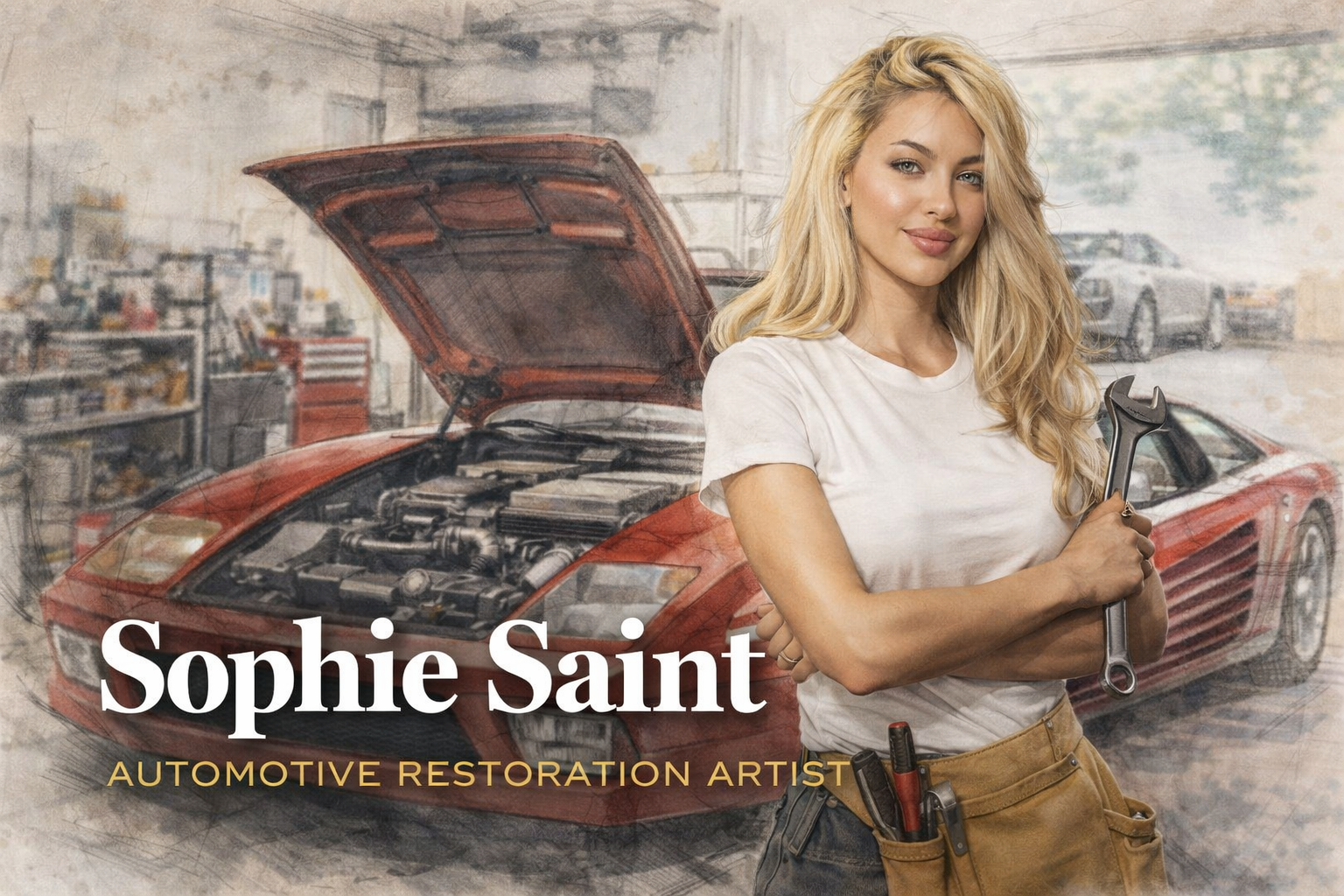
Where analog engineering, emotion, and artistry collide
There’s a certain kind of silence that lives inside a restoration garage.
Not the absence of sound, but the kind filled with intention. The quiet between decisions. The pause before something is taken apart, knowing it may not go back together the same way twice.
This is where you’ll find Sophie Saint.
Surrounded by fragments of the past, stripped panels, exposed frames, engines waiting to breathe again, she moves through the space with a kind of patience that feels almost out of place in today’s world. There is no rush here. No shortcuts. Just process.
Because for Sophie, cars were never just about driving.
They were always about understanding.

“I wasn’t drawn in just by the cars,” she says. “I was drawn to the era they came from.”
Long before restoration became her craft, it was the thinking behind the machines that caught her attention. The materials chosen. The engineering decisions. The intention behind every line and curve. To her, each vehicle represented a mindset, a moment in time when things were built differently, when expression and endurance mattered more than convenience.
And somewhere along the way, that fascination turned into something deeper.
Not a hobby. Not even a career.
A responsibility.
To preserve.
The Car That Wasn’t Just a Car
Every story has a turning point, though it rarely announces itself when it happens.
For Sophie, it came quietly, tucked inside a restoration garage in Los Angeles.
She had already been working with her hands long before that. In high school, she and her father transformed an old school bus into a fully functioning food truck, renting it out for events and weddings. It was creative, unconventional, and required problem-solving in real time.
But that wasn’t the moment.
This was different.
Inside that garage sat something unmistakable, the original 1959 Cadillac Ecto-1 from Ghostbusters. Not a replica. Not a tribute. The real thing.

And yet, what stayed with her wasn’t just the car.
It was what happened around it.
“People didn’t just look at it,” she recalls. “They felt something.”
Excitement. Nostalgia. Recognition.
That’s when it clicked.
These weren’t just machines. They were memory carriers. Cultural artifacts. Characters with presence.
And suddenly, restoration wasn’t about bringing cars back.
It was about bringing moments back.
Learning Structure Before Touching Steel
Sophie’s path into restoration didn’t follow the typical blueprint.
There was no formal automotive track, no rigid system guiding her step by step. Instead, her education unfolded through experience, through mentorship, and through a discipline that, at first glance, seems far removed from the garage.
Architecture.

Studying renovation and preservation changed the way she sees everything.
“It taught me to think in systems,” she explains. “To understand how components rely on each other.”
That perspective reshaped her approach entirely.
A car, in her eyes, is no different than a structure. It carries load. It distributes force. It depends on balance. Every piece exists for a reason, and when one element fails, it affects everything connected to it.
So when she restores a vehicle, she doesn’t just fix what’s broken.
She studies it.
Respects it.
Listens to what it was originally designed to be.
“I’m not trying to impose something new onto it,” she says. “I’m trying to understand what’s already there.”
Where the Story Reveals Itself
If there’s a moment where most people would hesitate, Sophie leans in.
The teardown.
To an outsider, it looks like destruction. Parts scattered, systems dismantled, the car reduced to something almost unrecognizable.
But to her, this is where the story begins.
“That’s when you really see what the last person did and why,” she says.
Every shortcut. Every workaround. Every decision made under pressure or limitation.
Sometimes it’s unconventional. A zip tie where a bolt should have been. A temporary fix that somehow lasted years. And instead of dismissing it, she studies it.
Because even those imperfect choices are part of the car’s history.
From there, the process becomes methodical. Parts are sourced through a mix of relentless searching and trusted relationships. Components are repaired, cleaned, or carefully replaced. And slowly, piece by piece, the vehicle begins to take shape again.
Not as something new.
But as something remembered.
When Not to Touch What’s Already Perfect
In a world obsessed with upgrades and modernization, Sophie operates with restraint.
Not every car should be improved.
Some should simply be protected.
She’s currently restoring a Ferrari F40, one of the last cars personally approved by Enzo Ferrari. A machine known for being raw, unforgiving, and entirely analog.
To soften it, to modernize it, would be to erase what makes it special.
“You don’t improve something like that,” she says. “You protect it.”
But not every vehicle carries that same weight. Some were built within limitations, shaped by cost or regulation rather than pure intention.
In those cases, she allows room for refinement.
Not to change the identity of the car, but to bring it closer to what it was always meant to be.
An Analog Mindset in a Digital Era
As the automotive world shifts toward automation and software, Sophie remains grounded in something far more tactile.
Analog experience.
“We’re physical beings,” she says. “We experience things through touch, sound, movement.”
There’s something undeniably human about machines you can hear, feel, and understand without a screen telling you what’s happening.
And while technology continues to evolve, she believes that connection won’t disappear.
If anything, it will become more valuable.
That belief extends into how she shares her work online. In a space driven by quick cuts and instant gratification, restoration doesn’t always translate.
It’s slow. Repetitive. Sometimes quiet.
And she refuses to turn it into something it’s not.
“I’m not interested in making it louder just for attention,” she says. “The integrity of the work matters more.”
Letting the Work Speak
The automotive industry has long been defined by a certain image, and Sophie is well aware that she doesn’t fit neatly into it.
But she doesn’t build her identity around that fact.
“I realized early on that my experience would be different,” she says. “Most of the time, people are just trying to understand what I’m doing there.”
Sometimes that curiosity turns into underestimation.
But instead of confronting it, she lets the results handle it.
“I don’t spend time trying to prove anything,” she says. “This is just what I love to do.”
And in doing so, she quietly challenges a much larger narrative.
“There are so many women in the trades,” she adds. “The industry just overlooks us.”
The Moment Everything Changes
After months of work, there’s one moment that stands above all others.
Not the final polish.
Not the first drive.
The first engine start.
The shop holds its breath.
“You take what was essentially a pile of metal,” she says, “and you turn the key.”
There’s hesitation. Uncertainty.
Then it happens.
A cough. A spark. A roar.

And suddenly, everything shifts.
“It feels almost forbidden,” she says. “Like you weren’t supposed to be able to do that.”
For a split second, the line between machine and life blurs.
“It’s no longer an object,” she adds. “It’s been revived.”
More Than Restoration
Sophie doesn’t describe herself as a mechanic.
Or even a historian.
She calls herself an artist.
Because what she does goes beyond function.
It’s about interpretation. Preservation. Emotion.
It’s about understanding that every car carries something invisible, something that can’t be replaced or replicated.
And when she hands the keys back to an owner, there’s only one thing she hopes they feel.
Not pride.
Not excitement.
Nostalgia.
Because in Sophie Saint’s world, restoration isn’t about moving forward.
It’s about bringing something back.