

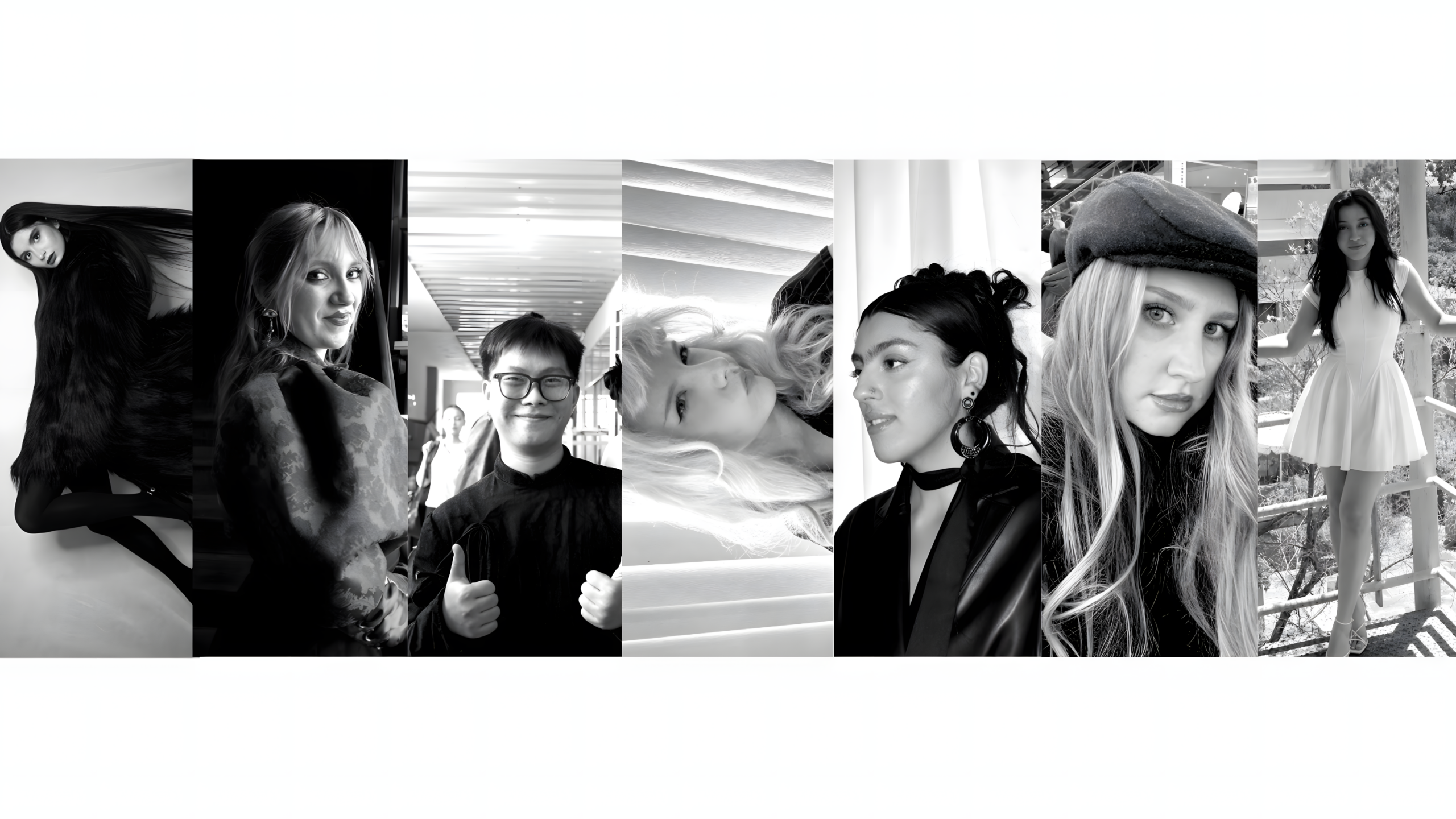
Whether rising onto the runway at the end of a show, or buried in the TikTok archive after algorithmic shifts and thousands of posts over the years..relegated to a locked vault where they don’t enter the people field of vision unless driven by a cause or a coincidence..their identities finally surface after being erased among the world’s contours. One of these discoveries revealed seven threads tied together by a shared philosophy, connected by at least one common gene: starting with Italy to casablanca.. There are roots everywhere, in every direction, yet the compass points to one destination: studying fashion.
Perhaps there is a common ground to discuss, something unique lingering in interpretation, or perhaps we shall begin with each thread to cast a stitch.
The Thread Number One

On November 12, 2004, designer Nguyễn Quốc Việt was born.
A purely creative mind, Việt’s journey led him to study fashion design at the University of Architecture in Ho Chi Minh City. Perhaps it was the city’s chaotic energy that triggered a sense of existential reflection. A realization that belief is the very foundation of an artist’s work. Belief is the first step a creator takes toward fulfilling what captures their soul and imagination.
Việt held a firm conviction that beauty must always come first. Believing that once people are captivated, they will begin to contemplate the finer details and the mind behind them. He spent his student years designing, planning, balancing projects, and working part-time jobs to cover his expenses. Was this his first hint that he was capable of achieving his ambitions? Not quite. The primary catalyst was far more direct. As he puts it:
“When I was in my second year, while working on a menswear street-style project, I discovered a strong interest in this aesthetic. Although the process was quite challenging at times. It helped me realize that I was capable of doing it. And I’ve been pursuing this direction ever since, all the way through to my graduation project.“
His design philosophy shines brightly in one of his standout collections, T-10 RUNG SAC. The collection seamlessly blends his penchant for avant-garde streetwear with utilitarian military influences, structured around a harmonious palette of earthy tones, silver accents, and sharp, aggressive silhouettes. His style naturally evolves into other design approaches across seasons, while effortlessly maintaining that same avant-garde signature.
You might be playing a favorite video game one day and suddenly be reminded of designers like Việt..creatives who subtly evoke the things you once loved, bringing them back to life through the lens of memory, even long after the game itself has faded into nostalgia.


The Second Thread

Lucy
Shall we begin with a letter to this pink-haired creative visionary? Lucy Rixon might just be that refreshing breeze that catches your eye among hundreds of videos..someone you admire like a rich, layered collage.
Lucy gifted herself this letter, placed here like a vintage vinyl record spinning memories and celebrating achievements a day before reliving the finer details of those memories themselves.
“A letter to my future self,
I hope you are reading this from your own studio, your latest collection finished and preparations for fashion week underway. Have you made it yet? Who have you collaborated with? Did it all work out?
I have so many questions. One thing I don’t need to ask is whether you are still trying. This past year changed everything for me, using my personal growth as fuel to pursue my craft on another level, whether it’s just natural progression or the aftermath of leaving a toxic relationship, I’ve become even more determined than I have ever been.
The pile of scrap fabric that I promise to use continues to grow by the week, the nights I spend working seeming to get longer. Within the chaos of my space, I often visualise where I will be in the future. I know that you, future me will continue to grow and achieve no matter the hardship and the thought of that is exactly what drives me to continue with focus.
What was the inspiration for your graduate project? It’s crazy to think that it’s likely inspired by something I haven’t even experienced yet.
and I imagine it was rather ambitious.
I often return to the reason I started this, I realise how far I have come in every sense.
hoping this letter allows you to do the same in this moment. I will continue to build my skills, my confidence and my creativity; leaving it in future me’s hands to stitch it all together.
Lucy ”
Now, what about the memory itself? A 21-year-old girl set to begin her studies this coming September at the London College of Fashion. Her creative journey started as a portrait artist exploring identity through painting, sketching, and printmaking during her fine arts studies. As her work evolved, she transitioned to a three-dimensional approach, ultimately leading her into fashion design.
Her core philosophy was embodied in two words: dystopian unease. This phrase encapsulates her design ethos, which centers on articulating deep emotions, lived experiences, and society’s growing, pervasive fear about its future. For Lucy, mentioning this phrase evokes a subtle, underlying suspicion…a sense of impending doom. She has always possessed a strong inclination and instinct for various creative fields, including television, cinema, photography, music, dance, and, of course, fashion..where all these disciplines ultimately converged on the horizon.
Lucy said:
“I began shifting towards creating fashion illustrations to imagine my ideas, though initially my work felt rather flat and my silhouettes almost always followed the body. It came to the point of realisation that I was viewing fashion all wrong: a way of making something pretty instead of a way of provoking emotion. This shift altered the course of my work and I started to push boundaries and step out of my comfort zone. “

Simultaneously, Lucy and many other visionaries recognized a distant gap…one entirely unrelated to skill sets or creative directions. What truly happens in that hidden chapter behind the curtain that so many fashion students share today? What is the thing that no one talks about or explains?
At 3:00 AM:
“When creating my final outcome for my foundation course, I became incredibly ill but had no choice but to push through towards the deadline. I embellished the dress in bed. Screen printed in the studio when I barely had the strength to walk and had to conduct the final photoshoot to a high standard. It was incredibly stressful and the volume of work I had to create in this state kept progressively adding to my weakness. The most unglamorous part of making a garment or studying fashion is that the deadlines do not wait, and with a bit of bad luck, like I had in this instance, makes it feel impossible to complete the physically and mentally taxing tasks that go into the making of a garment.”
Was that all there was to this gap? No. Competition, as Lucy described, was that singular piece that shatters everything bright about creativity and its physical environment. It felt as though the world had suddenly adopted a new mindset overnight: superiority. That was the keyword inside an industry claiming to be creative. Where the dynamics among those within it shifted until they resembled murky water. Charged with a strange, uncomfortable, and volatile tension.
So what about Lucy’s response to all this? One of her designs features a surreal look leaning toward a dark design philosophy. It seems like exploring themes of masks, dynamic structures, and a narrative DNA reminiscent of classic Japanese cinema. Expressing individuality, solitude, and sci-fi themes, as if portraying a figure surrounded by invisible surveillance cameras.

Perhaps this is precisely what she described as dark. Both as a personal style and as a core logic guiding her aesthetic. Perhaps this was what she described as dark in her logic and aesthetic.
Why Was the Needle Broken?
Salma
This chapter of our story begins in the realm of memory…in Casablanca, Morocco, where it all started for Salma Laabidate
It was during her transition from a fashion student to a full-fledged designer that Salma truly realized fashion was her mother tongue. To her, clothing is a sensory receiver. Emitting signals and broadcasting frequencies that resonate deeply with anyone tuned to the same wavelength. It creates an atmosphere and an emotion that words simply fail to capture. Almost as if the garment itself becomes an extension of the human senses. As Salma reflects:
“I realized fashion was my language when I understood that clothing has the power to communicate emotions that words sometimes cannot. A garment can carry memories, express vulnerability, strength, hope, or even silence.”
That realization completely reshaped her approach to design. Her perspective shifted toward storytelling, emotional expression, and building a shared value that creates a meaningful bridge with others.
At just 22 years old, Salma’s fascination with art and fashion began early in her upbringing. She has always been drawn to colors, textures, and the stories woven into garments. Driven by innate curiosity, she pursued fashion design at the Académie de Mode Casablanca, which refined both her technical mastery and creative vision.

There was a key turning point in her journey. A moment where Salma became captivated by fashion’s ability to blend elements that seem unrelated at first glance. But are subtly and powerfully connected beneath the surface. Speaking on this, she shares:
“Growing up, I was fascinated by how clothing could reflect culture, identity, and personality. I loved observing the details of traditional garments and the emotions people attached to what they wore. Over time, that fascination evolved into a genuine passion and eventually became my purpose. I knew I didn’t just want to wear beautiful clothes..I wanted to create pieces that make people feel seen, confident, and understood while telling stories that last beyond a single moment.”
When it comes to her core philosophy, it stems naturally from this idea: Salma designs for memory.
And that brings us to the question..what moves human emotion more than memory itself?
Salma’s aesthetic is deeply rooted in love, resilience, and the emotional weight of intimate letters exchanged between soldiers and those they love. This profound connection is best captured in her own belief that “hope can survive even in the darkest of moments.”


The second cornerstone of her philosophy is storytelling. After all, how can a designer convey such intimate, poetic messages to her audience without a narrative framework?
In her own words:
“Storytelling is at the heart of everything I create. Every silhouette and fabric is carefully chosen to serve the narrative behind the collection. I gravitate toward elegant yet intentional shapes that balance softness with strength, reflecting the emotional complexity of the stories I want to tell.
For me, fabric is more than a material..it is a language. Its texture, movement, and structure all contribute to the emotions a garment can evoke. I believe fashion should do more than dress the body; it should preserve memories, express identity, and create an emotional dialogue between the garment and the person wearing it. Each collection is an invitation to feel something before anything else.”
Today, Salma steps out of memory and into the present. Now based in Italy, she is passionately chasing her vision of becoming a global fashion designer. She continues to draw endless inspiration from art, architecture, literature, history, and the subtle beauty of everyday life reflected in the faces around her.
What follows is a collection that embodies Salma’s distinct design language. Offering a glimpse into her signature aesthetic, her philosophy, and the timeless emotion of those heartfelt love letters.
We ended up in Italy, but we forgot to change the needle

IRENE
Are we unintentionally channeling Gucci vibes here?
1960s Chicago… Irene was tracing her grandfather’s historical steps when she moved to the city. Right after completing her fashion design degree at the “Accademia di Belle Arti di Bari”, Puglia. And yes, you read that right..she graduated just a year ago.
Born and raised in a small town in Southern Italy, Irene Salatino’s story is only just beginning.
But who is Renell?
Perhaps the answer lies in a letter Irene once wrote to her future self:
Dear Irene,
or Renell as your grandparents used to call you tenderly. And sometimes less tenderly, in a
more upset tone because you just couldn’t stay still and behave.
You’ll find your path. All the hardship is just a temporary test, an exercise to keep you
patient, relentless and stubborn.
Trust me. It’ll be worth it. I’ll love what the future holds for you.
No more words needed, just passion and confidence.
And maybe a cornicello for good luck.
At 23 years old, Irene Salatino wasn’t always this bold. As a child, she was painfully shy, doing everything she could to avoid the spotlight. Speaking up terrified her, making it nearly impossible to reveal her true self to the world. A struggle made even harder by a persistent stutter.
Perhaps that is precisely why handcrafting became her sanctuary. Growing up in a creative environment, she was drawn to experimenting with clothes and jewelry from a young age. Falling in love with the sheer process of making things.
Fabrics, threads, and trims were the backdrop of her childhood. Her mother worked out of a small sewing station at home, crafting fine tablecloths and napkins for high-end hotels and restaurants. With babysitters out of the picture, that workspace became Irene’s personal playground. She would tinker with fabric scraps. Wielding heavy metal scissors to cut out pieces that, in her imagination, were her next great masterpieces.
It was her own quiet, peaceful sanctuary..a safe space where no one could judge her.
Over time, she realized there was a deeper reason behind her obsession with fashion.


“I realized that my shyness always stopped me from expressing my
authentic self.”
Irene reflects.
“My voice couldn’t show it but my clothes could, and they did. Fashion became
my voice. Fashion never stuttered.”
Her mother wasn’t her only influence, though. On the other side of her world was her grandfather, an antique dealer whose garage was a goldmine of chandelier ornaments and beaded furniture accents. Young Irene would pry these treasures off to use as embellishments for her “creations.”
It’s hard for her to pinpoint the exact moment she knew fashion was her calling, but one mentor pushed her forward: her professor, Loredana Filice. Filice instilled in her an unwavering faith in her craft, showing her the value of a slow, deliberate creative process long before a collection ever hits the runway.
Research as an Art Form
Did her environment single-handedly shape her? Not quite. What truly molded Irene wasn’t just where she was, but howshe learned to look at the world around her.
If one word could capture her design aesthetic, it would be research.
It might not sound glamorous or trendy, but to Irene, research is the heart of any collection. A piece can’t just look pretty; it needs depth, a story, and roots.
Her aesthetic is anchored in Southern Italian folklore…its culture, symbols, and rich history. To build something new that belongs to the future, she first needs to understand the past.
That’s why her story never starts with picking out fabric or drafting a cut. Long before choosing materials or silhouettes, Irene dives into research. She visits museums, digs through digitized archival newspapers, explores past fashion eras and historical moments, and compiles it all into mood boards and storyboards.
Concepts like comfort, rebellion, protection, and sustainability all weave their way into her work..but only if they are tightly bound to the narrative she is investigating.


What Happens Behind the Scenes
Then comes the side of fashion the public rarely sees.
For her final thesis project, Irene took a massive gamble: instead of simply tailoring a garment, she decided to make a pair of shoes entirely from scratch.
It wasn’t a random decision. The shoes were the core of her research..a symbol representing the complex story of Italian-American migration and its hardships.
She lacked proper tools and had almost no budget, but one belief kept her going: There is always a way to make it happen.
“No matter how much money or how many resources we have,“
Irene says,
“if we have passion and consistency, we can make
our vision a reality.“
Of course, the lack of resources made the process brutal.
She recalls spending endless hours carving away at what would become the shoe soles, using a cheap electric nail drill she bought off Amazon for about 10 euros. Her hands cracked, her fingertips bled, and her eyes strained through endless late-night hours as she hand-stitched intricate beadwork onto leather.


She worked day and night.
She pushed through not just out of love for fashion, but because she could clearly picture the end result in her mind…the thrill of breathing life into something that previously existed only as a spark in her head. That transition from an invisible idea to a tangible, touchable object is perhaps the most captivating part of her story.


The Unglamorous Side of the Craft
Ask Irene about the most exhausting, least glamorous part of making clothes, and she’ll tell you: time.
You don’t just design a garment and call it a day.
You spend endless hours hunting down fabrics that fit the cut, finding thread that matches the fabric, and sourcing hardware like grommets, buttons, and zippers.
Then comes the pattern-making.
You draft the initial pattern, test it, and almost certainly have to redraw it because the first draft is never perfect. Once the pattern is ready, you still can’t touch your final fabric..you can’t risk wasting yards of expensive material on a potential mistake.
So, you build a sample.
You pin the pattern to muslin, stitch it together, fit it, tweak it, and try again. You repeat the process over and over until the fit is flawless. It is painstaking, repetitive precision.
” We love every hour spent crafting, but we enjoy far less the countless hours we
sacrifice from our sleep to make it happen.”
That is the side that never shows up on the runway. The final piece might look effortless and serene, but behind it lie countless hours of trial and error, research, adjustments, and sleepless nights.
Beyond the Studio: The Business of Fashion
While research is her foundation, Irene believes another crucial aspect is heavily overlooked in fashion education: business, marketing, and data.
Students tend to hyper-focus on the purely creative side while ignoring the technical, less glamorous business realities. To her, fashion isn’t just art..it’s the intersection of art and commerce.
How is the fashion industry actually structured? What roles exist within it? How does a brand achieve long-term viability? How does trend forecasting drive revenue? What does modern marketing actually look like? And why does a designer need to know their way around an Excel spreadsheet to survive?
These are the questions Irene believes fashion students should be pressing their professors to answer.
Because a design doesn’t begin at the sewing machine.
It starts much earlier..in a museum archive, a yellowed newspaper, a piece of beaded furniture in a grandfather’s garage, fabric scraps in a mother’s workshop, or in the heart of a shy little girl who found in clothing a way to speak to the world when words fell short.
And that is precisely why Irene’s story is so compelling.
Not because she has arrived.
But because she is still on her way.
The Third Thread After Forgotten needle

Anusuya
Anusuya Mohan Kubba is a 20-year-old fashion student at IFA Paris. Whose personal evolution was forged in a world of chessboard tiles, paint palettes, poker tables, DJ decks, and an ever-expanding drop-down list of eclectic passions. Rooted in her Indian heritage. She is a soul driven entirely by the thrill of exploration, steadfastly refusing to be boxed into a single lane.
Her pursuit of standing out began early. Anusuya fell in love with fashion when she was just two years old, back when her grandmother would wrap her in shawls to transform her into a saree-clad woman, helping her pick out just the right shade of lipstick.
A pivotal visit to the iconic Sabyasachi flagship store in Mumbai cemented her calling. Anusuya described the boutique as even more magical than Barbie’s Dreamhouse. A place where she encountered pieces she had previously only seen on television, in magazines, or in her dreams.
From a young child piecing together fabric scraps to dress her Barbie dolls and waging wars over the TV remote just to catch runway shows on FTV. Anusuya’s journey has taken her from interning under French designer Anne-Marie to founding three of her own brands.
For Anusuya, family remains the single most profound influence on a person. Her mother studied fashion design, and both of her grandmothers were skilled seamstresses who could sew, knit, and craft almost anything. Yet, Anusuya sees their impact through a nuanced lens:
“had pursued fashion designing, and my grandmothers could stitch and knit almost anything. While it may seem as if they were the driving force behind fashion as my passion choice, it wasn’t until much later that I discovered their hidden talents. Their craftsmanship influenced my appreciation for garments.”
She continues:
“they taught me to step from ballerinas into heels, transitioning from girlhood to womanhood, embracing a bold femininity that transcended mere beauty and chores.”
Raised in a culturally rich environment, Anusuya picked up a multitude of disciplines, seamlessly moving between classical dance, the culinary arts, and block printing. She became adept at many things, though none quite captured her heart the way fashion did.
It was the intricate details that mesmerized her most: the meticulous hand-embroidery on her mother’s Pashmina shawl, or the precise way her mother draped a saree that Anusuya herself wasn’t yet allowed to wear.
She always envisioned herself as an actress, a model, or a designer. What began as a fascination with fabrics and tailoring swiftly evolved into an ambition to craft her own garments. When she took the leap of faith..handling everything from initial concept to modeling for her own brand..she knew she wanted this to be her daily reality: to grow, evolve, and prove that the sky is the limit.
Anusuya has always wanted to leave her mark on the world.
She views herself as a bouquet of diverse flowers. A blend of heritage, rebellion, nostalgia, and a relentless curiosity about what lies on the other side.
Her identity cannot be distilled into a single word, nor constrained within any single modern fashion trend. She is a tapestry of complexities, constantly evolving.
As she puts it:
“In Punjabi, we say, ‘Sone nu sab kuch sona lagda,’ which translates to the idea that beauty is in the eye of the beholder. There is so much I love in this world that it’s impossible to capture it all in one word. For me, fashion was never about chasing trends; it has always been a medium to voice my perspective, tell my story, and stand up for what I believe in.”
What began as an obsession with textiles and sewing naturally matured into designing, producing, and modeling her own brand’s collections. To her, fashion is not merely an end product..it is an experiential space where she tests who she is, what she can create, and how far her ambitions can stretch.
Behind the Label: Label Anusuya and the Genesis of Roar
Some might wonder: what about her brand?

Anusuya launched Label Anusuya when she was just sixteen. The label, as she describes it, was akin to her child. Four years later, her core philosophy remains unchanged: to create fashion that evokes a genuine transformation in others.
Before diving further behind the scenes, Anusuya introduces her debut collection.
Titled “Roar,” the collection was designed to empower.
“I wanted women to tap into their innate strength, and nothing felt more fitting than a feline spirit to embody that fierce, unapologetic femininity inside every woman. From sharp, structured tailoring to tactile fabrics, these choices make my pieces a statement of empowerment and individuality.”
The collection was more than just garments; it was an attempt to turn femininity into something formidable, present, and unapologetic.
This brings us to a quote that sits at the core of her relationship with fashion:
“If you want to be original, prepare to be copied.”
Translated from Coco Chanel’s famous line..“Si tu veux être l’original, prépare-toi à être copié”..Anusuya finds it ironic to quote Chanel, yet sees the value in returning to the roots of her obsession: those early days long before the label, the name, and the professional identity.
Expressing her desire to redefine Indian artisan luxury, she reflects:
“My motto was ‘Redefining Indian Handcrafted Luxury,’ born out of deep conviction. This was back in 2022, well before mainstream fashion began giving due credit to artisans; I wanted to challenge the marginalization of Indian craft. I believe honoring the craft should take precedence over the brand name itself..after all, without the artisans, the brand wouldn’t exist.”
For Anusuya, luxury is not just a name on a woven label; it is the hands that crafted it, the heritage passed down, and a discipline deserving of recognition.
Lessons from the Atelier: The Faux Fur Coat
Her journey was not without its trials, best illustrated by a faux fur coat..one of her earliest designs..and what it revealed to her about her own process.
She struggled immensely while shaping it:
“I was working on one of my very first pieces..a faux fur coat. My room was covered in mountains of shed fibers. Marking lines on a fabric densely covered in long fur was a battle in itself. Every cut released loose fibers into the air, coating every surface and making clean markings nearly impossible.”
It was perhaps this project that taught her that design is rarely a straight path.
Threads snapped or tangled, the machine jammed, and the needle caught the long fur, pulling it into the seams and leaving uneven edges instead of a clean finish.
The culprit became obvious: her domestic sewing machine simply wasn’t built for a fabric of such density and weight.
She had to transition to an industrial machine.
It wasn’t easy; she lacked experience with the heavy-duty machinery required for the job. But she faced a choice: give up on the coat, or slow down and master the machine instead of fighting it.
She chose the latter.
Anusuya meticulously studied the thread tension, tested small scraps before touching the main yardage, and took everything step by step—at a turtle’s pace.
Out of that frustration emerged one of her clearest insights:
“Never attach yourself rigidly to your initial expectations in fashion. The moment you let go of how you think a piece should look, you make space for it to become even better than what you originally envisioned. Commit to the process, and the result will take care of itself. You stumble, you learn; your mistakes aren’t a curse, but a blessing in disguise.”
The coat was more than a complex garment; it was a masterclass in navigating unexpected challenges.
Anusuya notes that the unglamorous side of fashion lies in the details no one sees:
“Before a garment reaches its final form, it undergoes endless iterations and tweaks. Think of it like going through puberty, aesthetic shifts, and self-discovery..but for something you have to bring to life from a flat sheet of paper.”
A quarter-inch adjustment to an armhole curve can completely throw off the shoulder seam. Fixing one minor issue might mean ripping out four rows of stitching, re-drafting the flat pattern on paper, and cutting entirely new panels.
Fashion demands technical precision. Fabric isn’t just a flat material; it has grainlines, textures, and unpredictable behaviors.
If you cut a garment on the bias, it might look stunning at first..only to stretch out by two inches on one side overnight. You have to leave it hanging on the mannequin for 24 hours before touching the hem, just to account for the distortion.
Indeed, patience is a virtue.
The world only sees the tip of the iceberg when a finished gown hits the runway; they rarely see the arduous labor hidden beneath the surface.
Navigating Fashion School: Reality vs. Expectation
Anusuya is someone who discovers herself by observing the world around her…through the eyes of a creator. Her persona changes with the seasons, refusing to be defined by a single sentence or label. She reflects complexities and emotional shifts that may not yet be obvious to everyone, some of which may forever remain behind the scenes.
Studying fashion at an academic level, however, was an entirely different story.
It is a journey every student understands, yet few can adequately put into words..a delicate balance of competition, perseverance, the slow passage of time, and immense patience.
Anusuya notes:
“Being a student means you are there to learn, not to have already mastered the craft. Yet, in a cutthroat, competitive industry like fashion, we are often expected to perform at professional standards before we are even given the grace to fail.”
For her, fashion education requires a balance between theory and execution. You cannot simply read a book to learn how to construct a flawless garment; it demands hands-on experience, trial, error, and time.
She adds:
“Labeling extreme pressure, high expectations, and harsh grading systems as ‘industry standards’ feels unfair, especially when you are a student without extensive field experience. While these high demands reflect the stressful, competitive nature of the fashion world, expecting someone who is still learning to seamlessly match commercial standards is unreasonable.”
Fortunately, Anusuya’s prior industry experience helped her navigate the friction between academic expectations and real-world creativity.
Still, she had to meet grueling deadlines, work alongside highly talented peers, and be evaluated on something deeply personal: her creativity.
Perhaps that was the hardest part..being asked a question with no single right answer, and being graded on pure artistic expression.
Above all, she had to accept that there will always be someone more skilled.

“You have to accept that you can never be ‘the absolute best’; there will always be someone out there who is better than you.”
Yet, this reality never deterred her. If anything, it fueled her.
To her, taking the leap remains worth every struggle, because nothing compares to the feeling of seeing someone wear a garment that began as a mere sketch in a notebook.
A simple line that turned into a design, then into fabric, and finally into a tangible piece that another human being can touch and wear out in the world.
Anusuya reflects:
“If you can survive fashion school, you can survive anything life throws your way. You learn how to separate constructive technical feedback from subjective opinions while keeping your core artistic vision intact. You discover parts of yourself, unlock your creativity, and start dreaming bigger..believing the sky is the only limit, while truly enjoying what you love. Doing what you love and loving what you do is a genuine privilege.”
Ultimately, studying fashion isn’t just about learning how to make clothes.
It is a lesson in how to construct yourself.
It is learning how to fall and try again. How to look at a garment that didn’t turn out as planned and allow it to become something else entirely. How to realize that critique isn’t rejection, and that failure isn’t the end of the road.
And how a tiny line in a sketchbook can one day become something the entire world gets to see.
A Letter to Her Future Self
Anusuya concluded her narrative with a letter to her future self..a note she hopes to return to one day, to remember the young girl who started it all.
Dear Anusuya,
By the time you read this, I hope you’ve stopped counting the years of “being iconic” and started living them instead. I hope you have achieved everything you have wanted to and most importantly, are happy in life and with life.
I hope you remember where this started – Sabyasachi’s store in Mumbai, draping dadi’s stole around yourself, Barbie doll clothes stitched from scraps, calling dibs on the outfits you saw on FTV, and raiding mom’s closet.
I hope you never let anything or anyone make you forget that your love for this craft began as play and not performance.
Most of all, I hope you’re still saying it, out loud, to anyone who’ll listen: that you really wanna make a change in this world. I hope fashion was just where you started and that by now, it’s carried you somewhere much bigger.
Stitch Number Two

Oleksandra (Sasha)
Dear Sasha,
Right now, I don’t know where I’ll be living in a year. I don’t know which projects will succeed,
which people will stay, or whether any of my plans will work out.
But I do know something else.
I know why I started.
If you’ve become successful, I hope it wasn’t because you became easier to understand.
( I hope you never traded curiosity for comfort or your own voice for approval.
I hope you’ve found confidence within yourself instead of searching for it in the people or
things around you.
and I hope opportunities keep finding you at every step, and that you never stop exploring them
and yourself through them.
I hope you still choose ideas that scare you a little. hope you still create things that make people stop, look twice, and feel something they can’t
immediately explain.
No matter what you’re doing, I hope you’ve found a way to fulfill yourself, to express your
creativity and your feelings, and to help other people feel something and discover something
about themselves.
Don’t become too comfortable.
Keep questioning everything.
Protect your curiosity.
Don’t make things because they’ll sell..make them because they need to exist.
and Don’t confuse recognition with meaning.
Don’t become afraid of changing your mind.
Remember that your best work has always come from uncertainty.
Keep becoming.
Love,
Yourself
Tuesday, July 28th.
Reflections and Letters…
Imagine reading through pages of Judy Abbott’s letters in Daddy-Long-Legs, but this time featured in Davinci Magazine, written in the voice of Sasha…Oleksandra Radchenko..a 24-year-old creative.
Oleksandra, or Sasha, is currently in her third year of the Bachelor’s program at Accademia Italiana in Rome, set to graduate in September 2026 Originally from Donetsk, Ukraine, her journey has been shaped by changes and facing differences…
She shares:
“I’m originally from Donetsk, Ukraine, and my journey has been shaped by change,
adaptation, and the constant search for identity. Growing up, I learned that who we are is
never fixed, we are continuously becoming, influenced by the places we leave, the people
we meet, and the experiences that transform us.”
Her words felt as though every experience in her life leaves a new mark, a memory…like visiting a country, leaving a piece of yourself behind, and moving on to the next place. Perhaps that’s precisely why identity, to Oleksandra, isn’t something static; it’s something formed with every location, every person, and every experience.
She continues:
“That idea has become the foundation of
both my personal life and my creative practice.”
Beyond the garments themselves, Oleksandra’s gaze naturally turns to what happens before a piece even comes into existence: the concept, the imagery, and the way a brand can evoke a specific feeling in whoever sees it.
She found herself drawn to branding and creative direction, intrigued by the question driving it all: Why do certain ideas resonate deeply with people, while others pass by unnoticed?
She loves exploring how visual language shapes identity…not just through clothing, but through storytelling, art, music, and culture.
Oleksandra continues her story:
“Before studying fashion, I worked across different creative fields, including events,
marketing, and creative production. Those experiences taught me that fashion is never just
about garments.It’s about creating emotion, building narratives, and giving people a way to
express parts of themselves that words often cannot.
Today, I see fashion as the intersection of design, psychology, and storytelling.Every
collection begins with a question rather than an aesthetic. I’m less interested in following
trends than in creating pieces that make people feel something, and, perhaps, recognize a
version of themselves they hadn’t seen before.”
And when did you realize that fashion wasn’t just clothing, but your most honest language for expressing yourself to the world?
Perhaps that was the very question that led her to the core of her relationship with fashion.

She reflects:
“I think I’ve always felt that I could fit into different environments and adapt to different
expectations, but I never truly felt that I completely belonged anywhere.That pushed me into
a deeper exploration of identity: how society shapes us, how people discover who they are,
and whether it’s actually possible to find your authentic self.That search eventually led me through art to fashion, and fashion has always been the
answer.
To me, fashion is one of the most powerful tools for self-discovery. It’s a way to understand
yourself, communicate with the outside world, and express emotions that words often fail to
explain.Looking back, I realized that since childhood I was constantly reshaping or
redefining my identity depending on where I was, who surrounded me, or what I wanted to
communicate.The more I leaned into that process, the more I understood that fashion is
never just beautiful clothing.It creates feelings, memories, confidence, and emotion – and
those invisible layers are far more important than the garment itself.”
Isn’t that a long journey of searching?
Perhaps Sasha, long before becoming a designer, was simply trying to figure out who she was.
Becoming

Then comes the question that seems to sum up her entire design universe:
If your design ethos could be distilled into a single word, a feeling, or a state of mind, what would it be?
“Becoming.”
“My design aesthetic revolves around evolution. It’s about building unexpected forms and
challenging conventional ways of seeing garments.I’m not trying to capture attention through
loud colours or something immediately obvious.I’d rather invite people to slow down,
discover what feels different, notice the construction, and reflect on the emotions the
garment evokes.More than anything, I want people to feel confident in what they wear.
I want clothing to
become a tool that allows someone to step into the version of themselves they want to be
that day – to communicate a feeling, a mindset, or a message without saying a word.”
Yet “becoming” for Sasha isn’t merely a label for clothing forms.
It’s how she views human nature itself: a person who never stops evolving.
Bringing the Vision to Life
Sasha went through one of her most exhausting moments while developing her graduation collection, State of Becoming—specifically while working on the jacket.
She recalls:
“I had one of those moments while creating my graduate collection, State of Becoming,
especially when working on the jacket.
Because the collection relied on experimental construction techniques, the pattern-making
process took much longer than I expected. Ironically, I thought the corset would be thebiggest challenge. I wanted to create a structured silhouette without traditional boning, so I
spent weeks experimenting until I found a solution that worked.
Instead, the real challenge became the jacket. I redrafted the pattern around six times.Every
version brought me closer, but none of them felt right. The final pattern was finished just one
day before the last fitting, leaving me only twenty-four hours to sew the entire deconstructed
jacket.
It was exhausting, but completely worth it. What kept me going wasn’t discipline alone, it
was the inability to accept that this idea would exist only in my sketchbook. I needed to see it
become real.”
What the Audience Doesn’t See
What is the most draining, unglamorous aspect of garment making that the public knows nothing about?
People rarely see the long hours separating a designer from the initial vision they fell in love with.
For Sasha, the hardest phase is spending so much time with a single idea that you begin to lose sight of what made it special in the first place.
She explains:
“The hardest part is spending so much time with one idea that you eventually become tired of
it. You stop seeing what made you fall in love with it in the first place.Everything starts to
look wrong. Every detail feels like it should be changed.
Yet you have to keep working.You have to stay calm until you finally reach the finish line,
step away from the garment for a while, clear your mind, and come back with fresh eyes.
Only then do you realise what you’ve actually created.
It’s almost like every project goes through the same emotional cycle: you love it, you hate it,
and then somehow you fall in love with it again.
One of the hardest lessons I’ve learned is knowing when to stop evolving an idea.If you
keep redesigning a garment every single day, it will never be finished, and eventually it won’t
even resemble the original thought that inspired it. Sometimes it’s better to preserve that
creative energy for the next idea instead of endlessly trying to perfect the current one.”
What Nobody Tells You About Studying Fashion
Perhaps the most grueling part of studying fashion is that it doesn’t just teach you how to make clothes…it forces you to reexamine everything you thought you knew about yourself.
She notes:
“All of your beliefs and your creative vision will be torn apart before you have the chance to
rebuild them.You’ll go through a complete shift in your perception of reality, your values, and
your beliefs. The most important part is that, in the end, you’ll come back to your originalvalues. Not because someone told you they’re right, but because you’ve questioned them
enough to know they truly belong to you.
I think the whole fashion education system is, in many ways, designed to fit you into a box,
even though at every step you’re told that your creativity and individuality are valued.
Fashion schools also create a very competitive environment among classmates, so at some
point it becomes less about your own growth and more about competing with each other.
Ideas begin to overlap, everyone is fighting for recognition, and before you realise it, you’re
no longer asking yourself, “What do I really want to say?” but instead, “Is this enough? Is this
better than everyone else’s?”
Maybe that’s a valuable experience for people who want to continue working in the industry,
but I don’t think it was for me in the way it was intended.In my opinion, the biggest lesson
you should take from it is that the only person you have to challenge and compete with is
yourself.You shouldn’t spend your energy trying to fit into someone else’s vision of what
good design is. Instead, you should put that energy into discovering and developing what is
right for you.”
Tracing Back to Childhood… The First Spark
Before fashion became a career path, it existed in Sasha’s life as play, imagination, and a way to build worlds.
She shares:
“Looking back, I think fashion had been speaking to me long before I ever considered it as a
career.
Even as a child, getting dressed was never just about choosing clothes.Every outfit had to
tell a story, and I loved creating characters through what I wore. I also loved drawing clothes,
although I never imagined fashion could become my profession.
The turning point came when I watched Lady Gaga’s Alejandro music video for the first time.
I still remember that feeling vividly.Of course, I didn’t understand the deeper meaning behind
the video or the song, but that didn’t matter. It made me feel something completely new.It
wasn’t just the clothes that fascinated me, it was the feeling they created and the world they
invited me into.
Lady Gaga was the first person who showed me that fashion could communicate emotions,
identity, and ideas just as powerfully as words.My friends and I started filming our own
music videos, creating costumes, building improvised sets, and inventing our own
characters.Looking back, I think we were unknowingly exploring creative direction.
As I grew older, I explored different creative roles, but I always came back to fashion.The
biggest challenge wasn’t choosing this path, it was believing I was enough for it.I’m grateful
I didn’t wait until I felt like the “perfect” version of myself before starting. Instead, I allowed
myself to grow into the designer I’m still becoming.”
Beautiful Armor
For Sasha, clothing is inextricably linked to the idea of protection.
She says:
“I choose fabrics that serve the story I want to tell.
I’m drawn to textiles that feel subtle yet
strong, soft yet structured, materials that create a sense of protection while remaining
comfortable.
In many ways, I see my garments as a kind of beautiful armour. They don’t hide vulnerabilitythey protect it. They strengthen confidence without sacrificing comfort.
For me, combining
comfort and confidence is one of the most powerful forms of protection clothing can offer.”
And so, Sasha’s garments are less about hiding the person within and more about offering a safer space for them to emerge.
Perhaps that is precisely why the word “Becoming” feels like much more than a collection title; it is how Sasha chooses to see herself and the world around her…not as something finished, but as something continuously taking shape.
End of Friday, July 31st.
The ending of Oleksandra’s Journal

What date did the message arrive?
August 2, 2026
Aliyah Primich
A senior at Drexel University, Aliyah is majoring in Fashion Design with a minor in Fashion Merchandising, on track to graduate in the spring of 2027.
Introduced through her background, Aliyah notes:
“Though I grew up with an extensive background in the performing arts before studying fashion design, my passion for fashion developed at a young age when I discovered thrifting and upcycling and decided it was time to learn how to sew.“
Since then, the designer has been crafting a universe of her own..a whimsical, detail-rich world blending historical fashion, folklore, fairytales, theater, and classic rock. Her work draws inspiration from iconic performance looks worn by artists like Lady Gaga, Freddie Mercury, Chappell Roan, and Doechii.


Her creative focus extends beyond standard garment design; she is equally drawn to costume and character design behind the scenes..whether for theater, drag performances, television, film, dance, music videos, or live entertainment.
Even her hands-on craft feels like a natural extension of this vision: she thrives on sewing, crocheting, knitting, embroidering, beading, and sequining..the intricate touches that grant every garment a life of its own.
Yet beneath these technical layers lies a fundamental question:
When does clothing become more than just clothing?
For Aliyah, that shift happened when she realized the necessity of feeling undeniably like herself…feeling like Aliyah.
She believes that everything she wears..from pajamas and workout gear to loungewear..must resonate with her identity. As her fashion journey evolved over the years, she found herself closer to her true self and aesthetic than ever before.
Everything she creates, the way she thinks, and how she navigates the world have become extensions of that identity.
While conducting a fashion research project examining clothing’s impact on psychological well-being, she encountered the concept of Self-Concept Consistency…the human need to align our external presentation with our internal sense of self.
And who understands the self better than the individual lived within it?
Perhaps that is precisely why fashion has become one of Aliyah’s primary mediums for self-expression.
As for her design identity, she sums it up in a single word: Whimsical.
An imaginative, enchanting, playful, and unconventional world.
But what was the turning story ?
Aliyah said :
“When I was 13, I looked in my closet one day and realized that something didn’t feel right. Everything I owned was pretty much the same cut in about 4 colors, a truly ghastly thing given how strongly I feel about colors and shape now. This realization pretty much set me on the track I’m on today, something I only just put together.”
“Motivated to make my outside better match how I was beginning to feel inside, I decided to dip my toe into the world of thrifting, and I IMMEDIATELY fell in love. I became obsessed with the unique pieces I would find, and began to gain an understanding of the quality of construction and materiality through collecting vintage pieces. Not long after, I started buying pieces at the thrift store that caught my eye, ripping them apart, and turning them into something completely new. Once I got hooked on that, there was really no stopping me. Even today one of my favorite things to do is thrift flip and upcycle. Something about it is truly so fun for me, and brings so much joy to my life.”
What was her famous sentence ?


“I create because I want to feel the magic!”
Having spent most of her life in the performing arts before entering fashion and sewing, Aliyah finds that her stage background deeply shapes her approach to design.
To her, the concept never ends with the garment itself. Every element works in unison: the piece, the styling, the setting, and even the essence of the model. Each component helps build the performance, sculpting the world her creations are meant to inhabit.
She also firmly believes in the power of choosing joy and celebrating life…seeing joy not just as a feeling, but as a catalyst for change, and even a form of resistance.
She chooses joy.

Behind the Scenes
What happens when the runway lights fade, leaving nothing behind but a sewing machine, a piece of fabric, and a looming deadline?
Addressing this unglamorous side of the craft, she explains:
“I think the public typically doesn’t know or truly understand the physical time it takes to make a garment. Whenever people ask about the hardest part of the work I do for my classes, I tell them that it’s the fact that there’s simply no way to cheat time.”
Hours spent in a chair, racing the clock from one stitch to the next.
A 3:00 AM studio session, as Aliyah describes it, means sitting before a sewing machine for an unreasonable number of consecutive hours..clad in pajamas, eyes heavy, body exhausted, headphones on..pushing through mental and physical fatigue to finish what remains.
This often follows a full day of lectures, repeating for multiple nights in a row, or at least throughout the week leading up to finals.
She adds, with a touch of irony, that during her most recent finals week, people constantly commented on how visibly exhausted she looked.
Yet, 3:00 AM isn’t defined solely by fatigue.
It’s also friends playing a runway show or a movie on screen while working. It’s a classmate gathering anyone interested for a quick 7-Eleven run to grab snacks and take a breath, or a fellow designer stopping by a peer’s machine to ask for feedback.
And sometimes, when there is no pressing deadline or race against the clock, 3:00 AM in the studio can be unexpectedly quiet and serene.
Behind every piece that makes it to the runway lie invisible hours no one ever sees.
Things Were Hiding
Set to graduate from Drexel University in the spring of 2027, Aliyah’s academic journey revealed another side of fashion education..one that isn’t discussed enough.
“No one is talking about the importance of taking care of yourself while studying fashion. I’ve found it’s so easy to let your work take the focus and to let your wellbeing just take a backseat to it all. It often even feels like that’s the energy that has been cultivated and perpetuated throughout both schools and the industry.”
Aliyah grew up seeing the trope of the artist sacrificing everything for fashion in movies, interviews, and articles.
However, witnessing the impact of that mindset..and living through it yourself..is a completely different reality.
She reflects that her deep passion and dedication to her craft pushed her down that same path, until she eventually realized how unsustainable it was, recognizing the physical and mental toll it took once she finally paused to take a break.
Over the past year, she began working toward a healthier balance…one that allows her to pour everything into her work without losing herself in the process.
For her, it starts with foundational habits: starting projects as early as possible, sleeping when fatigue sets in, prioritizing rest, tackling hard tasks early, reserving daily time to unwind, spending time with friends, and ensuring her body and mind get the nourishment they need.
If fashion taught her how to express herself, it also taught her that self-expression shouldn’t come at the expense of the self.
“Though it’s often been portrayed that success in fashion looks like sacrificing yourself, I think it’s important that we talk about the negative impact that mindset and lifestyle has, and to both talk about and show that sacrificing your well-being isn’t needed to navigate fashion and be successful.”
A Fitting Finale
Perhaps Aliyah’s designs cannot be defined by a single piece, a single fabric, or even a single style.
They exist within the diversity of her stories, the depth of her ideas, her versatile skillset, and the many angles through which she views both design and life.
Her aesthetic is rich in detail, where distinct influences converge: a touch of Baroque, a sense of fantasy, a theatrical flair, and a bold rock-and-roll edge..all reassembled through her unique lens.
Imagine her designing a fragrance campaign, an evening gown, a custom stage costume, or a concept unlike anything seen before.

Perhaps that is where Aliyah truly resides.
In her ability to take disparate elements and unite them within a world entirely her own…a world the eye cannot capture in a single image, nor the hand compress into a single stitch.
And perhaps, in the end, every stitch she sews is simply another attempt to make the outer world reflect the one within her.
The final stitch… yet far from the end.