

A garment can be more than an object. Over time, it becomes a memory of movement: the weight of wool across the shoulders, the shape of a collar in winter light, the quiet confidence produced by clothing that understands the body. With Le Parfum, Max Mara attempts to translate that experience from fabric into air.
Launching globally on August 24, 2026, the fragrance marks the first release under the Italian fashion house’s long-term worldwide licensing agreement with Shiseido. Florence Pugh fronts the campaign, photographed by Mario Sorrenti, while the composition itself turns Max Mara’s most recognizable visual codes: camel, structure, warmth and restraint: into an olfactory language.
The result is not simply a fashion label entering beauty. It is a study in how luxury houses build new habitats around their identity.
The Radiance of a New Chapter
Max Mara has long been associated with a particular kind of Italian elegance: precise but not austere, luxurious without theatrical excess. Its world is composed of camel coats, disciplined tailoring, tactile fabrics and silhouettes designed to endure beyond a single season.
That visual vocabulary gives the brand an unusually clear foundation for fragrance. The house does not need to invent an entirely new fantasy. It already possesses one.
Le Parfum is developed with Shiseido as a sensual, enveloping woody-floral eau de parfum. Its central concept is an “olfactive coat”: an invisible layer that surrounds the wearer in the same way that a carefully constructed outerwear piece creates protection, presence and shape.
The metaphor is direct, but its implications are sophisticated. A coat is both practical and symbolic. It shelters the body, yet it also announces how the wearer wishes to enter the world. Fragrance operates in much the same way. It cannot be seen, but it alters the atmosphere around a person. It becomes a private ritual with a public consequence.
For a house rooted in outerwear, Le Parfum is therefore a logical extension rather than a departure.
Tuberose, Vanilla and the Architecture of Warmth
The fragrance was created by perfumers Marie Salamagne and Fabrice Pellegrin, who built its structure around a focused group of materials: tuberose, vanilla, sandalwood, cedarwood, Australian sandalwood essence and benzoin extract.
At its opening, the composition brings together two expressions of tuberose. Fresh tuberose flower from Grasse introduces a luminous floral quality, while tuberose absolute from Guatemala gives the note greater creaminess and depth. This duality is important. Rather than treating white florals as merely delicate or decorative, Le Parfum gives tuberose both radiance and density.
Vanilla forms the heart, adding a rounded warmth that softens the floral volume without making the composition weightless. In the base, sandalwood and cedarwood provide a firmer organizing principle. Their presence suggests polished wood, dry tailoring and the interior architecture of a well-appointed room.
The effect is intended to be enveloping, but not shapeless. This is warmth with structure.
That balance reflects the Max Mara wardrobe. Its most enduring pieces often depend on proportion: a generous coat controlled by an exact shoulder, a soft textile sharpened by a clean seam, a fluid silhouette held in equilibrium by disciplined construction. Le Parfum follows a similar logic through the contrast between the lushness of tuberose and vanilla and the more grounded presence of woods.
The fragrance is also described as vegan and made with approximately 90 percent ingredients of natural origin. Its refillable design places the product within the continuing conversation around more considered luxury, where desirability must increasingly coexist with questions of longevity, material use and responsibility. These claims belong to the product’s official positioning; their lasting significance will depend on how the refill system performs in real consumer use.
A Bottle With Its Own Silhouette
The flacon makes the translation from fashion to beauty almost tactile. A camel-colored band wraps around the glass body, recalling the belt of a coat. Stitching details give the band the appearance of leather, while the gold-toned cap evokes the polished hardware and button details that often complete a tailored garment.
It is an example of visual semiotics working efficiently. The bottle does not need a complicated ornament or an oversized emblem to communicate its origin. Its shape and materials do the work.
In luxury packaging, this kind of recognition is valuable. The object must function as a vessel, but it must also become part of the home: something placed on a dressing table, carried in a travel case or encountered in a moment of preparation. Le Parfum’s design turns the bottle into a miniature piece of Max Mara’s visual universe.
The refillable format strengthens that idea. A fragrance bottle designed to remain in use has the potential to become less disposable and more personal, accumulating meaning through repetition. Like a favorite coat, it can become part of a ritual.
Florence Pugh and the Modern Max Mara Woman
Florence Pugh gives the launch its human center. In Sorrenti’s campaign imagery, she appears wrapped in camel outerwear against a minimal interior, with the atmosphere kept intimate rather than spectacular. The visual emphasis falls on expression, posture and texture.
That restraint is significant. Pugh is not presented as a distant fantasy figure separated from the product. She embodies the relationship between clothing, scent and self-possession. Her presence suggests a woman who wears luxury not as armor, but as a means of feeling grounded within herself.
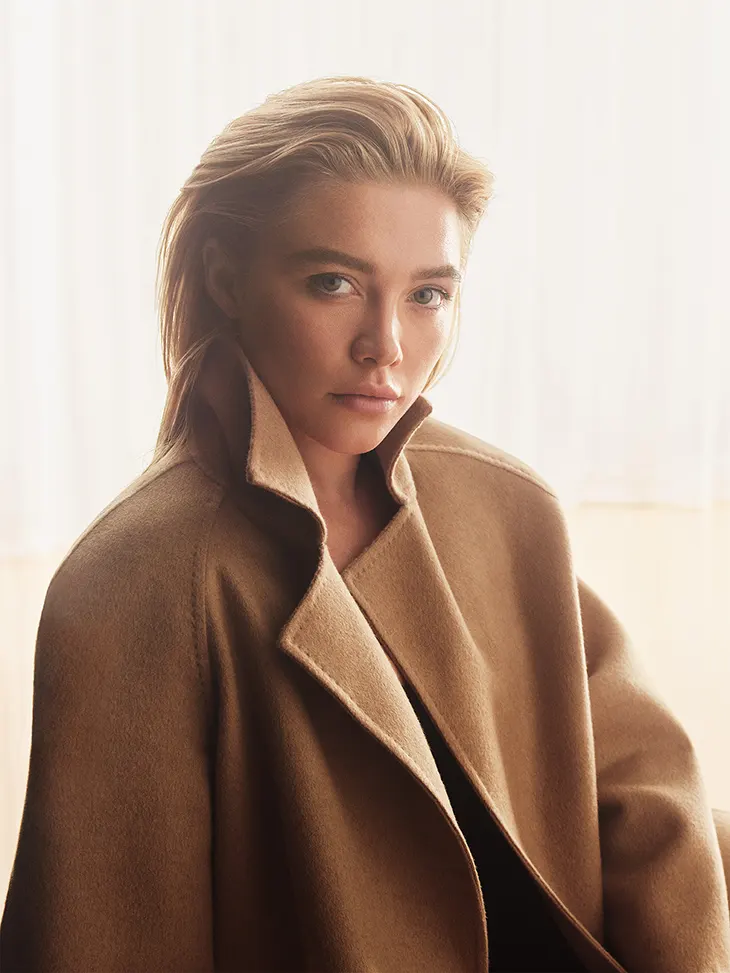
Max Mara describes Pugh as an expression of the “Max Mara woman”: modern, instinctive and confident. Those terms are broad, but the campaign gives them a clear visual interpretation. She is composed without appearing remote, elegant without becoming overly formal. The coat frames her, yet it does not erase her individuality.
That distinction matters in contemporary fragrance communication. Consumers may be drawn to an ambassador’s cultural visibility, but they also look for a credible emotional connection. Pugh’s association with the fragrance is built around the idea that scent is worn for the self before it is noticed by anyone else.
The campaign therefore extends the central concept of Le Parfum. The coat supports the body. The fragrance supports the mood.
Why Fashion Houses Continue to Enter Beauty
Beauty extensions offer established fashion houses something that ready-to-wear cannot provide as easily: a more intimate and accessible point of entry.
A coat represents a significant investment. A fragrance can introduce a customer to the same brand language at a different scale, while still preserving the sensory codes of luxury. It offers reach without requiring the consumer to adopt the entire wardrobe.
This is why fragrance remains one of the most powerful gateways into a fashion house. It is portable, ritualistic and deeply personal. It also allows a brand to occupy time in a way that clothing cannot. A garment is selected for a particular look or season; fragrance can become part of the daily architecture of a life.
For Max Mara, the opportunity is particularly coherent. The house has an established visual identity that can be converted into material, color and atmosphere. Shiseido contributes the infrastructure required to develop, produce, market and distribute the fragrance globally, while Max Mara contributes the cultural codes that make the product recognizable.
The partnership is consequently more than a licensing arrangement. It is an exchange between technical expertise and brand mythology.
The Invisible Coat
The most compelling aspect of Le Parfum is its attempt to preserve the equilibrium at the heart of Max Mara: softness with authority, sensuality with discipline, Italian heritage with contemporary relevance.
Its tuberose and vanilla create the enveloping surface. Its woods provide the structure beneath. The bottle makes the coat visible, while the fragrance makes it spectral: present in the air, felt rather than seen.
As the fragrance enters the market, its ultimate success will depend on whether the scent itself can sustain the promise of its image. A beautiful bottle can attract attention, and a celebrated face can create recognition. But fragrance becomes lasting only when it enters memory.
Le Parfum begins with a clear proposition: Max Mara’s language of protection, proportion and understated luxury can exist beyond the wardrobe. It can rest on the skin, move through a room and accompany the wearer into the world.
That is the larger significance of this launch. Luxury is no longer confined to what we see. It is also what surrounds us, what we remember and what quietly changes the way we inhabit our own lives.
For more on the relationship between fashion, material responsibility and the future of luxury, explore Davinci Magazine’s sustainability coverage. To learn more about Le Parfum, visit the official Max Mara fragrance page.