

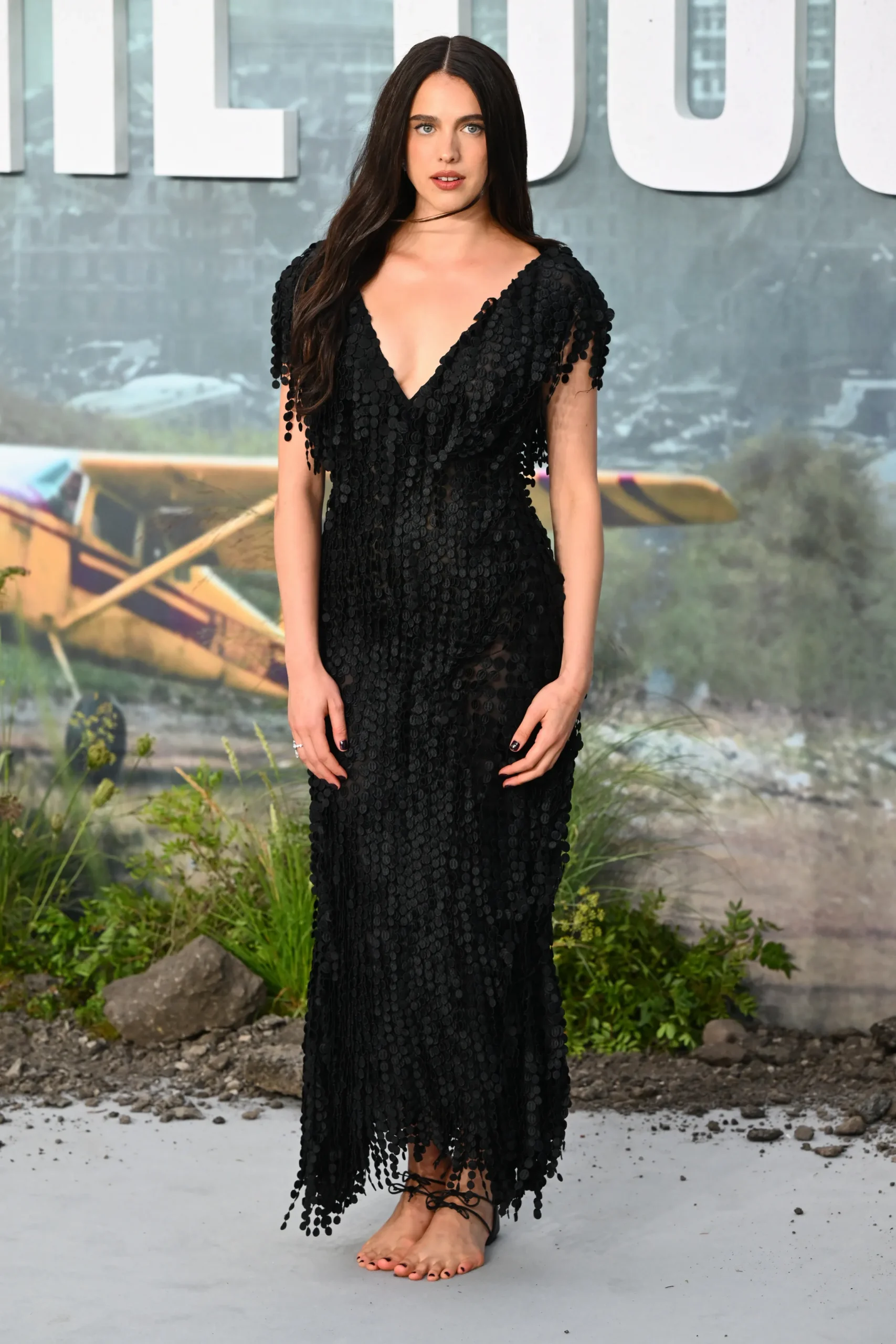
A red-carpet shoe traditionally completes the silhouette. Chanel’s new “barefoot” sandal does something more provocative: it interrupts it. By leaving almost the entire foot exposed, the design turns absence into the central visual event: and at the London premiere of The Dog Stars on August 20, Margaret Qualley gave that idea its first major celebrity close-up.
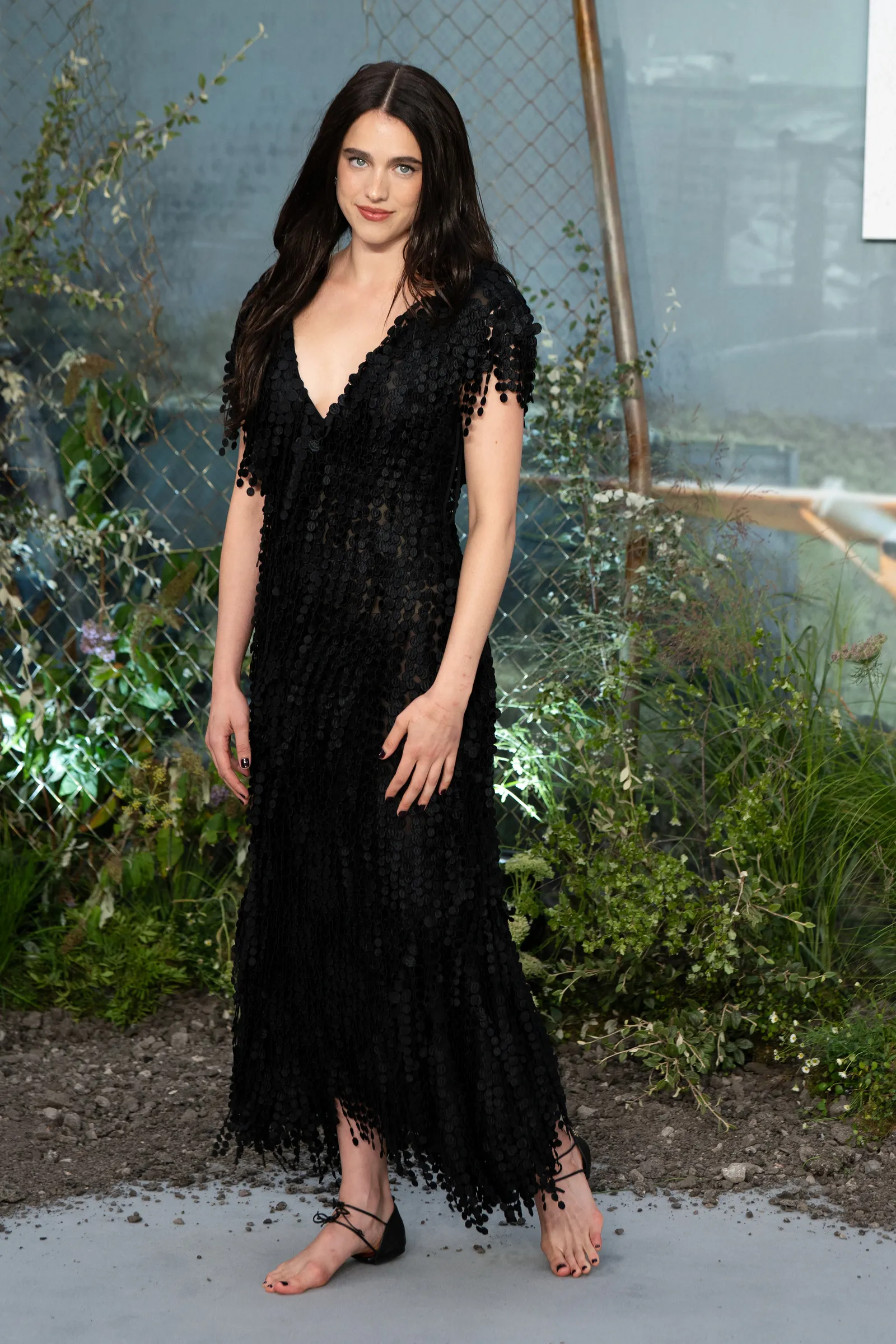
Qualley arrived in a black Chanel fringe dress paired with the house’s viral heel-only sandals, designed by Matthieu Blazy for Chanel’s Resort 2027 collection. The effect was deliberately spare and faintly surreal. The dress moved in a dark, fluid cascade; the footwear appeared to begin at the heel and then dissolve, leaving her toes, arches, forefoot, and most of the sole bare beneath the evening look.
It was not merely an accessory choice. It was a statement about what a shoe is required to do.
The Red Carpet Meets the Bare Foot
The sandals were first shown in Biarritz in April 2026, during Blazy’s debut Chanel Resort collection. Each shoe consists of a sculpted leather heel cap bearing the Chanel logo, supported by thin ankle straps. There is no conventional toe box, no visible vamp, and no protective sole extending beneath the front of the foot.
In practical terms, the design is closer to a jeweled architectural intervention than a conventional pump or sandal. It frames the heel, secures the ankle, and leaves the remainder of the foot to become part of the composition. The body is no longer placed inside the shoe. It becomes the shoe’s visual continuation.
That reversal explains much of the design’s viral charge. Fashion audiences are accustomed to seeing shoes enlarged, exaggerated, platformed, armored, or transformed into sculptural objects. Blazy’s proposition is more radical because it is subtractive. The shoe gains attention by removing almost everything viewers expect to see.
The result is both elegant and disquieting. Is it footwear, or is it an illusion of footwear? Is the heel cap a functional object, a logo-bearing jewel, or a trompe l’oeil fragment designed to make the foot look as though it is walking independently?
The question is the point.
A First Walk Into the Conversation
A runway presentation can protect an unusual design through atmosphere. Lighting, music, styling, and the controlled rhythm of the models create a complete visual language. A red carpet is less forgiving. Every element must function in the open air, beneath flash photography, from multiple angles, while the wearer stands, walks, pauses, and poses.
Qualley’s appearance therefore transformed the sandals from runway provocation into public experiment.
The pairing with a black fringe dress was particularly precise. Fringe introduces movement and optical softness, allowing the dress to shimmer around the body as Qualley walked. The sandals, by contrast, supplied a hard punctuation point: a sculpted black heel cap, delicate straps, and the stark exposure of the foot. The contrast created equilibrium between ornament and reduction.
Her dark pedicure sharpened the effect. Rather than interrupting the black palette with a bright or decorative color, the toes remained part of the monochromatic image. The styling treated the foot almost as a continuation of the dress’s shadow.
Shortly after the premiere, photographs of the look circulated widely because the design reads instantly on a screen. It requires no specialist knowledge of construction to understand its surprise. One glance communicates the central contradiction: the wearer appears to be in a high heel, yet much of the foot seems untouched by a shoe.
That kind of immediate legibility is rare in luxury fashion. It is also precisely what makes a polarizing design travel so quickly through digital culture.
Matthieu Blazy’s Chanel Begins With Disruption
Blazy’s Chanel direction has been shaped by a tension between historical codes and unexpected physicality. His Biarritz collection returned to the house’s coastal history, referencing the relationship between salon elegance and the liberating informality of the beach. The collection’s organizing principle was a “perfect balance between function and fiction”: a phrase that feels particularly relevant to the barefoot sandal.
The shoe belongs to both worlds. It has the precision, polish, and symbolic vocabulary of the salon, but it also exposes the foot with the directness of beachwear. It is refined and almost primitive at once.
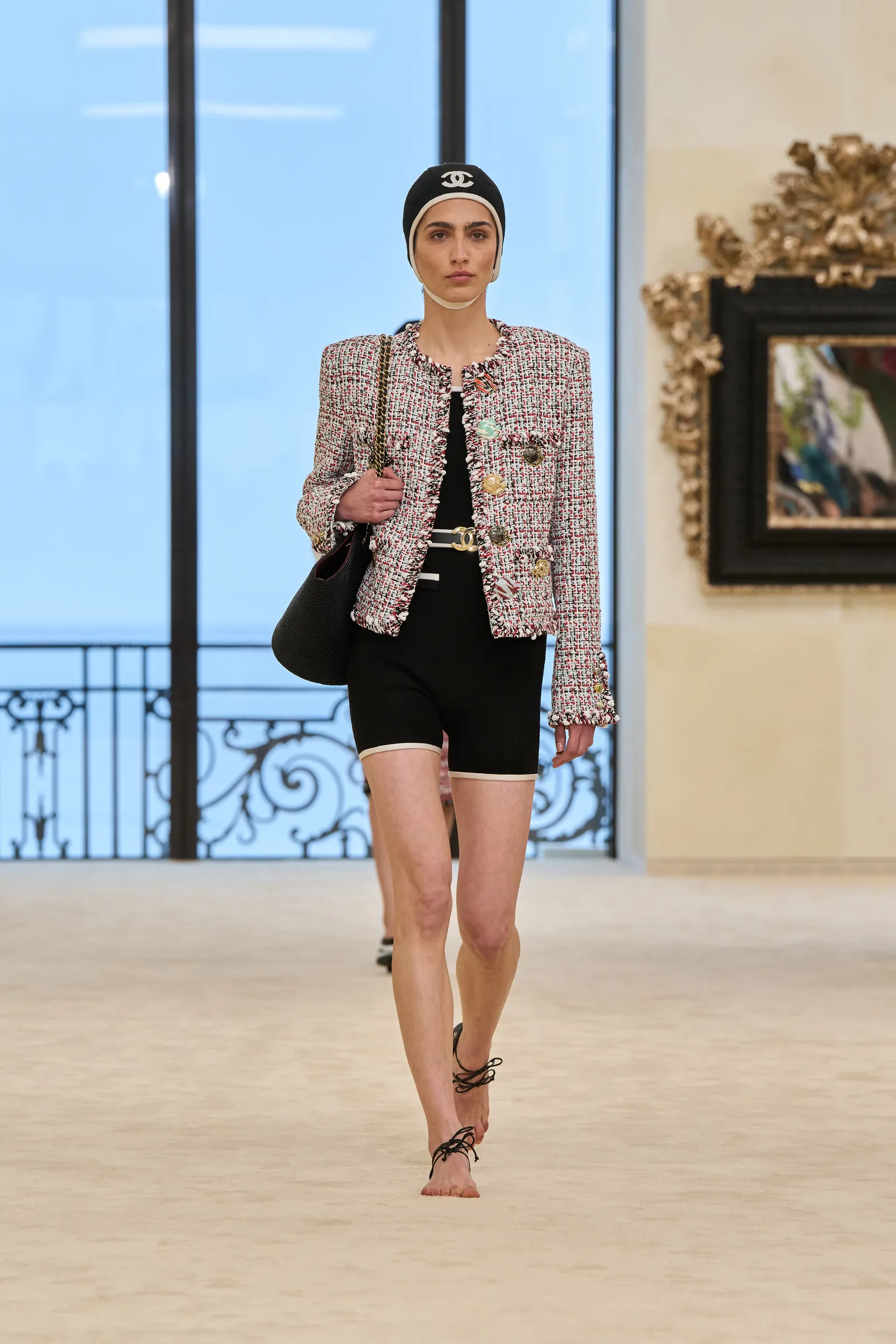
That duality is central to Blazy’s approach. Rather than treating Chanel’s heritage as a fixed archive, he appears to use it as a framework for movement. Tweed, monochrome dressing, chain details, interlocking logos, and polished eveningwear remain recognizable, but their proportions and functions are placed under pressure.
The barefoot sandal extends that method into footwear. It keeps the heel, the ankle strap, and the house emblem while discarding the traditional architecture surrounding the toes. Chanel remains visible, but the object refuses to behave like a familiar Chanel shoe.
This is not minimalism in the strict sense. The design is visually quiet but conceptually loud.
It also demonstrates how a creative director can make heritage feel contemporary without relying solely on novelty. The Chanel logo does not sit on a standard pump or sandal. It becomes part of a sculpted heel structure, turning the emblem into an organizing component rather than surface decoration.
Why the Body Has Become the Design
The barefoot sandal arrives at a moment when footwear is increasingly being reconsidered through the body. For decades, shoes were designed to shape the wearer’s posture, conceal the foot, lengthen the leg, or create an image of elevation. Contemporary fashion is asking a different question: what happens when the foot itself becomes visible as form?
The exposed sole carries a particular intimacy. It is usually hidden from public view, associated with privacy, vulnerability, or rest. Placing it within a formal red-carpet context creates a collision between the ceremonial and the elemental.
The sandal makes that collision literal. The foot is simultaneously styled and unstyled.
There is also an element of visual risk. A conventional shoe can absorb scrutiny through polish, ornament, and construction. A heel-only design directs attention toward balance, stance, proportion, and the choreography of walking. It asks the audience to observe not only what the wearer is wearing, but how the body negotiates the object.
That is why the design may provoke very different reactions. Some viewers see wit and modernity; others see impracticality or incompletion. Both responses are evidence that the shoe has succeeded as fashion rather than simply functioning as a neutral accessory.
A design that generates no argument may be beautiful. A design that changes the terms of the argument is culturally active.
The Luxury Appeal of the Unresolved Object
Luxury has always understood the power of controlled difficulty. A complicated clasp, an intricate embroidery technique, or an unusual silhouette can make an object feel more valuable because it resists instant consumption. The barefoot sandal introduces a different kind of difficulty: interpretive uncertainty.
It does not look fully resolved in the traditional sense, and that is its attraction. The eye continues searching for the missing part. The mind fills in the outline. The shoe becomes spectral: a visible trace of an object that seems to disappear beneath the wearer.
That quality makes it unusually compatible with the contemporary image economy. On a runway, its strangeness was part of a broader collection. On a red carpet, it became a single striking idea capable of surviving the compression of a photograph, a video clip, or a social post.
Yet virality alone does not make the design important. Its deeper significance lies in the way it reflects luxury’s current appetite for products that are conversation-driving, not merely recognizable. In a crowded market, a logo can identify a house, but an idea can define a moment.
The barefoot sandal is an idea.
It proposes that a luxury shoe does not need to cover the foot to control the image. It can do so through framing, proportion, material, and symbolic precision. Its value lies not in excess, but in the confidence to leave space around the body.
A New Red-Carpet Vocabulary
Qualley’s Chanel appearance suggests that the red carpet is becoming an increasingly important laboratory for fashion experimentation. The event remains ceremonial, but its images now enter culture at extraordinary speed. A look must perform in person and in circulation, under the pressure of immediate interpretation.
The barefoot sandal was suited to that environment because it created a visual pause. The black dress was glamorous, but the shoe made the look memorable. It introduced a question where a familiar stiletto might have offered only completion.
That may be the clearest signal of Blazy’s Chanel direction so far: a willingness to preserve the house’s codes while making them behave unexpectedly. The future of the maison may not be found in abandoning its past, but in allowing its most recognizable elements to become less predictable.
On Qualley, the sandal did not read as a novelty detached from the outfit. It acted as the look’s conceptual hinge. The dress belonged to the language of evening; the exposed foot brought the body back into view. Together, they created a modern form of glamour: one built not on concealment, but on calibrated revelation.
The red carpet has always been a stage for transformation. Chanel’s barefoot sandal asks whether transformation requires more material, or simply a more exact understanding of what can be left behind.
In Margaret Qualley’s London debut, the answer was unexpectedly clear: sometimes the most powerful shoe is the one that almost disappears.