

Luxury has always been an argument about time. What deserves to endure? Which gestures, materials, and memories can survive the pressure of modern speed?
At Copenhagen Fashion Week, Galib Gassanoff’s Institution offered a compelling answer. Its Spring/Summer 2027 collection, titled “YAD,” presented clothing as a living archive: tactile, architectural, and inseparable from the cultures that shaped its maker. The result was one of the season’s most discussed emerging moments: not because it pursued spectacle, but because it made slowness visible.
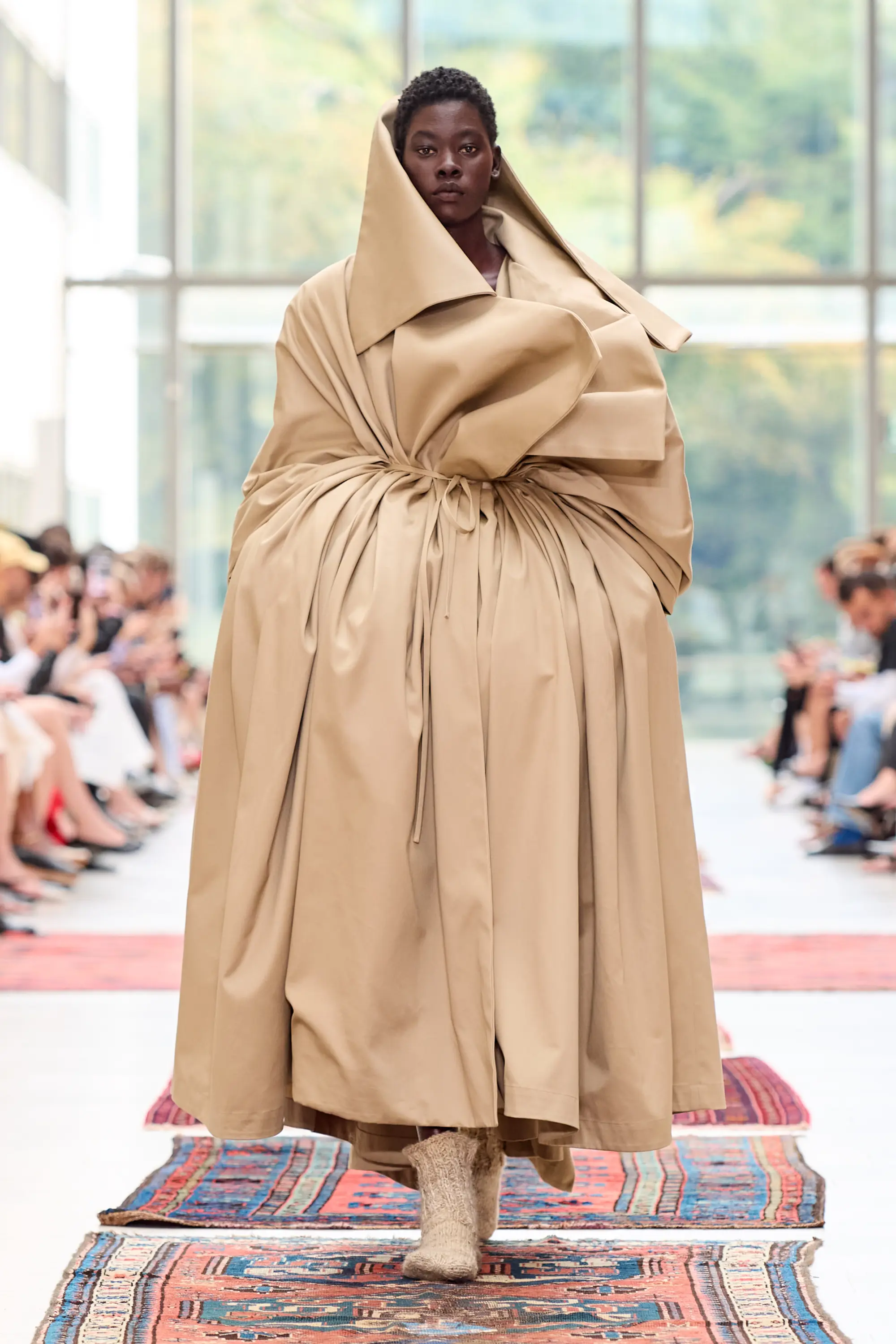
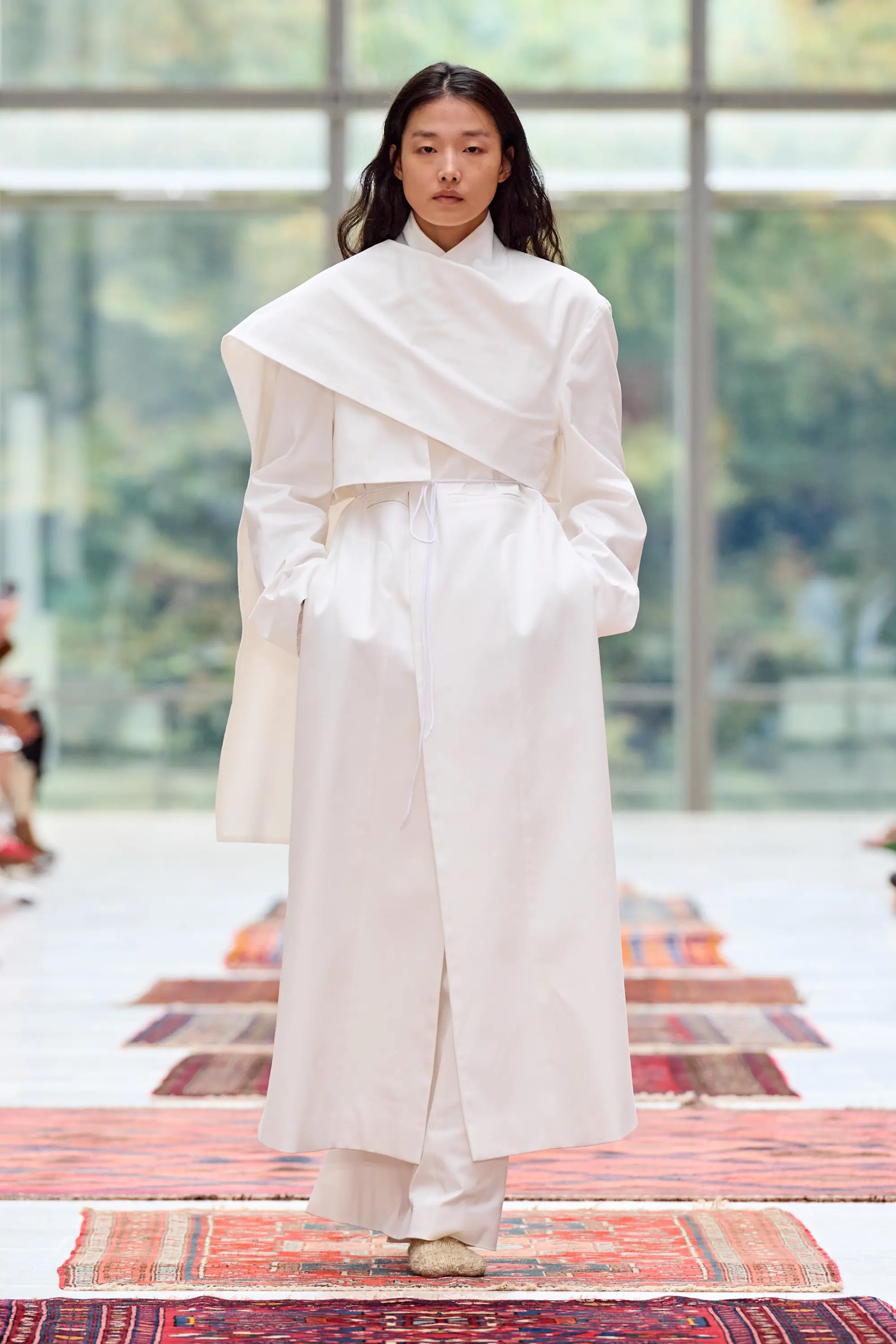
The runway moved through a vocabulary of ivory, stone, black, and muted earth tones. Models walked across layered Caucasian and Central Asian carpets in hand-knitted socks, their silhouettes expanding and contracting like ceremonial architecture. The effect was quiet but arresting. This was fashion as habitat rather than product.
The Memory of Elsewhere
Gassanoff is Georgian and of Azerbaijani descent, raised in Georgia’s Kvemo Kartli region and now based in Milan. His personal geography is central to Institution, which he founded in 2024 as a creative project extending beyond the conventional definition of a fashion label.
According to Institution’s official Copenhagen Fashion Week profile, the project was established to express Gassanoff’s personal and aesthetic sense of belonging, along with the cultural heritages connected to his life. That premise gives the label its organizing principle: identity is not treated as a fixed emblem, but as a field of relations: between Georgia and Azerbaijan, rural craft and metropolitan fashion, inherited technique and contemporary form.
The title “YAD” carries a particularly spectral resonance. In Azerbaijani, it can refer to the foreign or strange, while also evoking memory. The collection therefore inhabits a productive tension: the feeling of being both inside and outside a place, of carrying home through displacement, of recognizing oneself in traditions that may be changing or disappearing.
This is not heritage as decoration. It is heritage as structure.
Volume as a Form of Belonging
The clothes in “YAD” possess a distinctive physical authority. Gassanoff’s volumes are not inflated for theatrical effect; they appear to protect, shelter, and recompose the body. Coats gather into pronounced shoulders and oversized collars. Draped garments cinch at the waist before releasing into generous, almost architectural folds. The silhouettes suggest cloaks, tabards, domestic coverings, and ceremonial dress without becoming literal reproductions of any one reference.
That ambiguity is part of their strength.
The collection draws on elements associated with Georgian traditional dress, including crossed lapels, front pleating, and emphatic shoulders. Yet these references are translated through a contemporary system of proportion. A familiar gesture becomes abstract. A historical line becomes a new contour.
The technical language is equally considered. Fluid materials are disciplined through gathering and drawstrings, while tailored pieces rely on weight, construction, and controlled asymmetry. Crisp cotton meets soft wool. Sheer fabric interrupts dense handwork. Long coats create a sense of vertical continuity, while sculptural capes and tabards widen the body into a moving architectural plane.
The garments do not simply sit on the wearer. They establish an atmosphere around them.
When Craft Becomes the Luxury
Institution’s most persuasive proposition is that craft can be both social practice and luxury technology. Its pieces use natural materials including silk, cotton, wool, and leather, with many fabrics sourced from deadstock held by high-end producers. The resulting garments are limited not through artificial scarcity, but through the realities of material provenance and hand-led production.
That distinction matters.
A deadstock textile carries a history before it reaches the studio. A hand-knitted sock records the rhythm of its maker. A woven surface contains not only pattern but pressure, tension, and time. In this context, luxury is not merely the polish of the final object. It is the accumulated intelligence embedded within it.
Institution’s hand-weaving technique is drawn from Gassanoff’s Azerbaijani community in Georgia. Rather than allowing a fading method to remain locked in nostalgia, the label adapts it by replacing traditional wool threads with cotton shoelaces. The change is subtle but conceptually important: preservation becomes an active process of transformation.
The same logic appears in the collection’s knitted “jorab” socks, made by Azerbaijani craftswomen in Kvemo Kartli using wool from their own livestock. They are not styled as incidental accessories. They become visible foundations, grounding the models to the carpeted runway and bringing the labor of the region into direct contact with the spectacle of fashion.
A Coin, a Carpet, a Continuum
Among the collection’s most striking gestures is a going-out top constructed from Georgian tetri coins. Arranged across a translucent base, the coins create an openwork surface that catches the light like sequins, chain mail, or a field of small mirrors.
The effect is both ornamental and civic.
Currency is a symbol of national sovereignty, economic life, and historical transition. Recast as textile, it moves from the pocket to the body: from exchange value to cultural memory. It becomes wearable evidence that even the most ordinary objects can contain a nation’s emotional and political history.
The carpets beneath the models perform a related transformation. In a domestic setting, they would signal warmth, continuity, and ritual. On the runway, they become a topography. Every step across them suggests that fashion does not emerge from a blank surface; it travels over the accumulated patterns of previous lives.
The New Artisanal Landscape
Institution arrives at a moment when artisanal luxury is being reconsidered. For years, the category was associated with heritage houses, atelier prestige, and the controlled repetition of established codes. A newer generation is expanding the field. Their work asks not only how a garment is made, but who made it, where its knowledge comes from, and whether the fashion system can offer that knowledge a future.
Gassanoff’s approach is especially relevant because it refuses the false opposition between modernity and tradition. His silhouettes are resolutely contemporary, yet their force comes from materials and gestures with deep cultural roots. The collection does not attempt to make Georgian and Azerbaijani craft appear more fashionable by stripping away its identity. Instead, it allows that identity to reorganize the clothes from within.
This is also why Institution’s positioning as a social-artistic organisation feels more than conceptual language. The project treats clothing as an exchange between designer, artisan, community, and wearer. The garment becomes a meeting point.
Institution’s recognition with the Zalando Visionary Award 2026, which supported its Copenhagen Fashion Week runway debut, reflects the growing appetite for designers who unite design authority with cultural and social purpose. Gassanoff described the moment with characteristic directness:
“I believe in sharing my brand with the world and I am grateful whenever this project is recognized as a valuable one.”
His words are modest, but the ambition is not. Through Institution, he is building a platform where regional knowledge can circulate internationally without being reduced to a trend.

The Future Has an Ancestral Texture
The significance of Institution lies in its equilibrium. It balances sculptural volume with human touch, minimal color with complex material histories, and personal memory with collective responsibility.
That balance is not easy to achieve. Heritage can become museum-like; innovation can become detached from place. Gassanoff avoids both conditions by treating tradition as a working material: something to be cut, woven, reinterpreted, and brought into the present.
For Davinci Magazine readers following the evolving language of fashion and culture, Institution offers a vital point of attention. Its rise suggests that the future of luxury may belong less to excess than to discernment: fewer objects, more meaning; slower processes, greater accountability; silhouettes that carry not only the body, but a wider cultural memory.
The roadmap ahead is still being drawn. But Galib Gassanoff has already established its direction. In Institution, craft is not an echo of the past. It is a method of imagining what can endure.