

Miami’s Design District has never been simply about shopping. It is a neighborhood built around the idea that fashion, architecture, contemporary art, and culture can coexist. Now, Carolina Herrera is adding its own unmistakable perspective to that conversation.
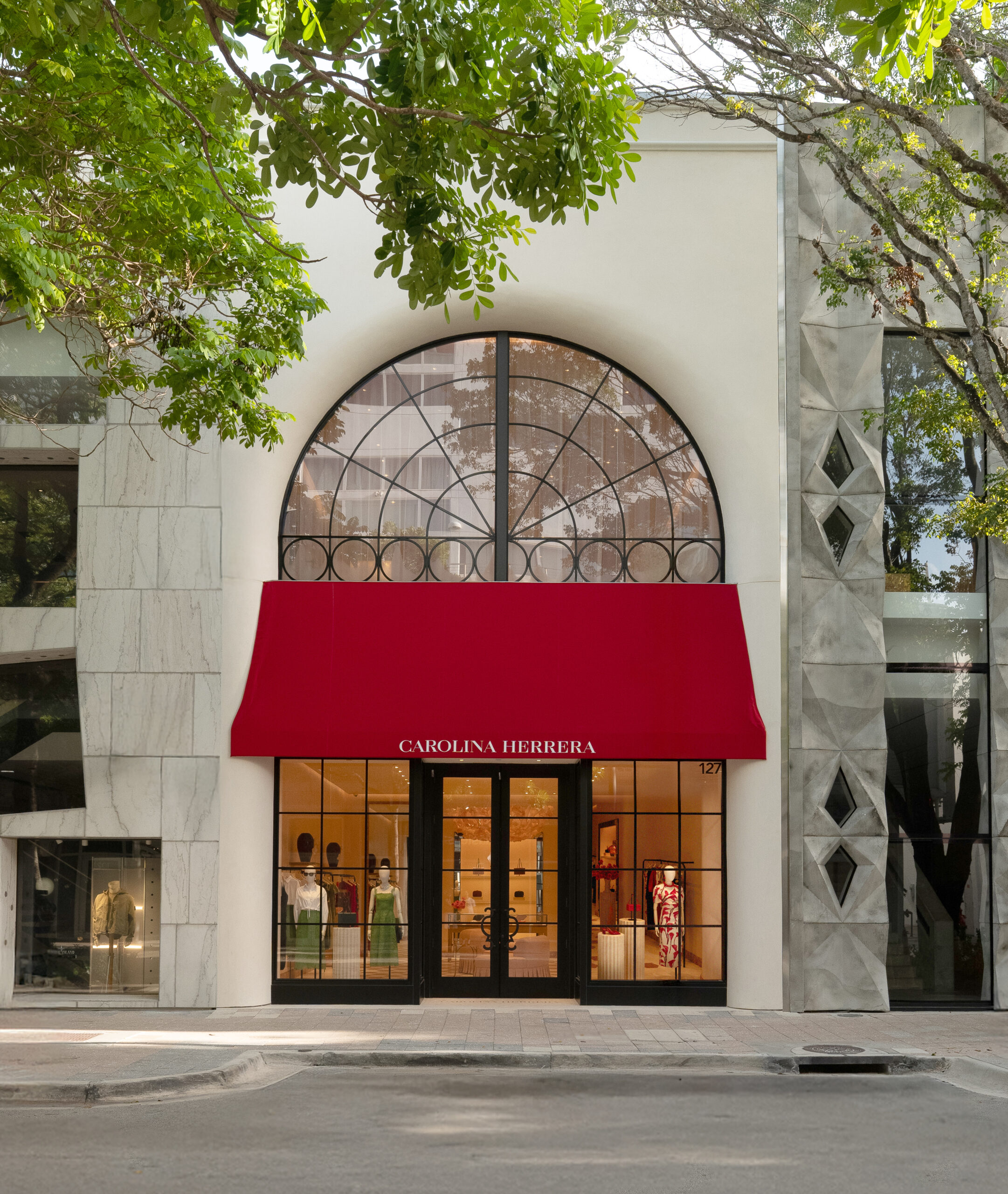
The New York-based fashion house officially opened its new flagship boutique at 127 NE 41st Street on August 15, marking Carolina Herrera’s sixth boutique in the United States and a significant expansion for the House during its 45th anniversary year.
At nearly 3,000 square feet, the new boutique is much more than another luxury retail address. Conceived specifically for Miami, the space brings together the complete Carolina Herrera universe, from ready-to-wear and eveningwear to handbags, accessories, beauty, fragrance and eyewear.
It also arrives at a particularly meaningful moment for the brand. The boutique debuts alongside the Fall 2026 runway collection, inspired by “Women in the Arts,” and the House’s newly introduced handbag line.
A New Chapter for Carolina Herrera in Miami
For Carolina Herrera President Emilie Rubinfeld, finding the right Miami location was a years-long process.
“This new opening is a significant milestone in the brand’s 45th year and an exciting opportunity for the business,” Rubinfeld said, noting that the House had worked closely with Miami Design District developer Craig Robins and his team to identify a location capable of complementing the district while expressing Carolina Herrera’s vibrant and feminine identity.
The result is a boutique that feels deliberately connected to its surroundings without surrendering the codes that have defined Herrera for decades.
Creative Director Wes Gordon envisioned the space alongside interior designer Brandi Howe and Jessica Hyland of Hyland Studio. Rather than creating a traditional luxury boutique and transplanting it into Miami, the team developed an environment specifically around the character of the city and the Design District.
That distinction begins before visitors ever walk through the door.
A dramatic custom façade designed by Gordon features a grand architectural arch and sculptural limestone finish, immediately establishing the boutique as both a retail destination and a piece of design.
Inside, the experience becomes warmer, softer, and decidedly more colorful.
Inside the World of Herrera
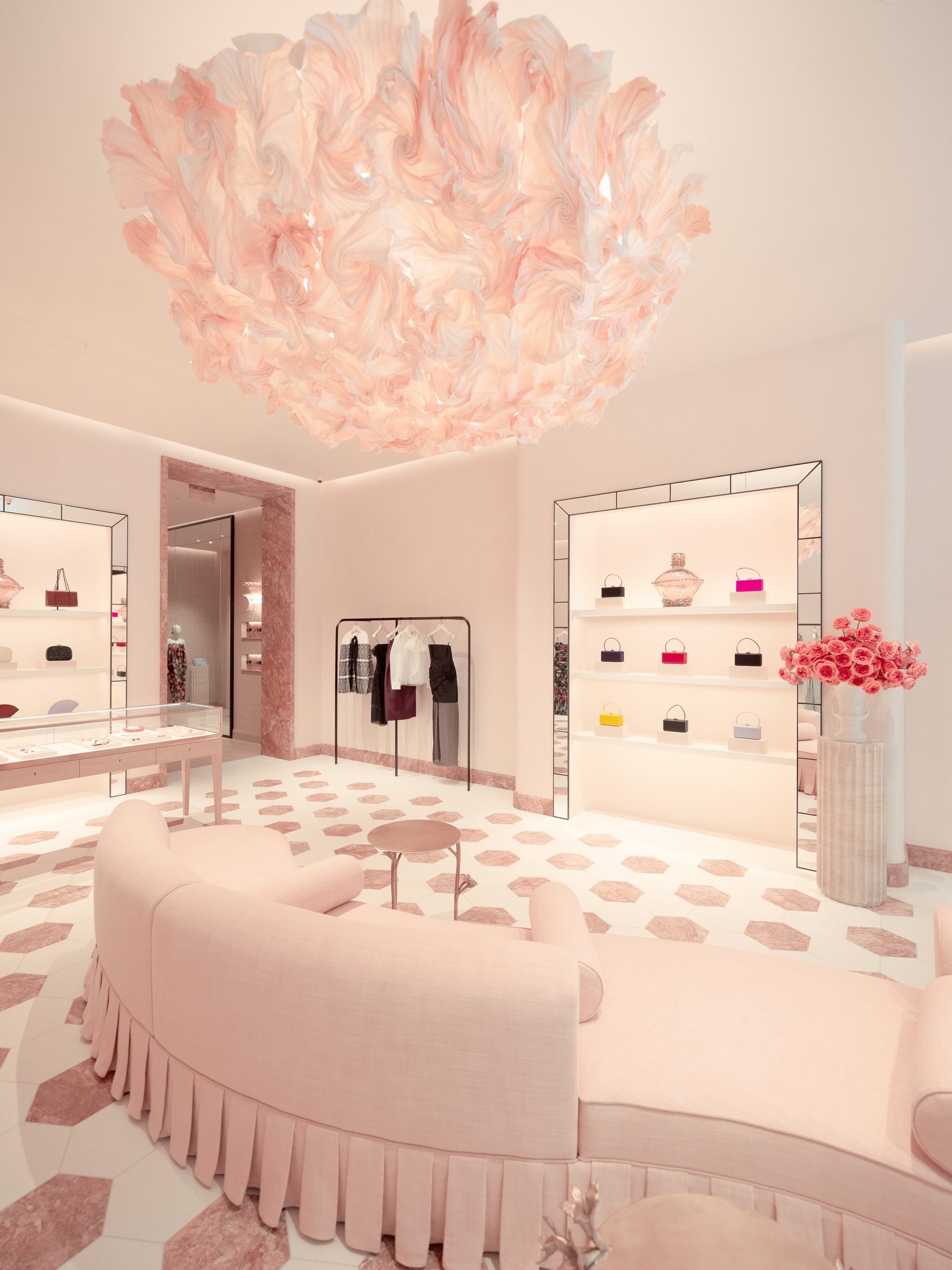
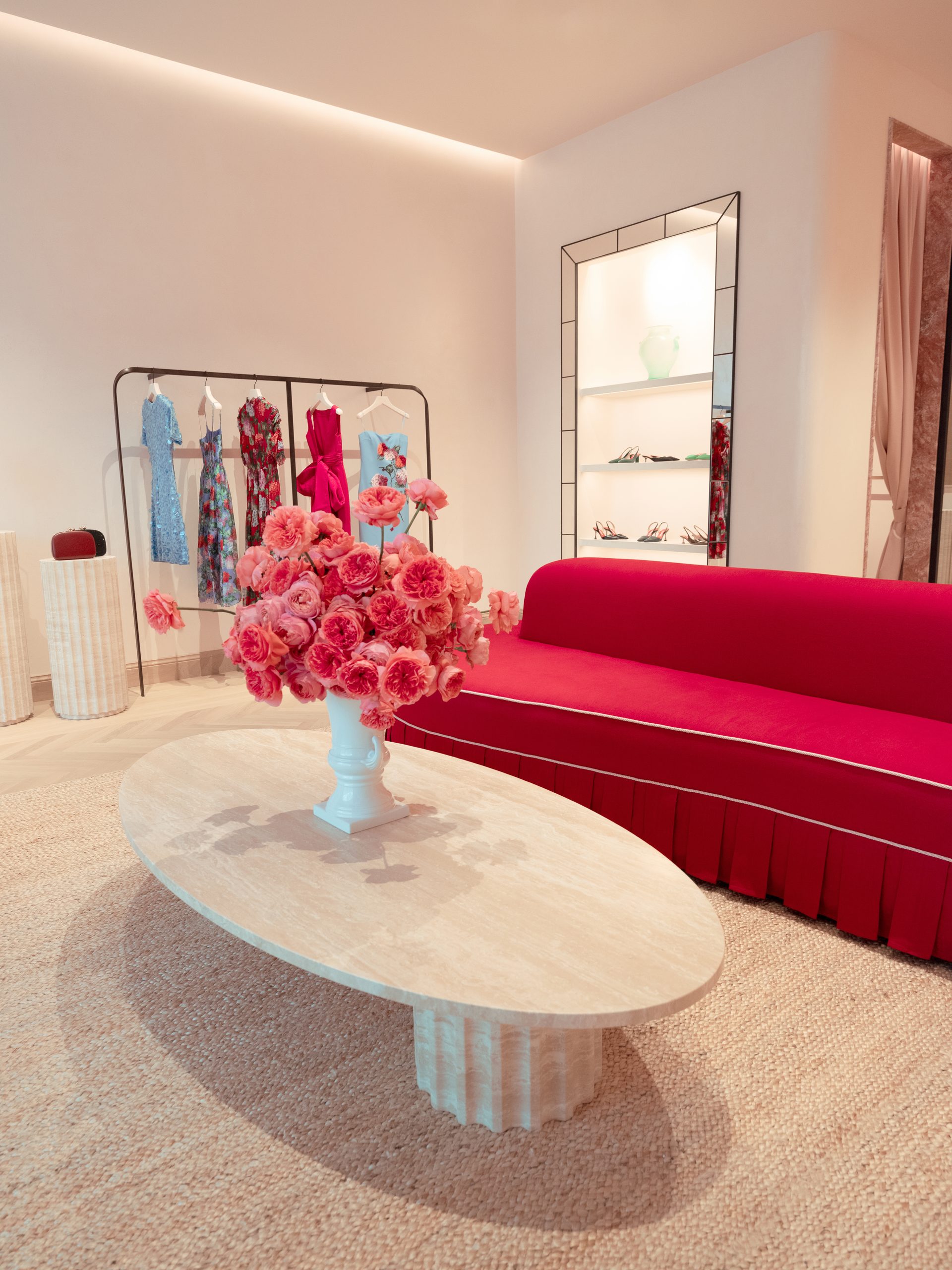
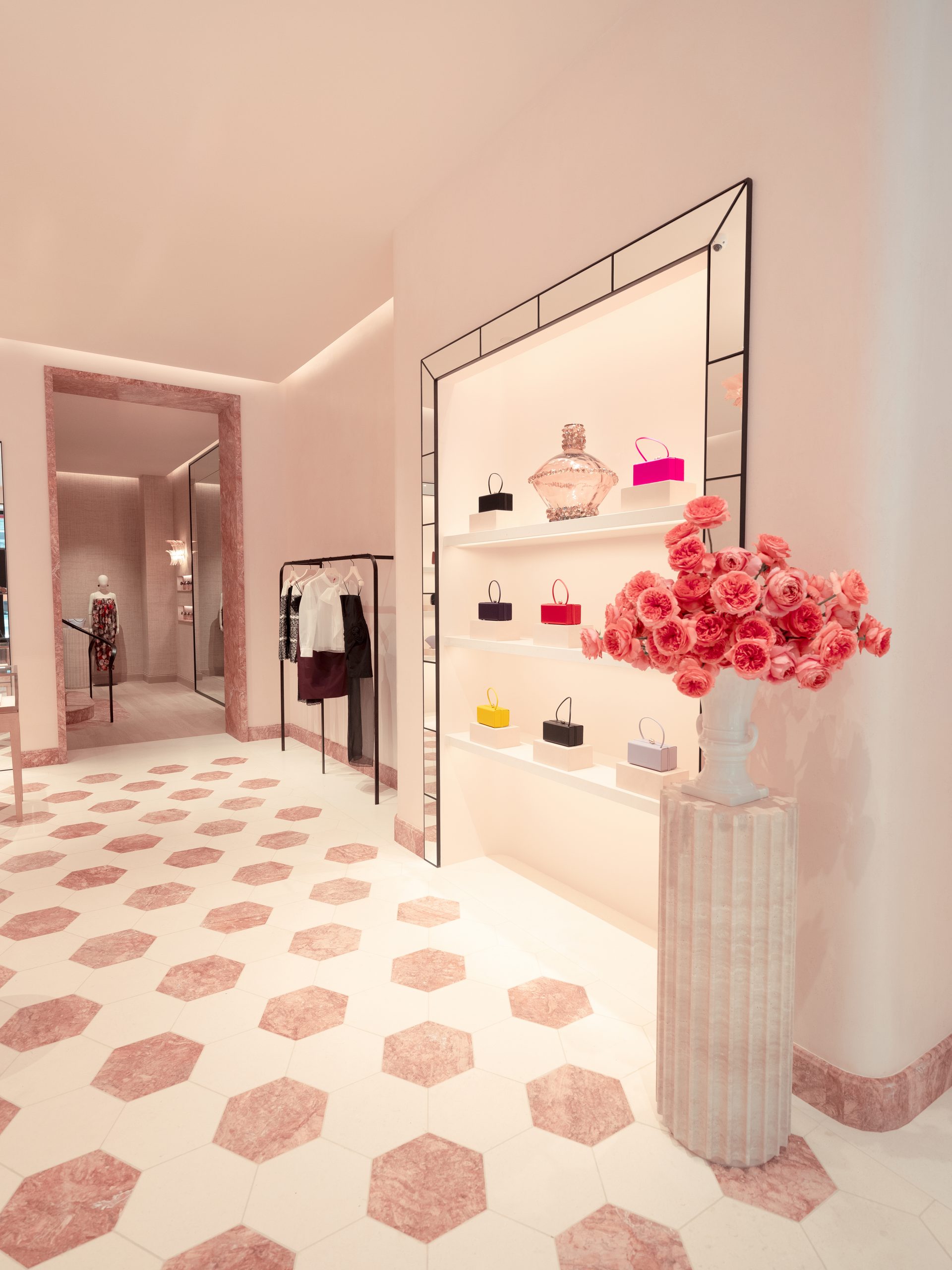
Soft shades of pink meet vivid Carolina Herrera red. Curvilinear forms soften the architecture while geometric flooring gives the rooms structure. White limestone is paired with rare blush-pink travertine, creating a custom floor whose naturally occurring rose tones reinforce the House’s long relationship with color.
Walls finished in soft pink Venetian plaster are infused with shimmering mica, catching and reflecting light throughout the space.
Sculptural travertine fixtures, tactile materials and upholstered seating bring an almost residential intimacy to the boutique, balancing the grandeur expected of a luxury flagship with a sense of warmth.
A serpentine sofa anchors the main salon, its sweeping curves creating a natural gathering point while demonstrating how deeply the language of fashion has been incorporated into the furniture and architecture.
The details feel less like decoration and more like an extension of couture itself.
Moving upstairs, visitors ascend a sculptural staircase wrapped in natural fiber wall coverings. Marble display insets integrated along the journey showcase Carolina Herrera eyewear before oak parquet flooring introduces another shift in texture and atmosphere.
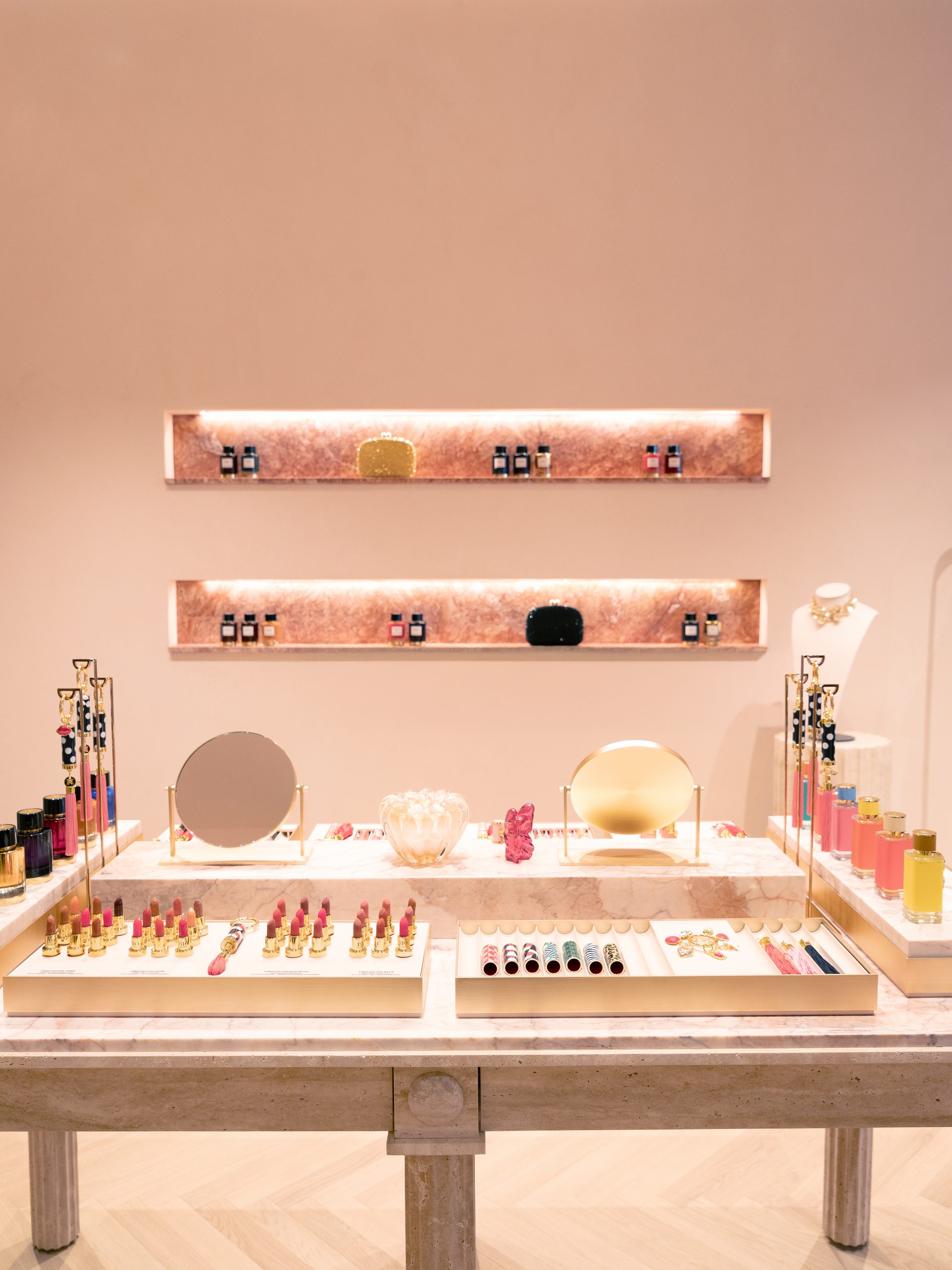
Carolina Herrera Beauty greets visitors on the upper level, helping connect the House’s fashion, fragrance, and beauty categories into one continuous experience.
For Gordon, Miami and the Carolina Herrera woman share something fundamental.
“The Carolina Herrera woman is bold, elegant, and joyful. She embraces color, expresses herself with confidence, and never shies away from making an entrance,” Gordon said. “Her energy is magnetic, much like the spirit of Miami, so it feels entirely natural that we should open our next home here.”
Women in the Arts Takes Physical Form
Perhaps the most compelling aspect of the Miami flagship is the way Carolina Herrera has incorporated the work of women artists into the identity of the space.
The boutique extends the mission of Carolina Herrera for Women in the Arts, the House’s ongoing platform supporting female-identifying creative talent.
Instead of treating artwork as something added to the boutique after its design was complete, the commissioned pieces are woven directly into the environment.
Argentine artist Constanza Vallese developed a custom floral motif exclusively for Carolina Herrera. Appearing across sculptural tables, vases and decorative fixtures, her work introduces organic forms while referencing the floral language deeply associated with the House.
Above the central salon, Los Angeles-based artist Liz Oliver created one of the boutique’s defining installations.
Her dramatic textile work takes inspiration from organic shell forms and transforms the traditional chandelier into a sculptural centerpiece. Draped fabric introduces movement overhead, recalling the volume, fluidity and theatricality found in Carolina Herrera gowns.
Created specifically for the proportions of the Miami boutique, the installation occupies the intersection between fashion object, interior design and contemporary art.
Brooklyn-based all-women studio Choplet Ceramics also contributed handcrafted ceramic planters. Their sculptural vessels introduce another organic layer to the interior while continuing the boutique’s celebration of women working across creative disciplines.
Together, the commissions make the store’s connection to “Women in the Arts” tangible. The theme does not end with the Fall 2026 collection hanging on the racks. It surrounds it.
Where Fashion and Miami Meet
The opening also reflects the continued evolution of the Miami Design District itself, where major luxury houses increasingly use architecture and art to create destinations that extend beyond conventional retail.
“Miami Design District is a place where great brands are encouraged to fully animate their artistic vision,” said Craig Robins, founder and CEO of Dacra, the company behind the development of the district.
According to Robins, Carolina Herrera’s combination of architecture, design and materiality gives both longtime clients and newcomers an opportunity to experience the complete expression of the House.
That idea feels particularly relevant in an era when almost anything can be purchased from a screen.
Luxury retail increasingly has to offer something digital commerce cannot easily reproduce: atmosphere, discovery, personal service and a sense of place.
Carolina Herrera’s Miami flagship leans fully into that idea.
There is product here, of course, but the environment surrounding it is part of the proposition. The Fall 2026 collection exists alongside commissioned artwork. Handbags sit within custom architecture. Beauty and fragrance become part of a physical journey through the House rather than separate categories.
It is retail designed to be experienced.
Herrera at 45
Forty-five years after Carolina Herrera established her fashion house in New York, the brand continues to evolve without abandoning the femininity, confidence and polish upon which it was built.
The Miami flagship captures that balancing act particularly well.
There are recognizable House signatures throughout the boutique, but they have been interpreted through Miami’s relationship with color, architecture and contemporary art. The result does not attempt to recreate New York in South Florida. Instead, it considers what Carolina Herrera can look and feel like when placed within Miami’s creative landscape.
That may ultimately be what makes the boutique significant beyond its nearly 3,000 square feet.
It represents a luxury house using physical retail as another creative medium.
Fashion is on the racks, but Carolina Herrera’s identity is in the limestone, travertine, textiles, ceramics, color and art surrounding it.
For a House celebrating 45 years, the Miami Design District flagship is both a reflection on what has endured and a statement about where Carolina Herrera intends to go next.
Carolina Herrera Miami Design District
Address: 127 NE 41st Street, Miami, Florida 33137
Hours: Monday through Saturday, 11:00 AM to 7:00 PM
Sunday, 12:00 PM to 6:00 PM
The boutique was developed with architect of record Dakota Hendon and Red Door Construction.