Luxury has always depended on a delicate paradox: the object must feel rare, yet the desire for it must remain alive. For several years, many maisons resolved that tension through a simple commercial instrument: raise the price, narrow the supply, and allow scarcity to perform the work of design.
That formula is now being tested.
Chanel’s reported 16% like-for-like revenue growth in the first half of 2026 offers one of the clearest signals that luxury may be moving from price-led expansion back toward product, assortment, and creative desirability. The central figure in that shift is Matthieu Blazy, whose first collections for Chanel reportedly generated demand strong enough to outpace supply soon after arriving in stores.
The implications reach well beyond one house. They concern the future of brand value, the psychology of affluent consumers, and an industry asking whether the next chapter of growth will be built through higher prices: or better reasons to buy.
The Radiance of Newness
Chanel’s reported performance is striking partly because of its contrast with the previous year. The house recorded approximately 1.8% comparable growth in 2025, according to figures available through its official financial results archive. For the first half of 2026, however, comparable revenue was reportedly up 16%.
The qualification matters. Chanel does not publish half-year financial statements in the same way as many listed luxury groups, and the H1 2026 figure has not been formally released by the company. It should therefore be treated as reported, rather than audited public guidance.
Even with that caveat, the direction is significant. The acceleration appears to be broad-based, but fashion: roughly 60% of Chanel’s business: was reportedly growing in line with the group. Watches and fine jewelry were said to have increased by approximately 35%, while fragrance and beauty grew by around 8%. The United States was reportedly particularly strong, with growth of more than 25%.
Numbers, however, rarely explain desire by themselves.
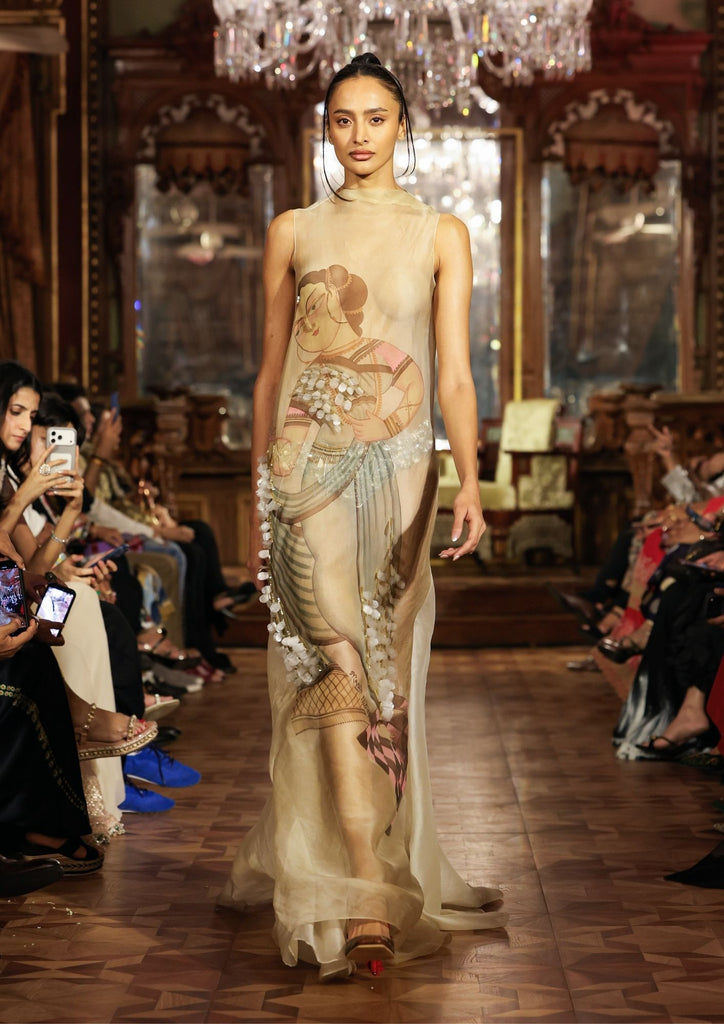
The more compelling story is the arrival of Blazy’s first collections in stores from March 2026. His work has been associated with a renewed attention to silhouette, material intelligence, and the tension between the familiar and the unexpected. Rather than treating heritage as a museum display, the approach appears to use it as an organizing principle: a structure from which new forms can emerge.
That distinction is commercially decisive. A price increase can change the value assigned to a product. A compelling product can change the value felt by the customer.

When the Product Becomes the Argument
The luxury sector’s recent price architecture was built during an unusually favorable period. Demand surged, customers became accustomed to buying through digital channels, and iconic handbags and accessories acquired the status of quasi-assets. Across the market, brands raised prices repeatedly: sometimes by double digits: while maintaining the narrative of exclusivity.
The result was what might be called basket inflation: revenue increased because each transaction became more expensive, even when unit growth was less certain.
Chanel benefited from that architecture. The Classic Flap, among its most recognizable icons, reached a markedly higher price level than it held before 2020. A handbag purchased today contributes far more revenue than the same category did several years ago. This provides a powerful financial floor.
But a floor is not a future.
Once price rises begin to outpace perceived creative movement, the relationship between maison and customer becomes fragile. The customer is not only asking, “Can I afford this?” They are also asking, “Why is this worth more now?” The answer cannot remain scarcity alone. Scarcity is a condition. It is not a complete creative proposition.
Blazy’s early momentum suggests that luxury is recovering the lost grammar of the product: cut, proportion, tactility, function, and emotional recognition. Customers may accept a high price when the object feels newly consequential: when it offers a visual language that enters the wardrobe rather than simply adding another logo to it.
This is why assortment matters. A house must offer more than one symbolic object. It must create a habitat of desire across ready-to-wear, accessories, jewelry, footwear, beauty, and occasion dressing. The customer should be able to encounter the creative idea at different levels of intimacy and investment.
That is particularly relevant for Chanel, where reported strength in jewelry and beauty complements the excitement around fashion. The ecosystem becomes more resilient when a new silhouette leads to an accessory, a piece of jewelry, or a beauty ritual. Each category extends the same world without repeating the same product.
The Hand, the Material, the Proof
Luxury ultimately rests on proof. The proof may be hidden in construction, felt in the weight of a clasp, observed in the behavior of a fabric, or understood through years of cultural continuity.
In an era of extraordinary price increases, craftsmanship has sometimes been used as a retrospective justification: the price rises first, and the language of craft follows. The return to product reverses that order. It asks the object to make its own case.
This creates a more demanding brief for creative directors. They are no longer responsible only for producing a memorable runway image. They must establish a coherent system that survives contact with the store floor. A showpiece must translate into garments people can wear, accessories they can understand, and materials that reward touch.
The technical challenge is considerable. Fashion must hold equilibrium between novelty and recognizability. Too much familiarity produces stagnation; too much experimentation weakens commercial clarity. The most powerful collections operate like trompe l’oeil: they appear immediate at first glance, then reveal construction, reference, and complexity over time.
For consumers, this can restore pleasure to the buying decision. The object becomes less like a financial instrument and more like a companion to lived experience. Its value is not only what it might retain on the resale market, but how it behaves in motion, how it ages, and what it allows the wearer to express.
That shift also carries an environmental dimension. When brands invest in better product rather than endless price escalation, the incentive moves toward longevity, repair, and meaningful ownership. A beautifully made object has a stronger chance of remaining in circulation. It can become part of a personal archive rather than a disposable marker of a season.
Davinci Magazine’s ongoing interest in sustainability in fashion belongs within this conversation. Sustainability is not only a question of materials or manufacturing. It is also a question of whether a product earns a long life.
The Consumer’s More Exacting Eye
The luxury customer has not become less aspirational. The customer has become more discerning.
After years of price increases, consumers possess a sharper understanding of price histories, resale values, category differences, and creative cycles. They can distinguish between an icon that has accumulated meaning and a product whose exclusivity is being manufactured through limited availability. They also move fluidly between houses, markets, and cultural references.
This makes product desirability more difficult to engineer: and more valuable when it appears.
A new creative director can generate attention, but attention alone is spectral. It must become repeat purchase, wardrobe integration, and long-term trust. Blazy’s first collections therefore represent more than a successful debut. They are an early test of whether creative renewal can produce durable commercial momentum after an era in which price performed so much of the labor.
For consumers, the return to product may also create a more varied luxury landscape. Instead of competing only on the height of a price point, houses will need to compete through distinctive silhouettes, richer category architecture, stronger materials, and more precise cultural positioning.
The most interesting brands will not simply ask how to make a product scarce. They will ask how to make it legible, desirable, and difficult to replace.
A New Equilibrium for the Maison
The end of outrageous price hikes is unlikely to be absolute. Luxury brands have little reason to abandon pricing power entirely, particularly when inflation, labor, materials, and retail investments continue to shape the cost structure. Icon products may remain expensive, and selective increases will continue.
What appears to be ending is the belief that price can serve as the primary engine of desirability indefinitely.
The next phase will require a more balanced commercial model. Price will remain one instrument, but it must operate alongside product innovation, assortment depth, client experience, cultural relevance, and aftercare. A maison will need to protect its icons while creating new forms capable of carrying the brand forward.
This is where creative leadership becomes inseparable from business strategy. Blazy’s Chanel debut demonstrates the possibility of a “return to product” not as a retreat from luxury’s economic ambitions, but as a more intelligent foundation for them. Growth built on compelling design can be broader, more resilient, and less vulnerable to consumer fatigue than growth built primarily on higher tickets.
The wider industry is watching because the question is universal: what happens when status is no longer enough?
The answer may be found in the object itself. In the cut of a jacket. The balance of a bag. The tactility of leather beneath the hand. The quiet confidence of a collection that does not need to explain its value because the product has already begun the conversation.
Luxury is not leaving price behind. It is being asked to make price answer to product again.
And that may be the healthier roadmap: for brands, for consumers, and for an industry whose future depends on creating objects worthy of being kept.