

A painting survives by refusing to remain still. It travels from hand to hand, from wall to archive, from memory into new forms. In Moonlit Palace, Anamika Khanna gives that movement a body: 19th-century Kalighat painting leaves the paper, crosses the threshold of history, and enters contemporary couture.
Presented at Hyderabad’s Taj Falaknuma Palace as the opening show of India Couture Week 2026, the collection unfolds as a meditation on light, inheritance and the living intelligence of craft. Its Kalighat chapter is especially compelling because it does not treat Bengal’s visual tradition as a decorative quotation. Instead, it asks what happens when an old artistic language is permitted to evolve.
The answer is quietly radical.
The Line That Remembers Kolkata
Kalighat painting emerged in 19th-century Calcutta around the Kalighat temple and its bustling marketplace. Patuas: hereditary folk artists and scroll painters from Bengal: created quick watercolour works on paper for pilgrims and visitors. Their images often depicted Hindu deities, mythological scenes and domestic life, but the form was never confined to devotion.
Kalighat artists also observed the city around them. Tigers, cats, courtesans and the much-mocked babu culture of colonial Calcutta entered the compositions with wit and economy. The paintings were direct, expressive and alert to society. Devotional image-making and street satire occupied the same visual habitat.
Their language was immediately recognisable: bold, sweeping contours; simplified figures; areas of confident, often flat colour; and a sense of gesture that could make a single line appear to contain an entire personality. The effect was not ornamental excess but equilibrium. Every mark carried weight.
Khanna’s interest lies in precisely this economy. She has spoken of being drawn to Kalighat’s “confidence and simplicity of line,” as well as the emotions embedded within the tradition. Her translation is therefore less an act of reproduction than of distillation. The clothes absorb Kalighat’s proportions, movement and expressive restraint, allowing the source material to remain visible without becoming trapped in the past.
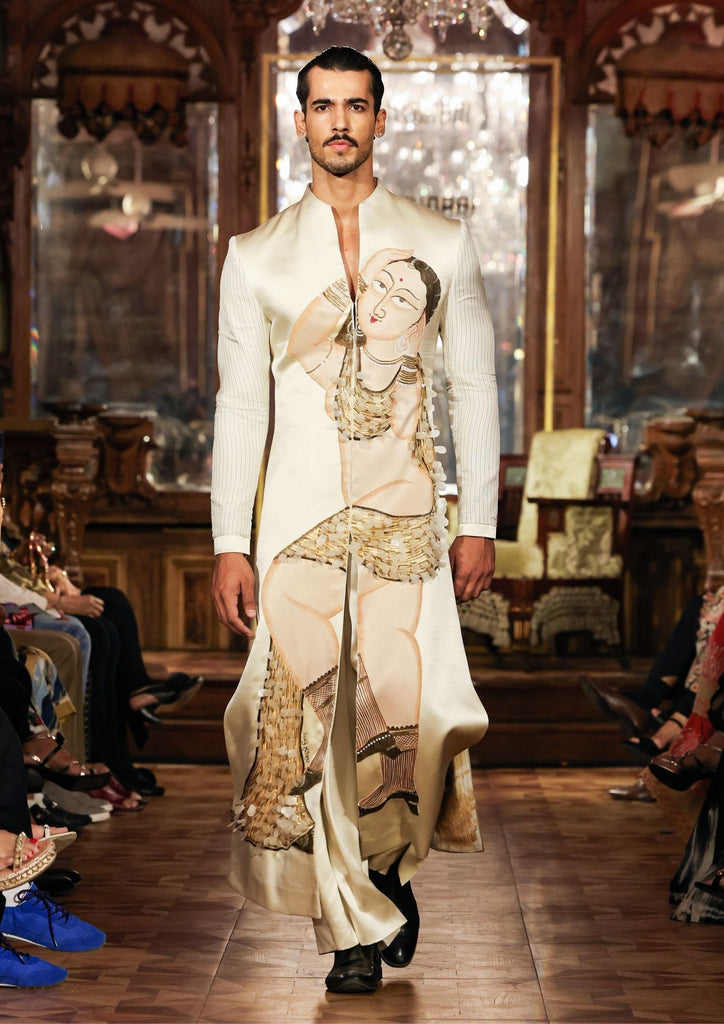
In the collection’s painted garments, Kalighat imagery becomes part of the silhouette rather than a surface applied after the fact.
From Paper to Organza, From Gesture to Form
The most significant distinction in Moonlit Palace is that the Kalighat references are not treated as ordinary prints. Motifs are hand-painted onto textiles, moving the patua’s brush from paper to silk and organza.
That change in material alters the image. Paper holds a painting in a stable field; fabric carries it across the body. It bends, folds, stretches and responds to light. A painted figure no longer simply depicts movement. It moves.
One sheer column dress allows a Kalighat-inspired figure to travel vertically across the body, its lines interrupted by the transparency of organza and framed by shell, sequin and kardana work. The painting is not an isolated panel. It becomes an organising principle, guiding the eye through the garment and giving the silhouette its rhythm.
Elsewhere, a cream kurta carries a female figure adorned with bangles and jewellery. A gold brocade coat is marked by the image of a cat curled along a branch, its outline recalling the thick, assured contours of classic Kalighat animal studies. On menswear, painted figures appear across achkans, jackets and sherwani-length forms.
The technical achievement is considerable. Hand-painting on a fluid textile demands a different discipline from working on paper. The artisan must account for absorption, transparency, seam placement and the behaviour of the fabric in motion. Embroidery cannot simply conceal the painting; it must converse with it.
This is where couture becomes a form of contemporary art. The garment is both canvas and architecture, both image and inhabitable space.
The Palace as a Chamber of Light
The presentation’s setting intensified the collection’s dialogue between history and modernity. Inside the ornate Falaknuma Palace, chandeliers fractured the light into spectral points across polished wood, mirrored surfaces and moving textiles. The atmosphere was theatrical without becoming excessive.
Moonlit Palace used this environment as more than a backdrop. The palace became a chamber in which different forms of inheritance could meet: royal architecture, regional craft, urban folk painting and the precision of contemporary couture.
The show’s structure moved through distinct creative movements, including references to Barmer in Rajasthan and Kalighat in Kolkata. Barmer connected to Khanna’s birthplace; Kalighat to the city she calls home. One tradition brought saturated colour, textile density and mirrorwork. The other introduced softer lines, restrained tones and a more contemplative sense of gesture.
The contrast was not oppositional. It was architectural. Together, the two traditions created a broader geography of Indian craft: one that refuses the notion that heritage is singular, fixed or geographically sealed.
The collection’s official India Couture Week 2026 archive reveals this range through its garments: richly worked surfaces, fluid drapes, sharply tailored menswear and silhouettes that oscillate between sculptural control and ease.
Women’s Hands, Living Knowledge
The collection’s cultural significance rests not only in its imagery but also in its process. Khanna worked with artisans connected to Bengal’s Kalighat tradition, alongside women-led craft communities associated with the collection’s other regional references.
This is essential. To revive Kalighat responsibly is not merely to borrow its visual vocabulary. It is to recognise the knowledge held by the people who understand the medium through practice: how a brush should turn, how colour settles into cloth, how an outline maintains its authority without becoming rigid.
Khanna has described craft as something that “continues to live, change, and find new expressions.” That philosophy shifts the conversation away from preservation as a static act. A tradition does not remain alive by being placed under glass. It remains alive by entering the present without surrendering its identity.
In couture, time is made visible. A hand-painted line records the pressure of the brush. A sequined surface catches the movement of the wearer. A carefully engineered seam determines whether an image remains centred or fractures into abstraction. Each decision carries the presence of another hand.
This human scale also challenges fashion’s accelerated systems. In an industry increasingly shaped by instant imagery and rapid production, Moonlit Palace insists on duration. Its luxury lies not only in precious materials but in attention.
The Body as a Moving Gallery
Khanna’s silhouettes are most powerful when they allow the artwork to breathe. The Kalighat figure is not pinned to the garment like an illustration in a book. It stretches across a torso, disappears into a fold or emerges again as the wearer turns.
This creates a form of trompe l’oeil. The eye reads the body and the painted body simultaneously. A figure on silk seems to occupy the same spatial field as the model, while the transparency of organza produces an ambiguous border between skin, image and textile.
The result is hyper-sensorial. One notices the sheen of satin, the dry directness of a painted contour, the flicker of metallic thread and the soft collapse of a drape. These elements do not compete. They create a layered visual language in which line, surface and movement are inseparable.
Menswear receives the same treatment. The painted figure on an ivory sherwani transforms tailoring into narrative space, while the placement of the image across the front gives the garment a ceremonial presence. The work suggests that Kalighat’s expressive power does not belong to one gendered wardrobe. Its visual grammar can inhabit the achkan, the coat, the dress and the skirt with equal conviction.
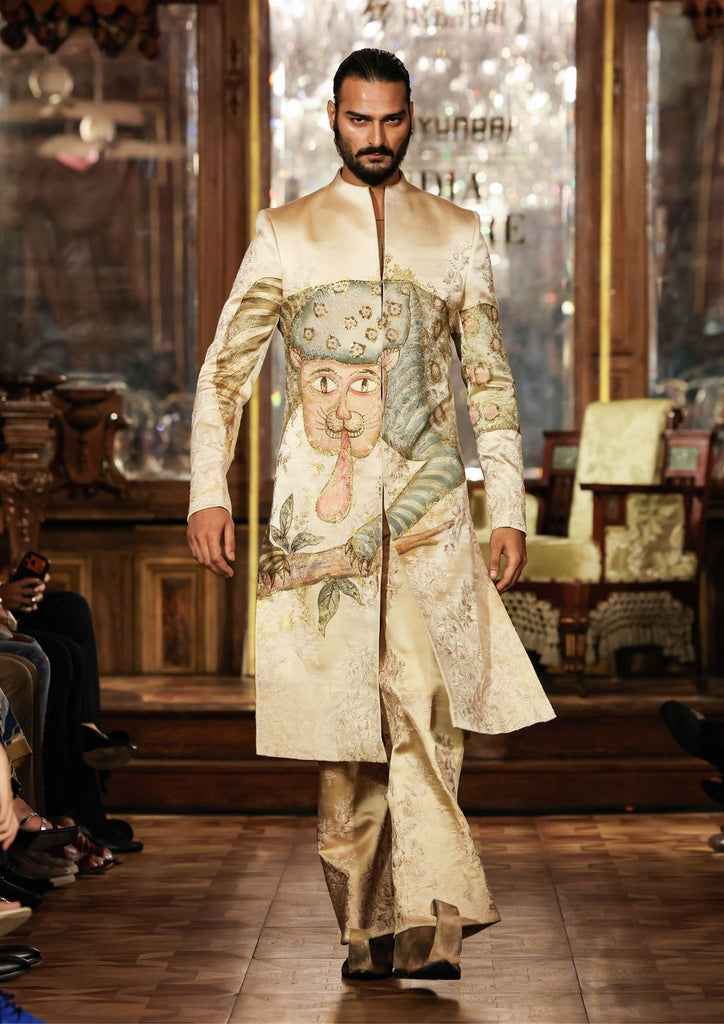
Kalighat’s animals and figures become animated elements within the collection’s tailored forms.
Beyond Nostalgia, Toward Dialogue
There is a difference between citing history and entering into dialogue with it. Citation can be superficial: a motif selected for instant recognition, detached from its original context. Dialogue is slower. It asks what the older form believed in, how it saw the world and what it might become under different conditions.
Moonlit Palace approaches Kalighat as a visual language rather than a catalogue of motifs. It acknowledges the form’s directness, humour and social intelligence while translating those qualities into a couture environment. The result is not an antique revival. It is a new conversation between folk art and high fashion.
That conversation also matters beyond the runway. When traditional forms are presented through contemporary design, they enter new networks of attention. Audiences who may never encounter Kalighat painting in a museum or archive can meet its line, gesture and emotional force through clothing. The garment becomes an ambassador: not for a frozen past, but for a living cultural memory.
Khanna’s own understanding of couture reflects this ambition. “It is not just about luxury,” she has said. “It is about craftsmanship, storytelling and creating pieces that have a life beyond a moment.”
The statement clarifies the collection’s deeper purpose. Moonlit Palace is not interested in nostalgia as an aesthetic mood. It is interested in continuity as an active practice.
A New Cartography of Indian Couture
Fashion has always been a meeting place between the intimate and the civilisational. It rests against the skin, yet it carries histories larger than the individual. In Anamika Khanna’s Moonlit Palace, Kalighat painting becomes an eloquent example of that duality.
The line once drawn for pilgrims in a Calcutta marketplace now travels across couture silk. The painted cat, the expressive figure and the assured contour find new life under chandeliers in Hyderabad. Nothing is erased. Nothing is simply repeated.
Instead, the collection proposes a roadmap for contemporary Indian fashion: one in which regional traditions can move across borders, collaborate with new materials and speak to global audiences without becoming diluted into generic luxury.
The moonlit palace, finally, is not a monument to what has been lost. It is a space of rediscovery: where craft, art and fashion meet in motion, and where the past continues to design the future.
By carrying Kalighat from paper into couture, Khanna frames heritage as an evolving, inhabitable form.
For further context on the cultural and material questions shaping fashion today, explore Davinci Magazine’s perspective on sustainability in fashion and learn more about our commitment to global fashion, art and culture on the Davinci Magazine About page.