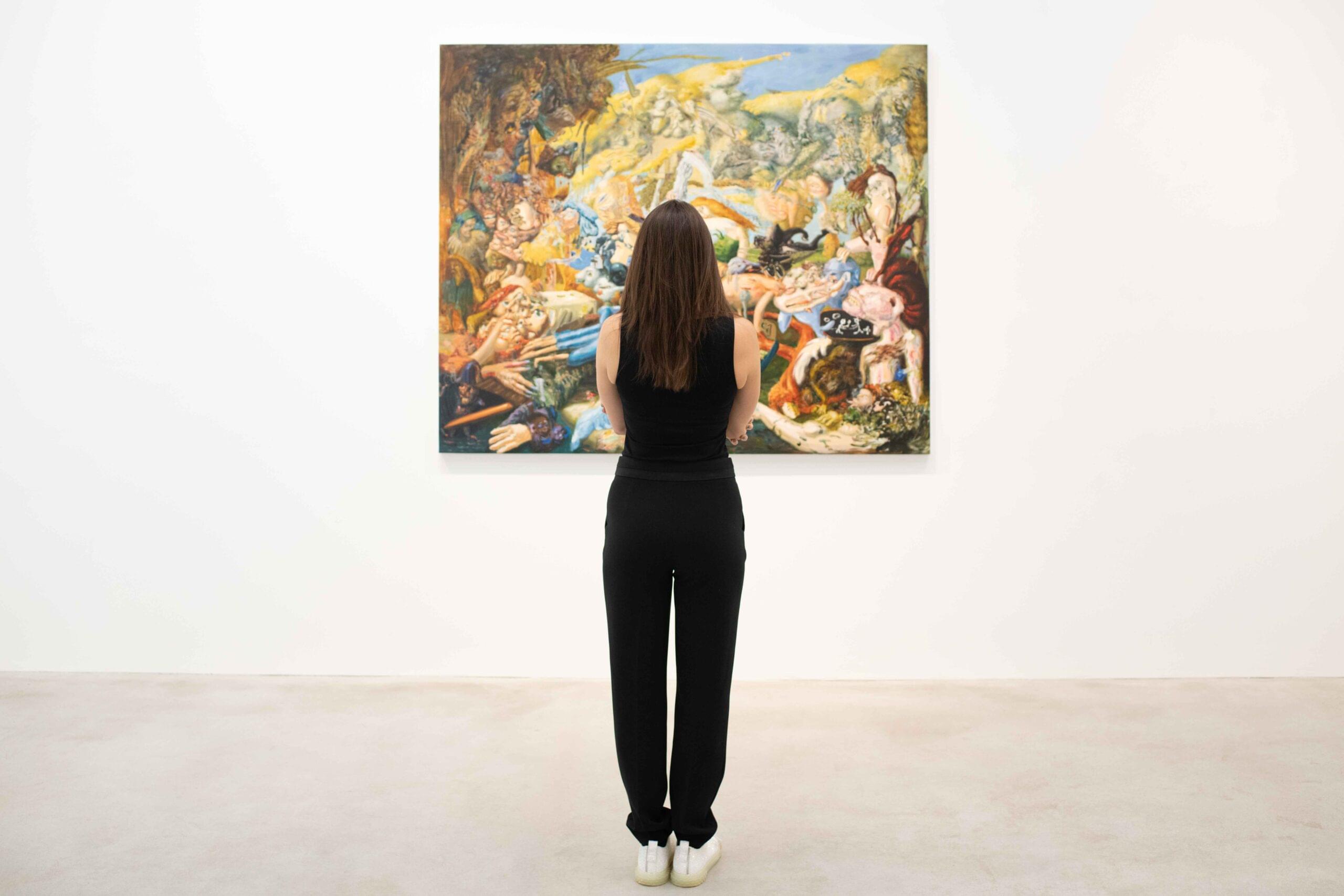
In a world obsessed with speed, Ashley Joan Schriefer paints in slow motion. Her canvases breathe, layers of oil that feel less like pigment and more like sediment from a deeper current. The kind that forms when you stop trying to keep up and start listening.
Schriefer has become a quiet force in contemporary art, not through spectacle but through stillness. Her practice resists the churn of trends and institutions. It asks for pause, reflection, and reconnection. In her presence, you sense an artist who has built her own rhythm, one that moves like water and speaks like weather.
When we met, she spoke about art not as a career or commodity, but as a form of grounding; a return to something elemental. “For me,” she said, “art is a way of staying connected to the ocean, the cosmos, and the invisible threads that link us all.”
That philosophy bleeds through every stroke. Her work feels both intimate and expansive, a dialogue between her own inquiry and the systems that surround her. Where others chase relevance, Schriefer seeks resonance.
On Process and Resistance
In a culture that rewards immediacy, Schriefer’s commitment to patience borders on radical. Oil painting, with its inherent need for drying, layering, and waiting, mirrors her worldview. “My work resists urgency,” she told me. “It creates space for reflection, for resilience and transformation to emerge naturally.”
There is discipline in her defiance. By slowing down, she reveals how depth itself becomes an act of rebellion. Her process transforms time into texture, silence into presence.
On Integrity and Alignment
The art world, as she describes it, can be a centrifuge, spinning faster than most artists can hold their footing. Schriefer has chosen not to compete with the noise. “One of the biggest challenges,” she admitted, “has been not letting external pressures define my path. My voice evolved by choosing alignment instead.”
That word, alignment, keeps surfacing. It is less about career strategy and more about spiritual geometry. Staying connected to nature, to teaching, to wonder, those become her creative infrastructure.
On Meaning and Scale
When I asked whether she views her work as a personal inquiry or a cultural dialogue, she paused before answering. “It always begins personal,” she said. “But when shared, the work becomes a mirror; people find pieces of themselves in it. That duality is what excites me most.”
This tension between the intimate and the universal defines her output. Her paintings are less statements than invitations, portals into states of being.
She speaks of future projects that stretch beyond the canvas, immersive environments where color, light, and sound dissolve the boundaries between viewer and memory. “I want people to feel surrounded by emotion,” she said. “Like stepping into the memory of water or light.”
On Legacy and Responsibility
Schriefer views the artist’s role not as commentator but as stabilizer, a necessary counterweight to cultural velocity. “Artists have the responsibility to create space for honesty and imagination,” she said. “In a fast-moving world, art can slow us down and invite us to see differently.”
Her contribution, she hopes, is a connection to self, to nature, to the larger rhythms of the universe. “The ocean, the night sky, they remind me of what’s timeless. When I stay rooted there, the work can exist both within the market and beyond it, without losing integrity.”
What Ashley Joan Schriefer offers is not just art. It is orientation, a compass for those trying to navigate an age of acceleration. Her canvases do not shout for attention. They wait for you to arrive. And when you do, they whisper something the world has nearly forgotten: That stillness is not absence; it is presence, distilled.