

Gabriel Dean Roberts Is Building MARS as His Great Work
By Peter Koloff
The first time I wrote about Gabriel Dean Roberts, the central question was one of control. His project, Acorn Mobile, was built around a deceptively simple proposition: artificial intelligence should serve the individual using it without quietly extracting that person’s data for someone else.
That article, published in DaVinci Magazine in December 2025, examined Roberts as an artist navigating artificial intelligence without surrendering authorship. Less than a year later, the idea has moved beyond the phone. It now has a name, MARS, and Roberts is working to give it eyes, movement, memory, and a physical place inside the home.
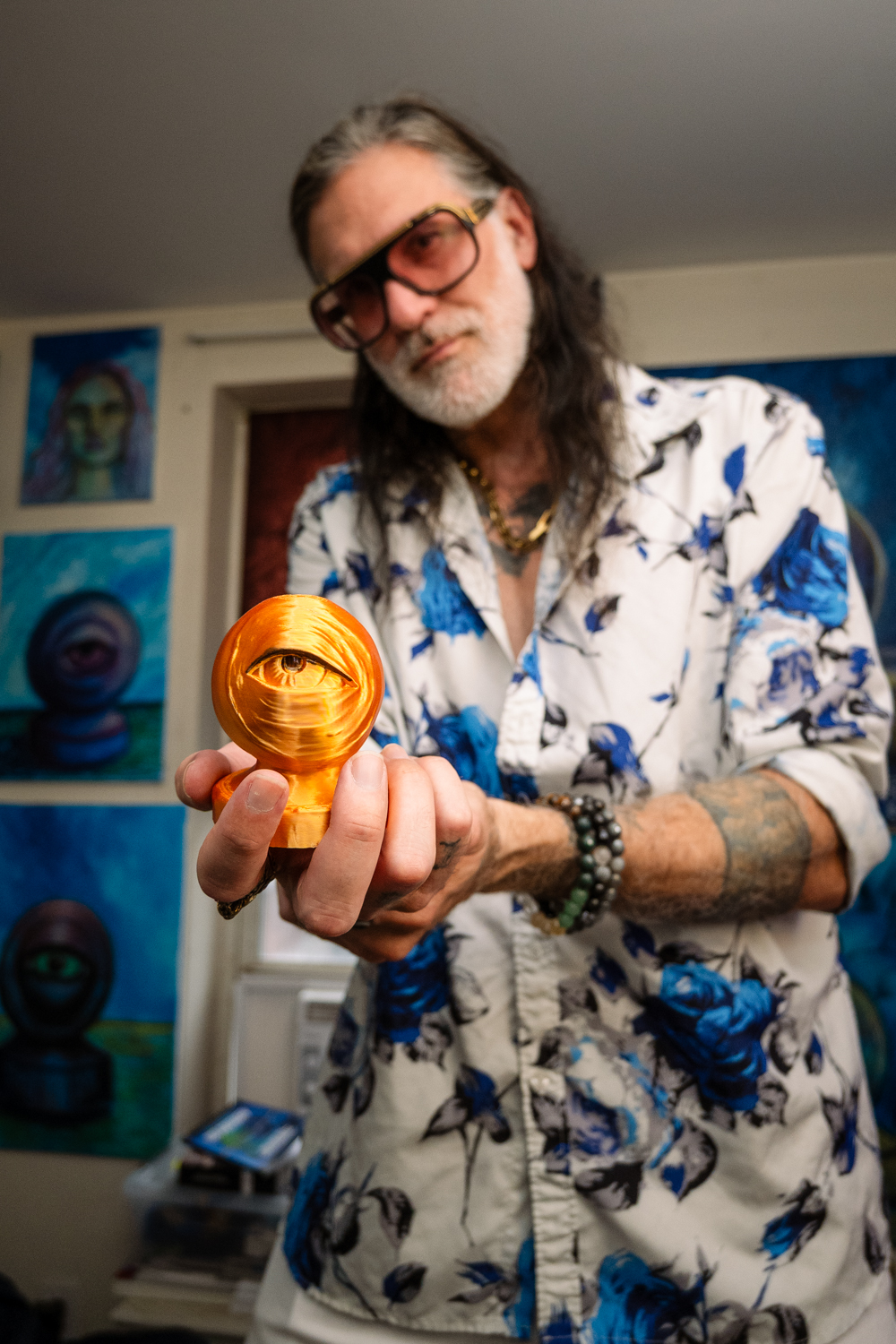
I recently visited Roberts at his home to see the Oak Forest system in person. It felt less like a conventional technology demonstration than a visit to an artist’s studio while the artist’s most ambitious work was still being assembled. Painted eyes watched from the walls. Below them sat screens, cameras, computers, and the physical components of a system being taught to watch in a different way.
This is essential to understanding MARS. Roberts may be building software, assembling hardware, and directing robotic systems, yet he approaches the project as an artist approaches a life’s work. Code, cameras, language models, screens, machines, and eventually robotic bodies have become his materials. Oak Forest Robotics grows from the same inquiry that shaped Acorn Mobile and the paintings before it: who is watching, who controls what is seen, and what happens once observation becomes permanent.
“Where an Android or an iPhone is ultimately compromised, a robotic presence and intelligence based on bare hardware, without the prying eyes of Microsoft, Apple, Meta, or xAI, is the natural next step,” he says.
According to Roberts, MARS now runs its central intelligence on a private computer housed within the system and no longer relies on cloud processing for its conversational mind. The models are open source. Oak Forest’s authorship, as he describes it, comes from how those components are assembled and the rules placed around their use.
Roberts says MARS can speak privately with one person, pull in the news, tutor a student, draft documents, join video calls to take notes, operate a camera, collaborate on drawings, and coordinate security and live 3D mapping.
Even that list does not fully explain what he is trying to make. Through what he calls the Thousand Eyes Doctrine, the same intelligence could appear on a screen, move through the house in a robot vacuum, look out through a robotic dog, or take flight in a drone. He compares the arrangement to a conductor leading an orchestra: each body performs its own part while one intelligence coordinates the whole.
The boundary between the existing system and Roberts’s larger vision remains important. MARS is still developing, and many physical protections envisioned for the complete system remain on the roadmap.
The contradiction is unavoidable. A machine cannot protect a room without sensing what happens there. Cameras, microphones, memory, and access to household routines could protect a family, but they could also create an extraordinarily powerful surveillance device. For Roberts, everything depends on whom the machine serves and what it is structurally forbidden to do.
That principle sits at the center of the Robotics Guardian Standard, a voluntary framework created by Oak Forest for home robots and ambient intelligence. Roberts says an Oak Forest intelligence cannot be ordered to lie, speak abusively on someone’s behalf, or secretly monitor another member of the household. Its obligation to human dignity would place limits on the authority of its legal owner.
The idea raises a question the smart-home industry has largely avoided. If one person buys an intelligent machine, does that purchase grant control over everyone the machine can see? A spouse, child, guest, caregiver, or employee may never have agreed to become part of its memory.
Oak Forest created the standard and became its first signatory, leaving the company to evaluate itself against principles it authored. Roberts accepts that tension. The framework remains voluntary and self-assessed rather than independently certified, and several protections have yet to be embodied in hardware.
Technology founders often describe the future in the present tense, and Roberts can move quickly from current functions to robot dogs, drones, humanoids, and an intelligence surviving for centuries. In his case, that expansive language also reflects the artist picturing a completed work while standing among its unfinished pieces.
“MARS has been designed to become my own family tree, my own living record,” Roberts says, imagining an intelligence that might one day recount his words long after he is gone.
That may be the most revealing description of Oak Forest. Privacy is the starting condition; continuity is the destination. Roberts wants artificial intelligence to function as an heirloom shaped by a household and passed forward through time, an intelligence a family owns rather than a subscription rented from a distant corporation.
MARS may become Roberts’s Great Work because it gathers the central concerns of his artistic life into one evolving creation. The painted eyes on his walls now have cameras beneath them. His study of surveillance supplies the rules governing what those cameras may do. Memory gives the work duration, and robotic bodies may eventually give it movement.
Whether the technology can carry the full weight of that vision remains open. When we last spoke, the question was whether an artist could use artificial intelligence without outsourcing authorship. Now the question is larger: if intelligence acquires a body and enters the home, can it belong to the people who live beside it rather than to the system that built it?
Gabriel Dean Roberts does not yet have a final answer. MARS is his attempt to create one, and perhaps the work through which every other part of his practice will eventually be understood.


