

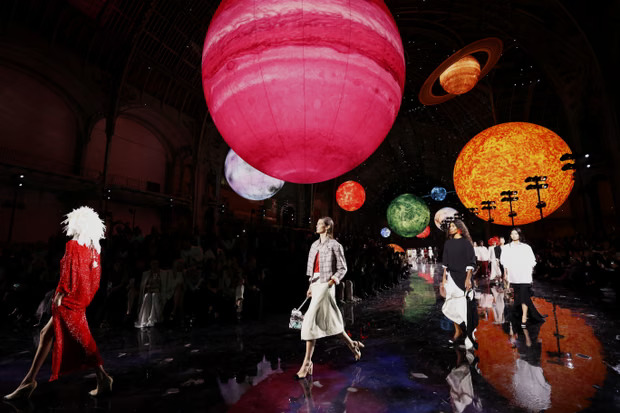
Paris didn’t expect this kind of storm from Chanel. Under a ceiling lit like a galaxy, Matthieu Blazy walked in and blew the dust off a house that’s been guarding its own legend for too long. He didn’t just present clothes. He cracked open Chanel and let it breathe again.

Gone were the polite bows to heritage. In their place came something messier, freer, and louder in its confidence. Models walked through a solar system of lights and planets, the air charged like a nightclub before the drop. Denim, feathers, silk, tweed, and color collided without apology. The bags looked broken in, not showroom-perfect, the kind of thing you’d steal from your grandmother and carry to a dive bar.
Blazy’s Chanel doesn’t whisper about luxury. It’s lived-in, touched, real. Some trousers moved like they had a story, jackets cropped sharp to the bone, shirts meant for midnight instead of boardrooms. Every piece felt like it was daring the audience to unlearn what they thought Chanel was supposed to be.
He’s not chasing nostalgia. Coco Chanel was a disruptor, and Blazy’s version carries that same nerve, stripped of its museum glass. It’s Chanel that knows the world has changed and decided to catch up. “She wasn’t playing nice,” he told the press backstage, his tone dry and direct. You could tell he meant it.
The front row buzzed with faces who rarely sit still: Ayo Edebiri, Pedro Pascal, and Nicole Kidman. But the real star was the energy. When model Awar Odhiang closed the show, spinning in a rainbow-feathered skirt, the room didn’t clap politely; it roared.
Behind the scenes, the pressure is obvious. Chanel has been without a loud voice since Lagerfeld, and while sales never faltered, the creative pulse dimmed. Blazy seems unbothered by that weight. His answer isn’t to mimic past brilliance, but to rebuild the brand’s rhythm from scratch. He’s taking Coco’s original rebellion and running it through the chaos of now.

Hints of his thinking were already there before the show. Teasers shot by David Bailey were blurred, intimate, and human. Invitations shaped like tiny silver houses felt more like keepsakes than tickets. You could sense the setup for something personal and less corporate.
And that’s exactly what landed. This wasn’t a designer trying to make Chanel cool again. It was a designer showing that cool doesn’t mean perfect. It means truth, texture, and risk.
Blazy’s next move is already set; Chanel heads to New York in December. If tonight is any sign, the brand that once defined quiet luxury might finally be ready to make some noise again.
“Chanel is everywhere,” Blazy said after the show, half-smiling. “I just made it feel alive again.”
